
 Search Articles


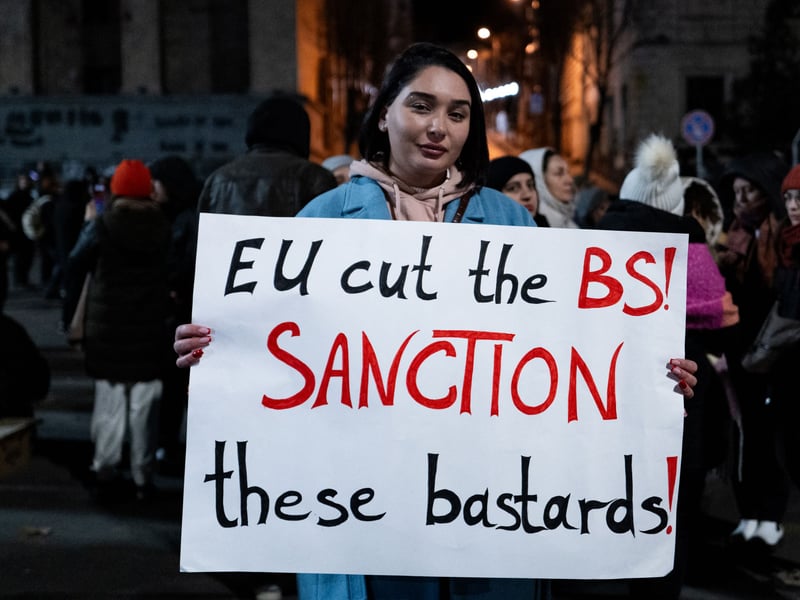
TBLISI, Georgia (AFP) — Georgia’s political crisis deepened Friday, as new pro-Europe protests gripped Tbilisi ahead of the nomination of a far-right government loyalist as president.
The Black Sea nation has been in turmoil since the governing Georgian Dream party claimed victory in contested October parliamentary elections, with its decision last month to delay EU accession talks igniting a fresh wave of mass rallies.
More unrest is expected on Saturday when Georgian Dream will appoint far-right former soccer player Mikheil Kavelashvili as president in a controversial election process.
The pro-Western incumbent, President Salome Zurabishvili, has refused to step down and is demanding new parliamentary elections, paving the way for a constitutional showdown.
On Friday, pro-Europe demonstrators took to the streets at a dozen locations, including in Tblisi, for the 16th consecutive day.
Speaking to AFP at a rally outside parliament, Dariko Gogol, 53, said Georgian Dream “rigged the election, and they are just dragging us towards Russia.”
“We need new elections,” she said, adding that Zurabishvili “has to stay and somehow guide us in this really difficult situation.”
‘Unprecedented constitutional crisis’
On Saturday, an electoral college controlled by Georgian Dream is expected to elect Kavelashvili as president in an indirect vote boycotted by the opposition.
Opposition groups accuse Georgian Dream of rigging the parliamentary vote, democratic backsliding and moving Tbilisi closer to Russia — all at the expensive of the Caucasus nation’s constitutionally mandated bid for EU membership.
Though the presidency is a largely ceremonial post, Kavelashvili, 53, is known for his vehement anti-West diatribes and opposition to LGBTQ rights.
Georgian Dream scrapped direct presidential elections in 2017.
With Zurabishvili refusing to leave office, opposition lawmakers boycotting parliament and protests showing no signs of abating, critics are questioning Kavelashvili’s legitimacy.
One author of Georgia’s constitution, Vakhtang Khmaladze, has argued that all decisions by the new parliament are void, as it ratified the mandates of newly elected lawmakers in violation of the legal requirement to await the outcome of Zurabishvili’s lawsuit.
“Georgia is facing an unprecedented constitutional crisis,” Khmaladze told AFP.
It remains unclear how the government will react to Zurabishvili’s refusal to step down after her successor is inaugurated on Dec. 29.
A former French diplomat, Zurabishvili is a hugely popular figure among protesters who view her as a beacon of Georgia’s European aspirations.
‘Brutal violence’
Amid the latest crisis, police have used tear gas and water cannon to disperse rallies, arresting more than 400 demonstrators. The country’s rights ombudsman has accused security forces of “torturing” those detained.
Raids on the offices of opposition parties and arrests their leaders followed, while the prime minister has repeatedly pledged to “eradicate liberal fascism.”
The police crackdown has been condemned at home and abroad.
Washington imposed fresh sanctions on Georgian officials overnight, barring visas for around 20 people accused of “undermining democracy in Georgia,” including ministers and parliamentarians, the State Department said.
French President Emmanuel Macron added to the international condemnation in a phone call to Georgian Dream’s honorary chairman and founder, Bidzina Ivanishvili. The tycoon is widely considered to be Georgia’s real power broker who raged against the West on the campaign trail this year.
Macron’s decision to call Ivanishvili — rather than Prime Minister Irakli Kobakhidze — is indicative of the West’s hesitancy to recognize the legitimacy of Georgian Dream’s new government.
In power for more than a decade, Georgian Dream has pushed increasingly conservative policies in recent years, including measures targeting civil society, independent media, opposition parties and the LGBTQ community.
Critics say the moves mirror repressive Russian-style legislation and Brussels has called them “incompatible” with EU membership.
—
By IRAKLI METREVELI Agence France-Presse
Subscribe to our free newsletters
Our weekly newsletter Closing Arguments offers the latest about ongoing trials, major litigation and rulings in courthouses around the U.S. and the world, while the monthly Under the Lights dishes the legal dirt from Hollywood, sports, Big Tech and the arts.