
 Search Articles


TBILISI, Georgia (AFP) — A Georgia court on Wednesday sentenced pro-Western reformer ex-President Mikheil Saakashvili to nine years in prison for misspending public funds, adding three years to the jail term he is currently serving.
Saakashvili, 57, was sentenced in absentia in 2018 to six years behind bars for abuse of office, a charge he and rights groups have denounced as politically motivated.
He was jailed and began serving the term in 2021, when he returned to the country.
The European Parliament has called for his immediate release, and Ukrainian President Volodymyr Zelenskyy has demanded that Saakashvili, a Ukrainian national since 2019, be transferred to Kyiv.
On Wednesday, a Tbilisi city court “sentenced Saakashvili to nine years in prison” in a case involving the misspending of public funds, his lawyer, Dito Sadzaglishvili, told AFP.
Prosecutors accuse Saakashvili of misspending 9 million lari (some $3.2 million) in budgetary funds over the nine years of his presidency in 2004-2013.
Sadzaglishvili said the charges were “fabricated.”
‘Orders of the regime’
Saakashvili said on Facebook that the funds he is accused of misspending were actually “official expenses of the presidential office.”
“This is not a fair and free trial. The judge is carrying out the orders of the regime,” said Secretary-General of Saakashvili’s United National Movement party, Petre Tsiskarishvili. “The regime is afraid of Mikheil Saakashvili, as the main opposition figure, and does everything to ensure that he remains behind bars.”
The increasingly repressive government of the ruling Georgian Dream party has faced mounting accusations of democratic backsliding and drifting towards Russian orbit.
It has jailed several former Saakashvili officials since he left office — in what rights groups have described as a political witch-hunt.
Ailing Saakashvili, who has been hospitalized in Tbilisi since 2022, didn’t appear at the hearing.
“He has several chronic illnesses, and his health condition periodically worsens,” Zurab Chkhaidze, the director of Vivamed hospital, told journalists.
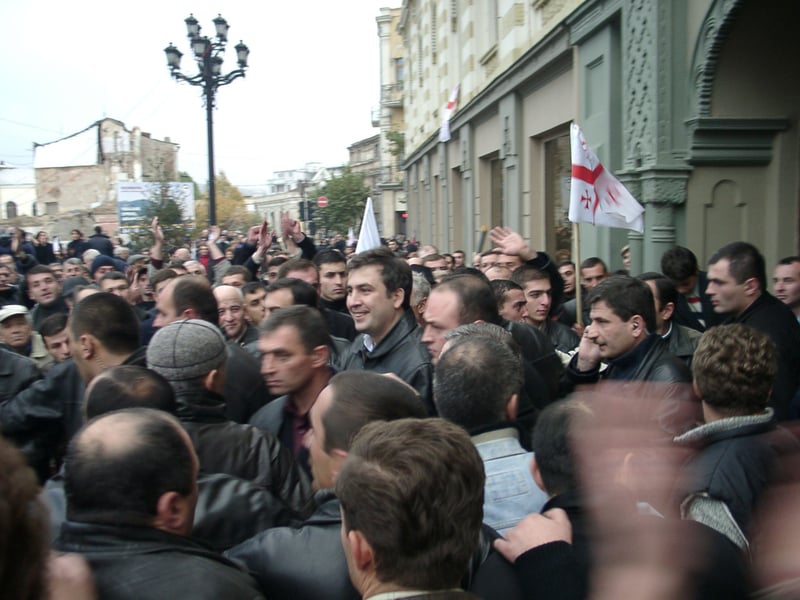
Saakashvili, who spearheaded the bloodless Rose Revolution in 2003 and led the Black Sea nation for nine years before going into exile, was arrested in 2021 after his return to Georgia.
He has accused prison guards of mistreatment and doctors have raised serious concerns over his health after he staged a 50-day hunger strike.
The Rose Revolution, which saw tens of thousands take to the streets against rigged elections and rampant corruption, reshaped Georgia and enabled sweeping political and economic reforms that helped to bring a more than threefold increase in per capita GDP.
But many felt sidelined — and even oppressed — during the de-Sovietization social experiment.
The revolution also had a wider impact on post-Soviet countries such as Ukraine, where the Orange Revolution the following year saw a pro-Western candidate elected as president over a Russia-friendly candidate.
The so-called “color revolutions” in Georgia, Ukraine and Kyrgyzstan led to confrontation with the Kremlin, which perceived the popular uprisings as a threat to its influence in what it sees as its backyard.
—
By IRAKLI METREVELI Agence France-Presse
Subscribe to our free newsletters
Our weekly newsletter Closing Arguments offers the latest about ongoing trials, major litigation and rulings in courthouses around the U.S. and the world, while the monthly Under the Lights dishes the legal dirt from Hollywood, sports, Big Tech and the arts.