
 Search Articles


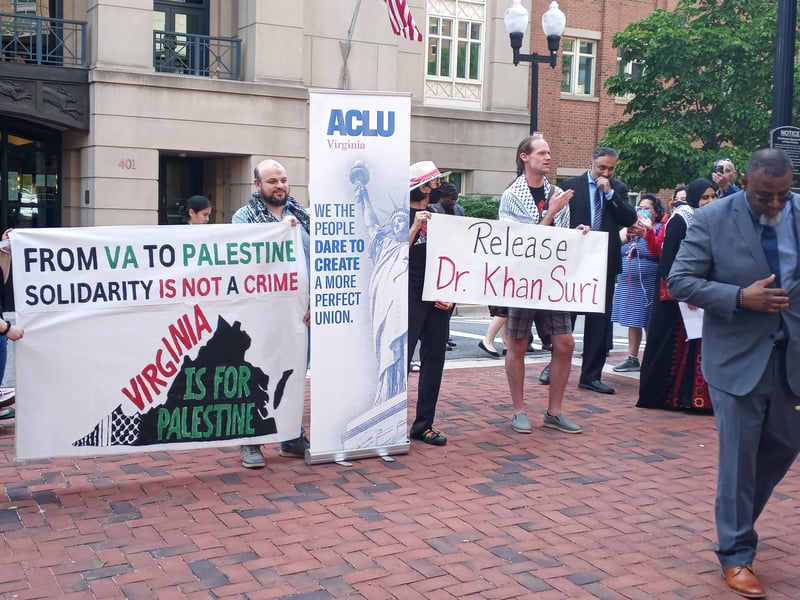
ALEXANDRIA, Va. (CN) — The Georgetown professor detained by Immigration and Customs Enforcement officers can remain free while he fights deportation, the U.S. Court of Appeals for the Fourth Circuit ruled Tuesday.
Badar Khan Suri, who held a J-1 exchange visa, was arrested in March. His legal team contended his detention was in retaliation for his political views. Khan Suri and his wife, the daughter of a former Palestinian political adviser, have voiced objections to the war in Gaza.
Khan Suri’s case has been championed by attorneys with civil rights organizations. After his arrest, immigration officers moved the professor first to a facility in Farmville, Virginia, then to Richmond, then Louisiana, and finally Texas. In court, government attorneys argued that the jurisdiction belonged in Texas. But U.S. District Judge Patricia Tolliver Giles, a Joe Biden appointee, ruled that jurisdiction remained in Virginia and ordered his release.
The U.S. Department of Justice had asked the court to stay that ruling. The appellate court, in a 2-to-1 decision, denied the request and affirmed Giles’ decision.
“The government chose to move Suri without informing his wife or attorney of his location or custodian,” noted the decision by Judge James A. Wynn Jr., a Barack Obama appointee, with the concurrence of Judge DeAndrea Benjamin, a Joe Biden appointee. “If not for our conclusion that jurisdiction lies in the Eastern District of Virginia, that deliberate choice would have deprived the petitioner of any meaningful opportunity to contest his detention prior to removal to a distant jurisdiction. Such conduct raises serious concerns. To allow the government to undermine habeas jurisdiction by moving detainees without notice or accountability reduces the writ of habeas corpus to a game of jurisdictional hide-and-seek.”
The appellate judges also found that the public interest lies firmly in the professor’s favor. “The government doesn’t contest the district court’s finding that it detained Suri in retaliation for his First Amendment activity,” they wrote. “A stay here would allow the government to immediately re-detain Suri, which would further chill speech protected by the First Amendment.”
A third member of the panel, Judge J. Harvie Wilkinson III, a Ronald Reagan appointee, dissented, pointing out that Khan Suri had filed a habeas petition in the Eastern District of Virginia challenging his detention during the pendency of deportation proceedings. Both cases seek to determine the underlying question of removability. “I would grant the government’s motion for a stay pending appeal,” he wrote. “Anything else would presage a perennial clash of rulings and orders between two different sets of federal tribunals.”
Allowing both proceedings to move forward “thus presents the government with the prospect of having to defend against the same constitutional arguments in two different forums.”
Khan Suri holds a Ph.D. in peace and conflict studies from the Nelson Mandela Center for Peace and Conflict Resolution at Jamia Millia Islamia in New Delhi, India. At Georgetown University, he is a post-doctoral scholar and teaches a class on minority rights in South Asia.
Subscribe to our free newsletters
Our weekly newsletter Closing Arguments offers the latest about ongoing trials, major litigation and rulings in courthouses around the U.S. and the world, while the monthly Under the Lights dishes the legal dirt from Hollywood, sports, Big Tech and the arts.