
 Search Articles


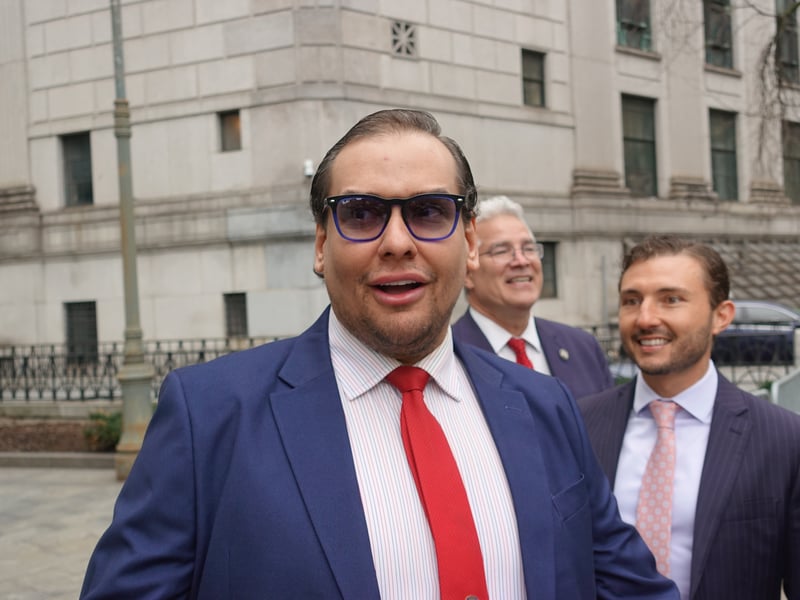
MANHATTAN (CN) — The Second Circuit on Monday was dubious to revive a copyright claim brought by George Santos, a disgraced former U.S. congressman, who sued late-night talk show host Jimmy Kimmel last year over the use of his Cameo videos.
After being expelled from Congress in 2023, Santos took his talents to Cameo, a short-form video platform that lets users pay for personalized videos from celebrities and other notable figures. The gig reportedly netted him six figures, as he claimed to sell more than 1,000 clips on the site for $350 each.
Kimmel used the platform to poke fun at the expelled Republican congressman, creating fake Cameo profiles to request outlandish custom clips from Santos then airing them on “Jimmy Kimmel Live!” in a recurring segment called “Will Santos Say It?”
According to Santos, Kimmel’s use of the clips wasn’t transformative enough to fall under fair use. Calling the clips “absolutely ridiculous,” Santos’ attorney Robert Fantone told a panel of federal appellate judges on Monday that his client’s videos were supposed to be satirical, meaning that Kimmel’s use of them in his jokey TV bit fulfilled the same purpose and violated the copyright.
“I don’t know if one of your honors or more laughed when you watched these Cameos,” Fantone said. “I know I laughed at them. It was the whole purpose, specifically, to get people to laugh at Mr. Santos for saying ridiculous things for money.”
Fantone pointed to one example of Santos “congratulating a furry” for being permitted to wear a half-beaver-half-platypus outfit to work — a request that Kimmel was behind.
“He congratulates another lady for successfully cloning a dog named Adolf,” Fantone continued, referencing another Cameo done at Kimmel’s behest. “If the original purpose is satirical, and we agree that the second purpose was satirical, then it’s not transformative.”
U.S. District Judge Denise Cote, a Bill Clinton appointee, dismissed Santos’ lawsuit last summer in the Southern District of New York. She found that Kimmel, while deceptive in obtaining the Cameo videos, did indeed transform their use sufficiently to be protected by the fair use doctrine.
Monday’s Second Circuit panel seemed inclined to agree with Cote, telling Fantone it was “surprised” by his argument — not necessarily because it lacked merit but because it appeared to run contrary to what Santos claimed in the now-dismissed complaint.
U.S. Circuit Judge Richard Sullivan, a Donald Trump appointee, stated Santos never acknowledged in his lawsuit that the videos were supposed to be “satirical” or “self-deprecating” in nature.
“We should fault the district court for not doing that when you didn’t do it?” Sullivan asked Fantone.
“It’s a separate argument from the argument you started out with,” said U.S. Circuit Judge Raymond Lohier, a Barack Obama appointee, echoing Sullivan’s skepticism.
Lohier added that Fantone’s new argument seemed to directly contradict the stated purpose for the videos in Santos’ complaint, which read:
“The works were created by Santos using his own effort, creativity and unique personality traits to generate an inspiring message. They capture Santos’ unique and distinctive form of motivational expression both in the personalized and engaging manner in which the videos are captured and in the originality with which Santos conveys his feelings of hope, strength, perseverance, encouragement, and positivity.”
That doesn’t seem particularly funny, the judges noted.
“It is totally different,” Lohier said.
Copyright attorney Nathan Siegel, representing Kimmel, Disney and ABC, agreed. He told the panel on Monday that the argument “contradicts everything that they have argued up to this point.”
The three-judge panel, which included the Bill Clinton-appointed U.S. Circuit Judge José Cabranes, alongside Sullivan and Lohier, didn’t immediately rule following Monday’s arguments.
Santos was expelled from Congress in December 2023 after a House Ethics Committee report concluded he “sought to fraudulently exploit every aspect of his House candidacy for his own personal financial profit." Last summer — on the same day that Judge Cote dismissed Santos’ copyright complaint in the Southern District of New York — Santos pleaded guilty to wire fraud and aggravated identity theft in the Eastern District of New York. He admitted to fraudulently inflating his campaign’s fundraising numbers and using campaign funds for Botox, designer clothes and subscriptions to the adult content platform OnlyFans.
 Follow @Uebey
 Follow @uebey.bsky.social
Subscribe to our free newsletters
Our weekly newsletter Closing Arguments offers the latest about ongoing trials, major litigation and rulings in courthouses around the U.S. and the world, while the monthly Under the Lights dishes the legal dirt from Hollywood, sports, Big Tech and the arts.