
 Search Articles


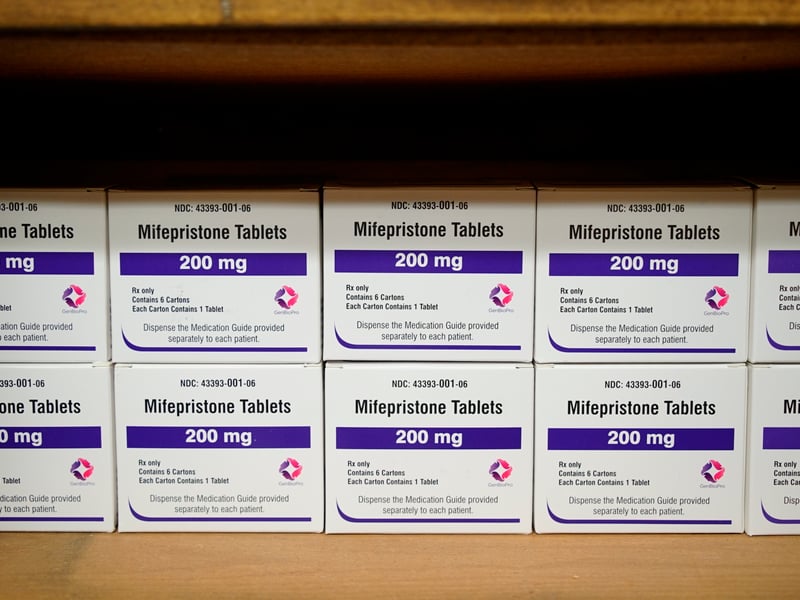
(CN) — A Fourth Circuit panel heard arguments Tuesday on whether West Virginia overstepped its authority by passing laws that restrict access to the abortion drug mifepristone.
GenBioPro, which makes the generic version of mifepristone, argues that a West Virginia law that bans most abortions, including drug-induced abortion, is preempted by the Food and Drug Administration Amendments Act of 2007.
The act grants federal regulators sole authority to monitor and manage the safety of certain medications, including mifepristone, the company argued.
West Virginia maintains Congress did not intend to strip the states of their power to regulate the abortion drug when it passed the 2007 act.
Mifepristone is the first in a two-drug regimen.) used to terminate pregnancies within 10 weeks of conception. Approved by the FDA in 2000, mifepristone blocks the hormone progesterone, which is needed for the pregnancy to continue. Its counterpart, misoprostol, causes contractions that expel the contents of the uterus.
In 2019, GenBioPro received FDA approval to sell a generic version of mifepristone, which is also known by the brand names Korlym and Mifeprex.
In 2022, West Virginia enacted the Unborn Child Protection Act which bans abortion in most cases, including drug-induced abortions. The law makes selling, prescribing or dispensing mifepristone to induce an abortion a felony, except in certain circumstances, and banned prescribing the drug by telemedicine.
GenBioPro sued state authorities in January 2023, claiming the FDA had sole power to regulate mifepristone under the 2007 law.
U.S. District Judge Robert Chambers granted summary judgment in favor of the state and dismissed the case in substantial part later that year. The Bill Clinton appointee determined West Virginia had the authority to regulate the health and safety of its citizens, which included access to abortion drugs.
Erin Hawley, an attorney for the D.C.-based conservative advocacy group Alliance Defending Freedom, represented West Virginia at Tuesday’s hearing. GenBioPro was represented by attorney David Frederick of the D.C.-based firm Kellogg, Hansen, Todd, Figel & Frederick.
Frederick fielded several questions from U.S. Circuit Judge J. Harvie Wilkinson III and U.S. District Judge Rossie Alston Jr. on Congress’ intent in passing the 2007 law.
Wilkinson wonder why, if Congress intended to strip the authority of the states to regulate access to medications, that isn’t that made clearer in the act. The Ronald Reagan appointee said the U.S. Supreme Court has placed an emphasis on clarity in the law in its recent decisions, and it was difficult for him to see a clear preemptive intent in the act.
Frederick pointed to a section of the act that granted the U.S. Health and Human Services secretary the authority for “providing safe access” to drugs with known health risks that were otherwise unavailable.
No state has claimed it has the authority to determine a drug’s safety, Frederick said, and for good reason. State governments do not have the resources to fund clinical trials or review the safety risks of medications. That is a responsibility that has traditionally fallen on the federal government.
Wilkinson asked if a state could impose additional regulations on access to oxycodone, an opioid medication that carries a substantial risk for abuse. Frederick said state authority to regulate oxycodone fell under the Controlled Substances Act of 1970.
“Mifepristone is not subject to the Controlled Substances Act,” Frederick said. “There is not a risk of addiction or similar type of crisis as with opioids.”
Hawley argued that Congress did not intend to infringe the authority of the states when it passed the 2007 law. But even if it did, the federal government set the floor, not the ceiling, for regulations. If a state determines that a drug, like mifepristone, poses a significant threat to the health and safety of its citizens, it has the authority to impose additional regulations for use.
Wilkinson asked Hawley to provide a case that granted states the authority to regulate medicine. Hawley pointed to the U.S. Supreme Court’s 1889 decision in Dent v. West Virginia , which established the right of states to regulate medical licensure.
U.S. Circuit Judge DeAndrea Benjamin, a Joe Biden appointee, seemed skeptical of the example.
“I would agree with you that states have the authority to deal with licenses," she said. “But we are talking about regulation of medication here.”
In the case of “highly controversial questions,” Wilkinson asked if there needed to be a clear expression of intent from Congress to displace state authority.
Hawley said that was correct, pointing to the longstanding “presumption against preemption,” which instructs that federal law should not preempt state law unless that was the clear intention of Congress.
Alston, a Donald Trump appointee, sat on the panel by designation from the Eastern District of Virginia. The panel did not indicate when or how it would rule.
 Follow @SteveGarrisonPC
Subscribe to our free newsletters
Our weekly newsletter Closing Arguments offers the latest about ongoing trials, major litigation and rulings in courthouses around the U.S. and the world, while the monthly Under the Lights dishes the legal dirt from Hollywood, sports, Big Tech and the arts.