
 Search Articles


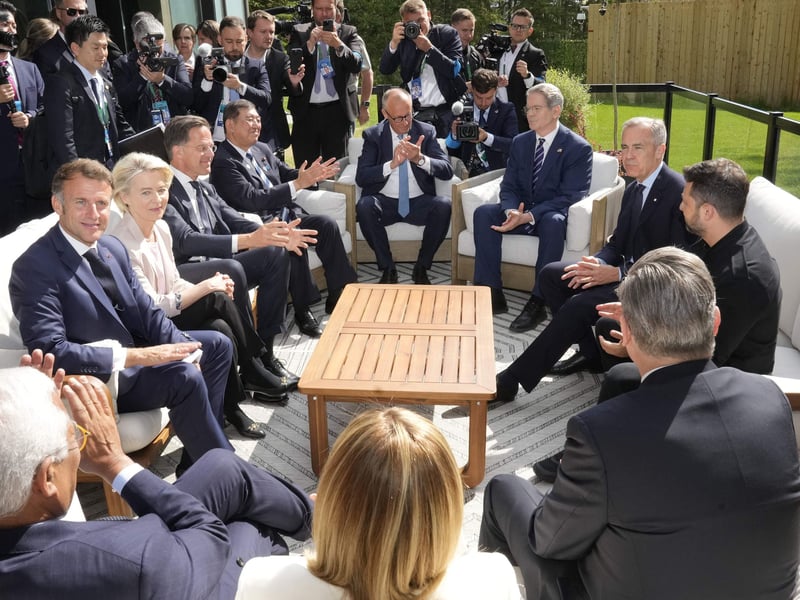
Brussels (CN) — The 2025 G7 summit concluded Tuesday without a joint statement on Ukraine, as escalating Middle East tensions overshadowed efforts to maintain unified pressure on Russia and left Ukrainian President Volodymyr Zelenskyy without the multilateral support he was looking for.
The U.S. blocked strong language on Russia despite earlier hopes for agreement. To avoid confrontation, Canadian Prime Minister Mark Carney issued his own statement instead of a G7-wide declaration, telling reporters: “We recognize that Ukraine alone has committed to an unconditional ceasefire and we all agreed that Russia must do the same,” while publicly denying U.S. obstruction and shifting focus to Iran.
Officials acknowledged the Americans had sought to water down tough language about Russia out of fear it could undermine their push to negotiate an end to the war. In discussions at the summit, Trump on Monday expressed reluctance to impose any further sanctions, saying Europeans should “do it first” and that “sanctions cost us a lot of money, billions and billions of dollars.”
The G6 nations — representing Britain, France, Germany, Italy, Japan and Canada but excluding the United States — are now expected to pursue their own sanctions against Russia, though implementation remains uncertain without full G7 backing.
An EU-Canada summit will take place in Brussels on Monday with European Council President Antonio Costa, European Commission President Ursula von der Leyen and Carney. The EU-Canada Security and Defence Partnership is expected to be agreed then.
Zelenskyy had traveled to Canada specifically to push for stronger sanctions against Moscow. But he left Tuesday without the joint G7 statement of support he had sought, though he secured significant bilateral support from Carney.
Standing next to the Ukrainian president, Carney announced a new $2 billion package to fund helicopters, drones and ammunition, plus $2.3 billion in loans for infrastructure rebuilding to be repaid by interest from frozen Russian assets.
“This will help Ukraine defend itself and rebuild for the future,” Carney said, also promising sanctions targeting Russian individuals and 200 vessels in Russia’s “shadow fleet” used to evade oil price cap sanctions.
Middle East dominates as divisions emerge
The Middle East crisis dominated talks, with European allies emphasizing de-escalation while facing pressure for stronger positions on the Israel-Iran confrontation.
French President Emmanuel Macron invoked past conflicts as cautionary examples, telling reporters Tuesday: “Collectively didn’t we see the consequences this had in the region and elsewhere? Does anyone think that what was done in Iraq in 2003 was a good idea? Does anyone think that what was done in Libya in the previous decade was a good idea? No.” He warned that regional nations cannot afford more “chaos.”
The G7 did manage to release a joint Middle East statement on Tuesday, affirming that “Israel has a right to defend itself” while calling for protection of civilians. The leaders declared that “Iran is the principal source of regional instability and terror” and reiterated that “Iran can never have a nuclear weapon.”
The statement urged that resolution of the Iranian crisis “leads to a broader de-escalation of hostilities in the Middle East, including a ceasefire in Gaza,” while expressing readiness to coordinate on safeguarding international energy market stability.
Von der Leyen’s social media declaration of EU support for Israel could anger member states not in the G7, as discussions continue after early Tuesday’s emergency EU Foreign Affairs ministers’ meeting.
Trade tensions complicate sanctions push
Trade friction between Washington and Brussels emerged as another complicating factor. Following his meeting with von der Leyen, President Donald Trump voiced frustration aboard Air Force One: “We’re talking, but I don’t feel that they’re offering a fair deal yet. They’re either going to make a good deal, or they’ll just pay whatever we say they have to pay.”
Both sides face a July 9 deadline to preserve their 1.5 trillion euro commercial relationship, with failure potentially escalating Trump’s blanket tariff from 10% to 50%.
Von der Leyen responded on social media that negotiating teams had been directed “to accelerate their work to strike a good and fair deal.” However, commission officials rejected media speculation that Brussels might accept Washington’s proposed 10% baseline tariff.
The European Commission scaled back its proposal to lower the G7 oil price cap from $60 to $45 per barrel as part of its 18th sanctions package, citing changing market conditions. A commission spokesperson said recent oil price increases due to Middle East tensions reduced urgency for action.
“The current price cap is already biting and hurting Russia. In this sense, it is already playing its role at the current level,” the spokesperson told reporters, suggesting the measure von der Leyen had actively promoted before the summit was now less pressing.
While the commission maintains the proposal remains part of its 18th sanctions package, the comments reflected the complex reality of coordinating sanctions policy amid multiple global crises and apparent U.S. reluctance to support tougher measures against Moscow.
Despite visible divisions, sanctions efforts continue advancing. The United States had announced plans for 500% tariffs targeting Russian fossil fuels before the summit, measures that would primarily affect China but have yet to materialize, while the European Union readies new sanctions packages.
Allied officials maintained that divergences didn’t necessarily signal broader disunity, with leaders like German Chancellor Friedrich Merz and Macron expressing cautious optimism on X that tougher measures against Russia may eventually gain broader support.
Partnerships and consensus areas
In a significant development amid the divisions, von der Leyen and Costa met with Australian Prime Minister Anthony Albanese and agreed to begin negotiations on a security and defense partnership.
“In a time of rising tensions and strategic competition, trusted partners must stand together,” von der Leyen said. “Europe and Australia’s enduring friendship enters a new chapter today.”
The partnership will cover defense industry, cyber security and counter-terrorism, though it excludes military deployment obligations.
“We see how deeply connected Europe’s security and the Indo-Pacific region have become,” Albanese said. “This will open the door to joint defense procurement opportunities and will benefit both our industries and our security.”
European Council President Antonio Costa emphasized: “Australia is an important partner for the European Union. We share the same values and a strong commitment to multilateralism and the rules-based global order.”
Despite divisions on Ukraine and Middle East approaches, the G7 released six joint statements all leaders had agreed to sign. The most significant was a Critical Minerals Action Plan aimed at reducing dependency on China and securing supply chains vital to digital technologies and the green transition.
Critical minerals formed a fundamental part of von der Leyen’s focus on China during the first day of the summit, highlighting concerns about dependency on Chinese-controlled supply chains.
“Critical minerals markets should reflect the real costs of responsible extraction … including pollution and land degradation,” officials wrote in the plan, emphasizing that “immediate and scaled investment is required to secure future supply chains.”
The plan has garnered support from Australia, India, and South Korea, marking a push toward a broader alliance of mineral-secure economies beyond the G7.
In a major technology initiative, the G7 released an AI strategy, declaring: “We will power AI now and into the future” while emphasizing human-centric development. The leaders launched a G7 AI Adoption Roadmap aimed at helping small and medium enterprises gain confidence with artificial intelligence.
“We seek to further promote secure, responsible, and trustworthy AI that benefits people,” the leaders stated, announcing the formation of a G7 AI network to replicate successful projects and share open-source tools.
Other joint statements included commitments on transnational repression, wildfire prevention, collaboration through a G7 Joint Working Group on Quantum Technologies, and efforts against migrant smuggling through a “follow the money” approach.
The summit concluded with mixed results for multilateral cooperation, as leaders navigated competing priorities between supporting Ukraine, managing Middle East tensions, and maintaining alliance unity amid differing strategic approaches.
Next year’s G7 summit will take place in Evian, France, from June 14-16, French President Emmanuel Macron announced on X.
Subscribe to our free newsletters
Our weekly newsletter Closing Arguments offers the latest about ongoing trials, major litigation and rulings in courthouses around the U.S. and the world, while the monthly Under the Lights dishes the legal dirt from Hollywood, sports, Big Tech and the arts.