
 Search Articles


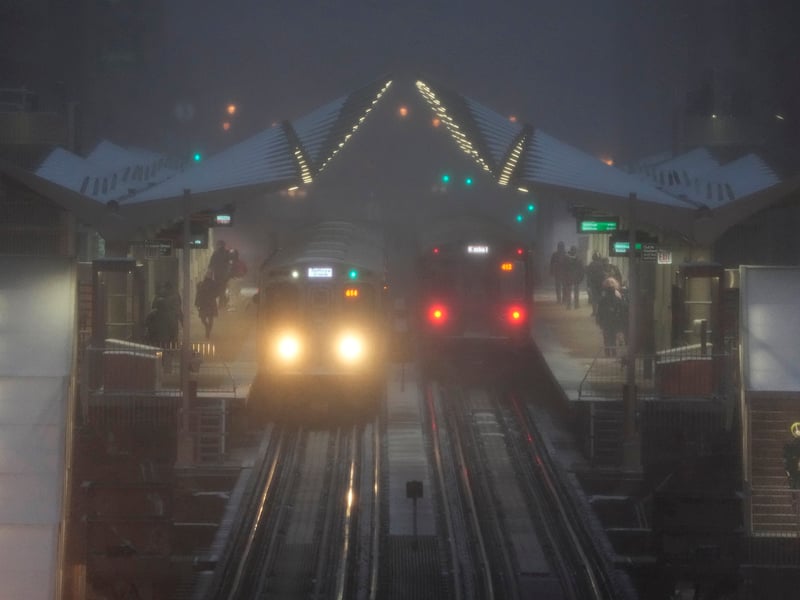
CHICAGO (CN) — Chicagoland’s mass transit authorities face layoffs and service cuts after Illinois lawmakers failed to address a looming fiscal cliff ahead of the end of the legislative session.
Legislators narrowly passed the state’s $55 billion budget before Saturday’s midnight deadline but left a $771 million gap in the transportation budget, driven by expiring Covid-19 aid and falling ridership. A special session could be called this summer, though no plans have been announced.
The Regional Transit Authority, which oversees the Chicago Transit Authority, Metra, and Pace, previously projected 40% service cuts if the deficit isn’t resolved. The CTA estimated that up to half of its rail lines could be suspended, 74 of its 127 bus routes would be eliminated, and nearly 3,000 transit workers would be laid off.
P.S. Sriraj, director of the University of Illinois at Chicago’s Urban Transportation Center, said Chicago could be facing a paradigm shift in its public transportation system.
“It will still be available in some anemic form, but not the way big cities have set up their systems; so, you go to many parts of the country, there are public transportation services that are functional only from seven in the morning six in the evening and no service on the weekends,” he said. “I’m not saying that’s where we’ll end up, but there’s a likelihood.”
The CTA has not indicated which services might face cuts, but Sriraj said they likely wouldn’t decommission entire lines because of how much they’ve already invested in the stations’ infrastructure.
“They have to have public engagement,” he said. “They have to conduct public meetings. They will have to ensure that they have done the due diligence with demographic analysis and equity analysis and make sure their service standards are protected and preserved.”
The CTA’s service standards require most bus stops to run approximately every one-eighth to one-quarter mile, and most rail stations are to be spaced every half mile to one-half miles apart.
Sriraj said because the CTA runs both the rail and bus systems, there’s a lot of areas where the respective bus and rail services overlap.
“From a purely technical perspective, one could make a reasonable argument that eliminating several routes is still not going to adversely affect the ability of people to get to [where they need to go],” he said. “But the problem is, will we take them when they need to go.”
Lakeview resident and frequent red line rider Matt Maxson said he felt disrespected when the House didn’t take up the transit bill after its passage in the Senate.
“There’s this fundamental error, I think, of unseriousness both at the CTA [and] Mayor’s office side of things and in Springfield, where people are either not realizing the gravity of this issue or perhaps not caring about it,” Maxson said.
He expressed frustration with lawmakers for not exploring other avenues to address the revenue deficit, such as increasing fares.
“It’s not the CTA’s fault that the pandemic happened, but it is the CTA’s fault that they haven’t been able to increase ridership by as much as say the Washington Metropolitan transit authority in the same [amount of] time,” Maxson said.
Sriraj echoed some of Maxson’s concerns and recalled how when he moved to Chicago 35 years ago, it cost $1.50 a train ride. Now, it’s $2.25. Comparatively, in New York City, it cost a $1.15 per ride 35 years ago. Now, it costs $2.90 a ride.
The state Senate passed a bill Saturday with over $1 billion in new funding to close the deficit, but it stalled in the state House. The proposal included tax hikes on deliveries and ride-shares, a 50-cent toll increase, and an expansion of Chicago’s real estate transfer tax to nearby suburbs.
Lawmakers were hesitant to fund the RTA without structural reforms; the bill would have replaced it with a new Northern Illinois Transit Authority empowered to set regional fares and oversee agency budgets.
The board would have five members appointed by the mayor of Chicago, five appointed by the governor, five appointed by the Cook County Board president, and one director each appointed by the respective board chairs of Kane, Lake, McHenry, DuPage and Will counties.
Some state lawmakers vocalized concerns about the board, characterizing it as a Cook County and Chicago takeover of regional transit funding.
“There will be overlapping members to ensure that there’s that integrated mindset. The reality of the situation is that CTA not just serves the city of Chicago,” Senator Ram Villivalam, a Chicago democrat who sponsored the Senate bill, said to a gaggle of reporters.
The delivery tax proposal, which would have imposed a $1.50 fee on retail deliveries, was met with strong opposition from some lawmakers and local business owners. Those in favor of the tax characterized it as an “environmental impact tax,” whereas opponents likened it to a “pizza tax.”
State lawmakers have not indicated whether there will be a special session. In Illinois, the governor can call for a special session, or the presiding officers of the House and Senate can do so after a vote.
Illinois Governor J.B. Pritzker didn’t indicate whether he’d call for a special session in his post-session news briefing on Saturday, but he noted that there’s significant work to be done over the summer and fall.
“I can say this: we need transit reform. We need to make sure we’re addressing the needs of commuters, and not just in the city of Chicago or in Cook County or in the collar counties, but all across the state,” Pritzker said.
Chicago Mayor Brandon Johnson told reporters Monday that he’s hopeful that lawmakers in Springfield will find a solution. Sriraj echoed Johnson’s sentiment and said he’s cautiously optimistic.
 Follow @RosenCaitlyn
Subscribe to our free newsletters
Our weekly newsletter Closing Arguments offers the latest about ongoing trials, major litigation and rulings in courthouses around the U.S. and the world, while the monthly Under the Lights dishes the legal dirt from Hollywood, sports, Big Tech and the arts.