
 Search Articles


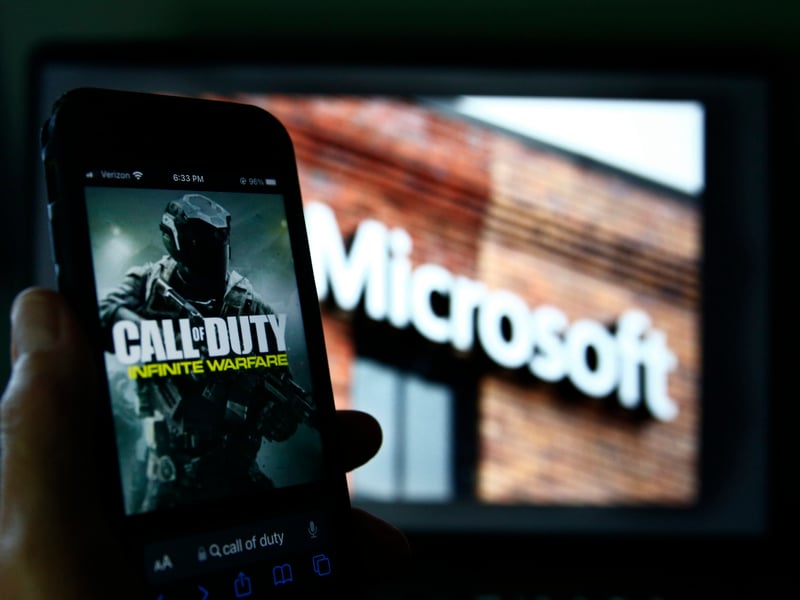
SAN FRANCISCO (CN) — A Federal Trade Commission lawyer told a Ninth Circuit panel Wednesday federal judge misapplied antitrust law when she allowed Microsoft’s $69 billion merger of Activision Blizzard to go through.
U.S. District Judge Jacqueline Scott Corley, a Joe Biden appointee, rejected the FTC’s request for a preliminary block of the merger in July after a weeklong evidentiary hearing. In her opinion, Corley wrote that the FTC was unlikely to prevail on its claim that the vertical merger may substantially lessen competition in the console, library subscription services or cloud gaming markets.
Activision Blizzard develops the Call of Duty franchise, which generates billions of dollars in revenue. This year’s release, Call of Duty: Modern Warfare 3, generated $1 billion in sales in just 16 days.
FTC lawyer Imad Abyad told the appellate panel Corley misapplied section 13B of the FTC act, which entitles the commission to a preliminary injunction if it “shows serious questions to the antitrust merits.”
“The district court misapplied in multiple ways, the most obvious of which probably is that it relied on the defendant’s proposed remedy to deny relief,” Abyad said.
Abyad argued Corley was too focused on the console market and not the nascent cloud streaming and subscription markets, where the merger will give Microsoft monopoly power. He said that Corley was swayed by Microsoft and Activision executives’ testimony that they would not make Call of Duty or other Activision games Microsoft exclusives.
“The district court’s finding that Microsoft does not have the incentive to foreclose rivals is built on testimony by Microsoft’s executives about their intent, whether they will do it or not,” Abyad said.
Abyad brought up the example of Zenimax media, which was acquired by Microsoft for $7.5 billion in 2021. Shortly after its acquisition, Zenimax titles became Xbox exclusives, including the recently released Starfield, which was developed by Zenimax studio Bethesda. Starfield’s release in September led to the single-biggest day of Game Pass sign ups in the platform’s history.
Because the market for cloud gaming and subscription services is so new, Abyad said the injunction was appropriate because it was impossible to predict what will eventually happen to those markets as a result of the acquisition.
“Microsoft, in the cloud market in particular, is the dominant player. And it’s not even close, Abyad said.
Abyad said that Microsoft has three times as many paying subscribers in the cloud market as its next competitor, and once Microsoft buys Activision, it will wall off its content from anyone else in the cloud market, ensuring it remains the biggest dog in that market.
“If you show that the merged party will have the ability to foreclose its rivals, and you show that it will have the incentive to do that, then you have met your burden” for the injunction, Abyad said.
Corley found the merger was procompetitive because it allowed gamers to access Activision Blizzard content on streaming services, whereas without the merger that content would not be available at all on streaming services.
Rakesh Kilaru, counsel for Microsoft, said the government failed to prove that Microsoft would foreclose any of Activision Blizzard’s content from competitors. He said it would not make financial sense to do so, as Call of Duty is an online game which relies in part on being available on all gaming consoles to be successful.
Kilaru also said that Microsoft does not own the cloud platform, so it is incapable of foreclosing any of its competitors on that platform.
Activision Blizzard’s games would not end up on any streaming or gaming platform if not for the merger, Kilaru said. This increases access to its games to consumers and is not anticompetitive.
Kilaru said that the FTC’s theory of foreclosure required showing that consumers would lose access to something; since Activision Blizzard games are not currently available on subscription or cloud markets, they cannot make that claim.
“They didn’t prove that any of this content would go to any of these services otherwise, and it is not a violation of the antitrust laws to give consumers something new,” Kilaru said.
U.S. Circuit Judge Daniel Collins asked Kilaru who the leaders in the subscription market are. Kilaru acknowledged Microsoft has more “high tier” subscribers than Sony right now, but said that is offset by the number of console exclusives Sony has.
“Most people are not in the lowest tier. I mean, overwhelmingly they’re in the highest tiers, and there you are,” the Donald Trump appointee said.
“I believe that’s right…” Kilaru replied. “[Sony] has not put their games and made the higher levels more attractive because they don’t see a reason to do so right now with their lead in exclusives.”
As to the government’s argument that Microsoft had withheld access in the past when it purchased Zenimax, Kilaru said that was not a fair comparison.
Zenimax’s games are mostly single player, Kilaru said, and don’t rely on other platforms for economic success like Call of Duty does.
To prove his point, Kilaru brought up Minecraft, the best-selling video game in history. Minecraft, like Call of Duty, relies on players from other platforms playing together for its economic success, Kilaru said.
After Microsoft purchased Minecraft in 2014 for $2.5 billion, it expanded access to the game on other platforms, not the other way around, Kilaru told the panel, and there is no evidence that Microsoft would restrict Call of Duty or other Activision Blizzard games.
U.S. Circuit judges Danielle Forest, a Trump appointee, and Jennifer Sung, a Joe Biden appointee, rounded out the panel, which took the matter under submission.
Subscribe to our free newsletters
Our weekly newsletter Closing Arguments offers the latest about ongoing trials, major litigation and rulings in courthouses around the U.S. and the world, while the monthly Under the Lights dishes the legal dirt from Hollywood, sports, Big Tech and the arts.