
 Search Articles


WASHINGTON (CN) — The Federal Trade Commission proposed an order Monday requiring an artificial intelligence content-detecting company to prove its claim of its product’s 98% accuracy.
The order against Workado, formerly known as Content at Scale AI, accuses the company of lying to customers about the effectiveness of its technology without providing reliable evidence.
“Consumers trusted Workado’s AI Content Detector to help them decipher whether AI was behind a piece of writing, but the product did no better than a coin toss,” Director Chris Mufarrige of the FTC’s Bureau of Consumer Protection said in a press release. “Misleading claims about AI undermine competition by making it harder for legitimate providers of AI-related products to reach consumers.”
The order prohibits Workado from making any representations of its product’s effectiveness without evidence and instructs the Arizona-based company to alert customers of the settlement with the commission.
According to the FTC’s complaint, Workado advertised its AI detection model for $49 a month in 2024 to marketers and others who use AI-generated content to highlight which sentences read as robotic. The company warns that AI-generated text can influence search engine optimization, academic grading and reader perceptions.
Norwegian students developed the open-source AI model that Workado uses for a thesis to detect Chat GPT-generated text in academic writing.
“Respondent did not build, train or fine-tune the AI model behind its AI Content Detector,” the FTC said. “The developers did not fine-tune the AI model using any non-academic content, such as Wikipedia entries or blog posts.”
The Norwegian developers released a study finding that their model was 98% effective in detecting AI-generated text in academic content. In contrast, the study revealed that when the model analyzes non-academic writing, its accuracy is 53%. Workado, however, deceptively used the 98% accuracy data point to advertise its non-academic AI detection without conducting its own studies.
“It was relying on the student testing and conceded that they hadn’t tested it more broadly,” Chuck Harwood, director of the FTC’s Northwest region, said in an interview.
Workado also advertised the model as able to detect AI-generated text stemming from any source when, in reality, the developers only trained the model to detect text from ChatGPT.
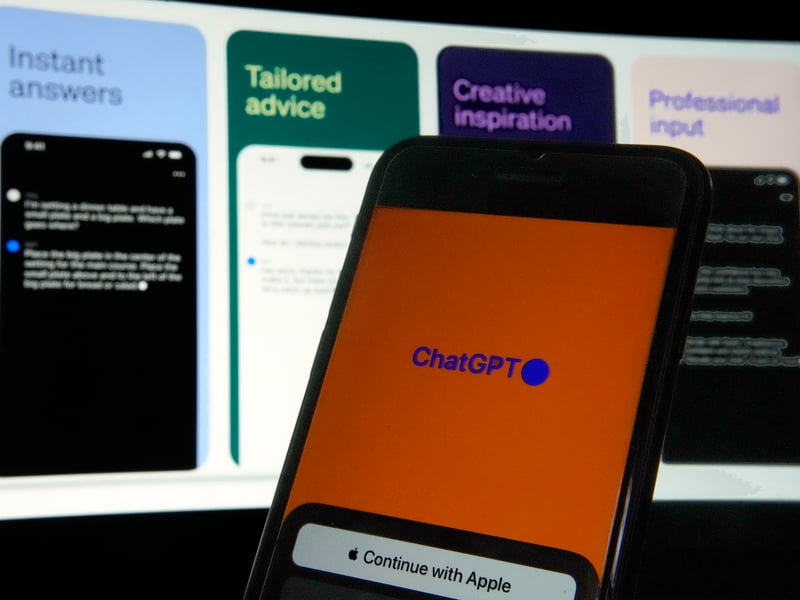
ChatGPT and other generative artificial intelligence chatbots create content, such as school essays, news articles and advertising copy, that sounds and looks like it was created by a human.
“if you’re a publisher, you want to be sure the author wrote it rather than AI," Harwood said. “Or if you are a business, you’re getting applications, you would like to know that it was written by a human.”
Businesses and institutions that require authentic work have turned to companies like Workado.
“The consequences of these tools’ assessments can be severe — such as a student wrongly accused of cheating or a journalist’s article rejected for publication,” the FTC said.
The order comes as litigation continues over President Donald Trump’s firing of the commission’s Democratic commissioners, Rebecca Kelly Slaughter and Alvaro M. Bedoya. The complaint filed in D.C. federal court accused the administration of firing the commissioners without cause. The commission currently consists of three commissioners.
Representatives from Workado did not return requests for comment.
The settlement includes a provision requiring three years of annual compliance checks. The agreement will be subject to public comment for 30 days, after which the commission will decide whether to make the proposed consent order final.
Subscribe to our free newsletters
Our weekly newsletter Closing Arguments offers the latest about ongoing trials, major litigation and rulings in courthouses around the U.S. and the world, while the monthly Under the Lights dishes the legal dirt from Hollywood, sports, Big Tech and the arts.