
 Search Articles


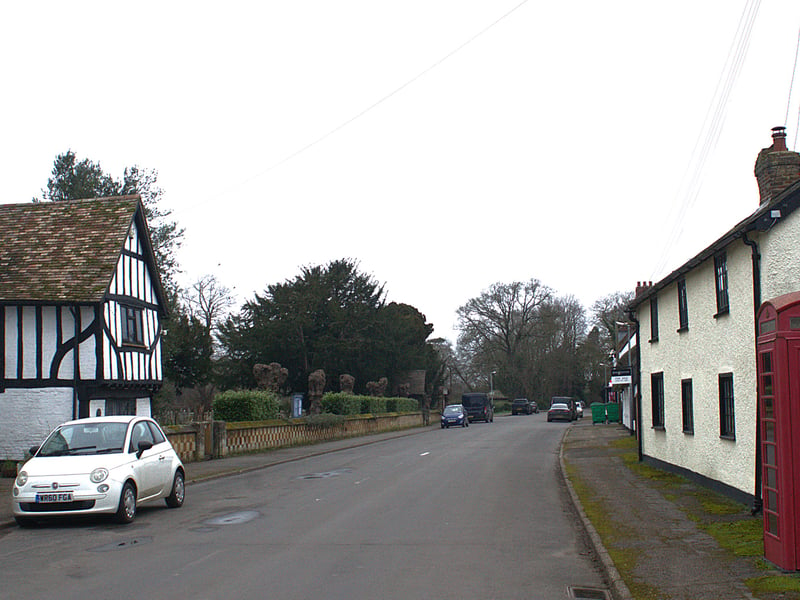
TEMPSFORD, England (CN) — Less than two hours by car from central London, Tempsford is a sleepy village with old cottages and about 600 residents.
Unfortunately for those who would like to keep it that way, it’s also the site of a proposed government “new town” that could see Tempsford’s population balloon with tens of thousands of new homes.
Planners say new housing here could help ease the United Kingdom’s severe housing shortage. Government maps call it a “placemaking opportunity.”
As is often the case with major development projects, those currently living in Tempsford see things differently.
“We will be surrounded,” said Jesse Lawrence, a retired schoolteacher and longtime Tempsford resident who opposes the plans. “It would no longer be a rural idyll.”
Troubles in Tempsford began last year, after the country’s Labour Party won a landslide victory.
Armed with a political mandate and facing a major housing shortage, Prime Minister Keir Starmer pledged to build 1.5 million homes within five years.
A so-called New Towns Taskforce is set to announce locations for so-called new towns — and this sleepy village is a likely candidate. These new town developments will include not only thousands of new homes but infrastructure like schools, parks, commercial districts and transit. Tempsford may learn its fate as early as September, as the U.K. waits for the taskforce’s final report.
Talk to Tempsford residents and local officials, and many believe a major project here is a done deal.
“The straws in the wind are pretty clear,” said Richard Fuller, a Conservative Party lawmaker who represents Tempsford in parliament.
In a phone interview, Fuller said he expects the New Towns Taskforce to back development in Tempsford.
“We’re facing a tsunami of change, with years of disruption,” he said. “That’s just a lot of change for a largely rural constituency like mine to absorb.”
Still, Fuller doesn’t totally oppose the idea. A development and population boom could bring more services to the area, he said, including new doctors and dentists. And he thought if done right, a new town here could incorporate green spaces and “maintain some of the rural character.”
“The great thing about doing a new town [is], you get a chance to plan it in advance,” he said. “You are designing it from the startup phase.”
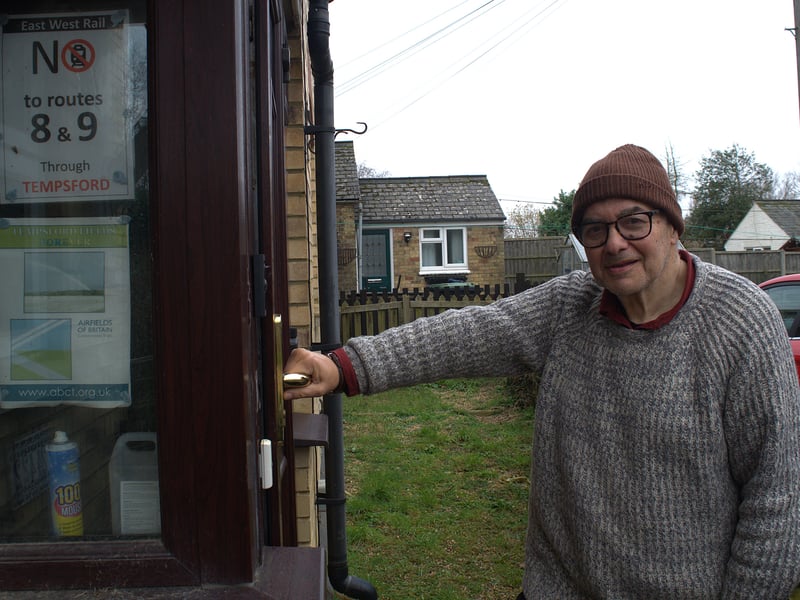
Others are more skeptical. Adam Zerny, head of the local Central Bedfordshire Council, worried that government planners weren’t adequately taking flood risks into account.
The area has historically been wet and marshy, with significant floodplains along the nearby River Great Ouse, he said.
“It’s conceivable they could push for 30,000 or 40,000 houses,” he said, “which would be a huge number for such a rural area.”
More than anything, there is a sense of resignation here. Residents said they were alarmed with the scale of the project and yet felt powerless to stop it.
As he sipped a cup of tea at home in the village, Lawrence, the retired schoolteacher, argued planners were taking the path of least resistance by planning major developments in a place with few residents and little clout.
“They’ve got lawyers,” he said. “What are we? I’m just a retired pensioner on a teacher’s pension.”
The mood was similar at the Wheatsheaf, the village pub.
“One minute, it was like 10,000 houses going up, and then there’s 25,000 houses, and now we’re talking about 350,000 houses,” local mailman Steve Cooney said as he sat at the bar with a pint of ale. “Nobody wants that.”
Despite serving on the village’s parish council, Cooney said he had little say over any proposed developments.
“All we can do is object,” he said. “I don’t think we really have much power. Parish councils don’t have the power.” In his view, efforts to seek comment from locals were simply a matter of optics. “We will be invited to these seminars,” he said, “but I think it’s been decided already.”
New towns are not a new idea in Britain. They date back to the late 1800s, when reformers and urban planners envisioned utopian “garden cities” in response to overcrowding and pollution in places like London.
The first, Letchworth Garden City, was unveiled in the early 1900s not far from Tempsford. The movement gained steam in the wake of World War II — and in the span of three decades, nearly 30 new towns were built.
The government got out of the homebuilding business in the 1980s, under Conservative Party Prime Minister Margaret Thatcher. The last new town, Milton Keyes, opened in the early 1970s. But new towns have remained an important part of British urban history, as well as a rallying cry for reformers. Today, about 2.8 million Brits live in one of these government-planned communities.
Now, amid a housing crisis and with a progressive-minded Labour government in charge, U.K. leaders are looking to revive the concept.
“The crisis is basically the result of building too few homes for too long with a growing population,” said Matthew Carmona, a professor of planning and urban design at University College London. “It makes a lot of sense to investigate the possibility of building new towns again.”
If one wanted to build a new city from scratch, Tempsford wouldn’t be a terrible place to start. It sits on the A1 highway and the East Coast Main Line railway, both of which run the length of the country from London to Edinburgh.
With both Cambridge and Oxford universities nearby, British officials hope to turn this area into what they call “Europe’s Silicon Valley.” Planners hope to complete the East West Rail line to connect Oxford and Cambridge. Tempsford would sit near the intersection of these two major arteries.
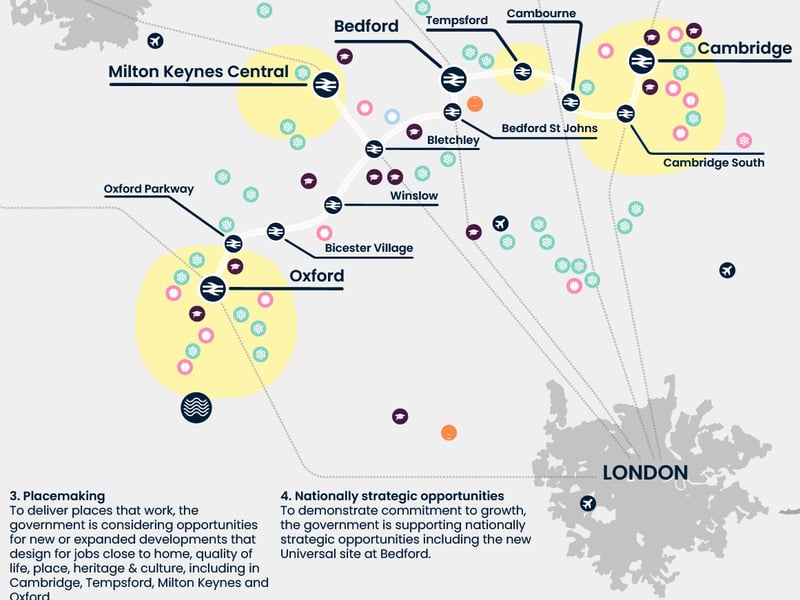
Despite its central location, the area around Tempsford is rural and largely undeveloped, with relatively cheap land. The think tank Centre for British Progress calls it “probably the best connected greenfield site in Britain.”
“The site could easily sustain a city-scale settlement of 250,000-350,000 people, twice the size of Oxford or Cambridge, and comparable to Utrecht, Bilbao or the largest postwar New Towns,” the report’s authors argue. “It would have every prospect of becoming a major economic center, supporting growth across the country as a whole.”
Carmona isn’t surprised that the Tempsford proposal is drawing opposition from current residents.
“There are many communities who don’t want lots of new housing built near them,” he said in a phone interview.
Nonetheless, he sees real benefits to the government getting back into house-building. For one thing, he argues the private market hasn’t resolved the housing crisis and is incentivized to build a few high-priced properties over lots of affordable ones.
Putting the force of government behind a problem can also lead to broader changes than is possible with the free market. For example, officials could prioritize pedestrians and environmentalism in any new development.
Indeed, government planners imagine these new towns as greener places where features like solar panels, electric car-charging stations, gray water tanks, heat pumps and recycling are the norm. The Labour government also wants 40% of homes in new towns to be set aside for people with low incomes.
“It’s not going to solve our housing crisis in the short term,” Carmona said. In the longer term, though, these new towns could have major ripple effects on housing costs and quality of life in the United Kingdom.
After World War II, during Britain’s previous boom in new towns, government-funded public development corporations were set up to oversee the design and construction of new settlements.
Observers expect that same playbook will be used again. If a Tempsford new town gets approved, officials could use a development corporation to buy up large tracts of land, then incorporate it into a new political entity. That could lower costs and streamline the process, but it would also mean that “no one [in the village] will have any power,” complained David Sutton, the head of Tempsford’s current parish council and owner of the Wheatsheaf pub.
Despite the new-town boosterism from officials and think tanks, many question how these proposals will benefit current residents — or why the government wants to build here at all.
“People are rightly concerned that the government’s main interest in our area is as a convenient location in between Oxford and Cambridge,” said Zerny, the Bedfordshire Council official. By that interpretation, Tempsford is nothing more than “a useful place to build vast numbers of houses.”

If a new town is approved in the region, Tempsford residents say they will fight it.
Even so, “they don’t have too many legal options,” said Carmona, the urban-planning professor. While he understands why Tempsford residents are up in arms, he stressed that sometimes, governments have to make difficult choices about where to put new infrastructure and development.
“You’re talking about a tiny number of people compared with the potential number of people that would eventually be living in a new town there,” he said. “It’s a question of what is in the public interest.”
One way to view the controversy in Tempsford may be through the lens of cultural anxieties.
Like much of the world, the United Kingdom is changing, sometimes in ways that are uncomfortable or scary.
Bedfordshire, the ceremonial county in which Tempsford sits, is seeing population growth three times the national average. Located not far from London, the area is already in the midst of a development boom. Major projects include the expansion of London Luton Airport, the first Universal Studios theme park in Britain and a variety of road and train projects like East West Rail.
Lawrence, the retired schoolteacher, says many people in the village have given up on the new town fight.
“I tell you what,” he said, “there’s apathy and indifference at times around here.”
But the proposed Tempsford New Town is just one facet of the problem. Sitting in his kitchen in the still quiet village, he shook his head as he reflected on the larger changes in the British countryside. Too many people were coming to the United Kingdom, and the government wants to pave paradise and put up housing lots. Many locals would prefer it stay “Tempsford Fields Forever,” to quote protest shirts made by Jesse Lawrence and his wife Clare.
“It’s overpopulation,” he said. “We can’t cope.”
Courthouse News reporter Cain Burdeau is based in the European Union.
 Follow @cainburdeau
Subscribe to our free newsletters
Our weekly newsletter Closing Arguments offers the latest about ongoing trials, major litigation and rulings in courthouses around the U.S. and the world, while the monthly Under the Lights dishes the legal dirt from Hollywood, sports, Big Tech and the arts.