
 Search Articles


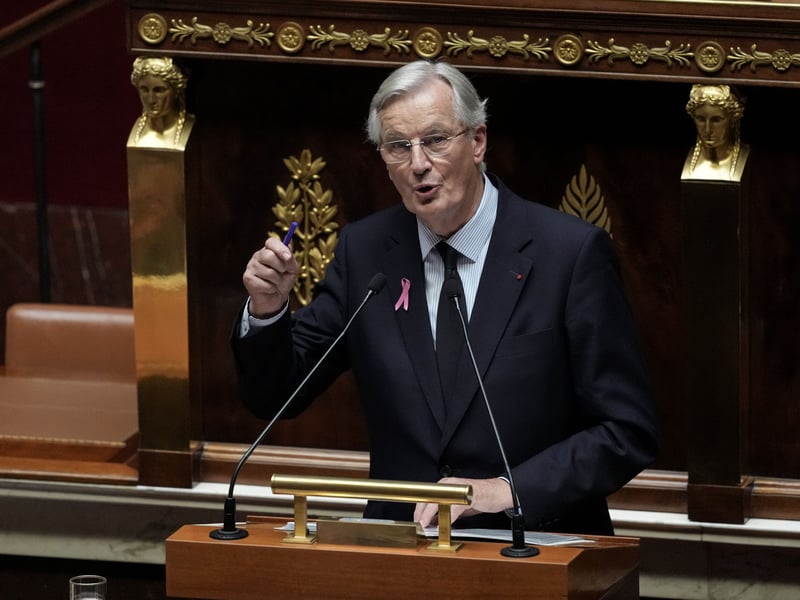
MARSEILLE, France (CN) — Prime Minister Michel Barnier will formally meet with party leaders next week in an effort to prevent France’s new government from collapsing before the holidays.
The government — which was formed in September — is hanging on by a thread.
On Thursday, Barnier said, “I don’t know how much time I have ahead of me” during a meeting with local elected officials. In an interview this week, Catherine Vautrin, a member of Parliament, emphasized the “if” in “If we’re still here at the beginning of the year … .” French headlines are inundated with the words “shutdown” and “censure.”
The extreme right and far left are both attacking Barnier over his 2025 budget plan, which is set to be adopted between Dec. 18 and 20. If both sides unite to issue a vote of no confidence, they would have enough numbers to force the government to resign.
Although the budget is presented as the critical issue, experts argue Barnier’s effort to appease concerns might be in vain. The anger is really a front for party leaders to advance personal ambitions and lay the groundwork for the next presidential election.
“I think we’re going to continue with this kind of uncertainty, where everyone is trying to play on each other’s nerves,” Olivier Costa, a director at the Center for Political Research at Sciences Po, told Courthouse News. “Because no one is thinking about the current political situation anyway; everyone is simply thinking about the next presidential elections and the next legislative elections.”
Barnier’s appointment as prime minister was meant to end months of unprecedented political chaos.
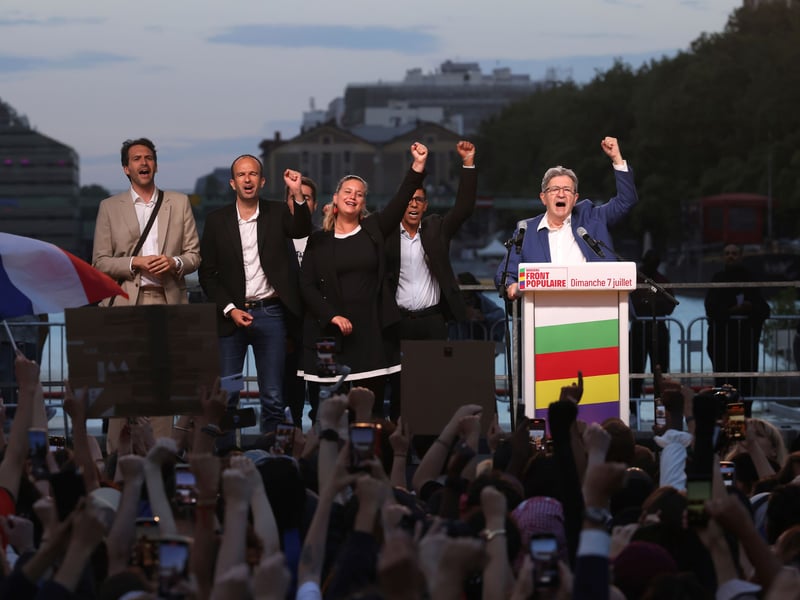
In June, when the extreme-right National Rally party made strong gains in the European elections, President Emmanuel Macron abruptly dissolved the governmentand called for snap legislative elections. Although the left-wing New Popular Front coalition ended up winning the mostseats — followed by Macron’s Ensemble group and the extreme-right National Rally — Macron refused to name a prime minister for months, leaving France politically deadlocked all summer.
Experts say Barnier — who is part of the Les Républicains party, whichfinished fifth in the elections — was chosen because he’s well respected and avoids controversy. He was best known for negotiating thepost-Brexit trade deal talks between the U.K. and EU.
“He had a good image when he arrived … . He’s someone who is calm, respected, attentive, so a good personal image,” Pierre Allorant, the chairman of the Committee for Parliamentary and Political History, told Courthouse News. “But it’s starting to deteriorate, because the French public opinion sees clearly that the government is paralyzed.”
In December, Barnier is expected to trigger France’s 49.3 constitutional article to pass the budget without a vote. This is what Macron used to push the controversial pension reforms into law in 2023, which sparked weeks of nationwide protests.
If Barnier takes that path, parties can issue a vote of no confidence. Though neither group controls the government, if they vote together, the National Rallyand New Popular Front would have a majority.
“It’s mathematical, it’s arithmetic,” Allorant said. “If the National Rally votes with the whole of the left, well, the government will be overthrown.”
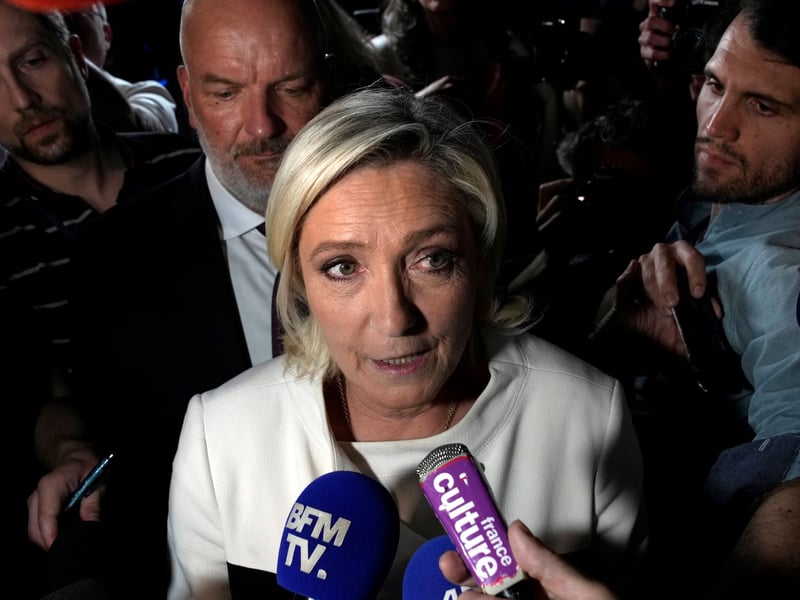
The New Popular Front has already said they will issue a no confidence vote. That means the decision essentially hinges on Marine Le Pen, the figurehead of the National Rally. Le Pen will be the first politician to meet with Barnier on Monday.
“We will not accept that the purchasing power of the French be hit once again,” she told a French radio station, referring to the government. “This is a red line, and if the red line is crossed, we will vote no confidence.”
Le Pen is angling to keep Barnier’s budget from increasing taxes on individuals, entrepreneurs or retirees. She has also stressed an electricity tax hike as a particular pain point.
But experts argue the real reason she’s flexing is not because of tax concerns but personal legal issues. Le Pen is on trial for embezzling public funds, and prosecutors are requesting a five-year ban from public office. This means she wouldn’t be eligible to run in the 2027 presidential elections.
“I don’t know the reason why she wants to censor Barnier, but I think that quite obviously it’s a way for Marine Le Pen to divert attention away from these legal problems,” Costa said. “If Barnier is overthrown, it’s going to be a political catastrophe and no one will talk about this legal drama anymore.”

Jean-Luc Mélenchon, the controversial leader of the far-left France Unbowed, could have similar motives. At 73, he has been vying for the presidency for years and has lots of left-wing competition.
“Some people on the extreme left, particularly France Unbowed, are looking for the collapse of the system, with Jean-Luc Mélenchon who will arrive as the savior of a country adrift,” Costa said. “So they are there to create chaos and political crises.”
Allorant says that Mélenchon could be hoping for Macron to resign if the government collapses, which would result in early presidential elections and an opportunity for the leftist firebrand to shoot for the Élysée.
Although Macron has previously said he wouldn’t give up the presidency in the case of a government overthrow, his hands would be tied. He can’t call for another round of legislative elections until June 2025, one year after the previous ones.
“He doesn’t have many cards left in his hand, and the president of the republic has many cards,” Allorant said. “What will be at stake in December, a week before Christmas at the time of the budget vote, is to know — if the government is overthrown, if all the oppositions join forces — what Emmanuel Macron will be able to do.”
Macron could reappoint Barnier, Costa said — nothing would legally prevent him from doing so. Charles de Gaulle did this with Georges Pompidou decades ago.
Costa and Allorant said Macron could also appoint a neutral player — like the head of the Bank of France — as prime minister. The government would then coast until the next opportunity for legislative elections.
“The other solution would be a technocratic government; we’ll go and get a senior civil servant, someone very neutral that no one knows, and this government could continue to govern by doing as little as possible,” Costa said. “And it would manage not to be overthrown by doing nothing.”
In the weeks running up to the holidays, Barnier’s government is on thin ice.
“Avoiding a censure is going to be very difficult for him,” Allorant said.
 Follow @lilyradz
Subscribe to our free newsletters
Our weekly newsletter Closing Arguments offers the latest about ongoing trials, major litigation and rulings in courthouses around the U.S. and the world, while the monthly Under the Lights dishes the legal dirt from Hollywood, sports, Big Tech and the arts.