Search Articles


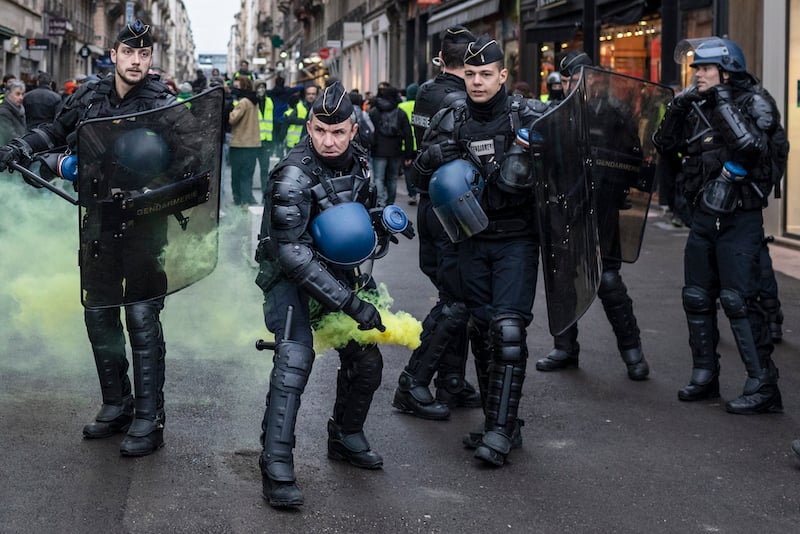
PARIS (CN) — Seven police officers appeared in the Paris Criminal Court this week over their conduct at two separate demonstrations, with videos showing punches thrown and bystanders being shoved to the ground.
“I didn’t go into the police to hurt people; on the contrary, it was to protect them,” Franck H., one defendant, told the courtroom Tuesday afternoon.
“But you’re conscious that this was the outcome?” Judge Thierry Donard responded.
“Yes,” Franck H. said.
The story dates back to 2023, when widespread protests against France’s pension reforms swept the country for months. Three officers from the Brav-M, which stands for the Motorized Brigade for the Repression of Violent Action, approached a man who was walking near the protest but not participating. After deciding to search him, they threw him to the ground, inflicted lasting damage to his shoulder and struck him in the face. The incident was captured on the brigade’s body cams.
The officers are charged with committing intentional violence as part of a group; the division’s captain, identified as Jean-Sebastien C., is also charged with failing to assist a person in danger.
In another Paris courtroom Monday, four officers were handed suspended prison sentences ranging from three to twelve months for beating up a World Cup supporter in 2022. The incident was also recorded.
In the past, such cases may not have gone to court.
Sébastian Roché, researcher and author of “Police versus the Street,” explained that in the age of social media — when videos circulate widely — there is a growing awareness of police violence where it used to be overlooked.
“First of all, this is an issue that has now become firmly established in the political debate,” he said. “So controlling this violence, minimizing this violence, is truly a new issue.”
In Roché’s view, the Yellow Vest protests — which began in November 2018 and lasted for over a year — brought the issue of police violence into the public discourse.
“Before the Yellow Vest movement, the term wasn’t commonly used in the press or in academic articles,” he said. “So there’s a greater awareness in society in general of the issue of, as lawyers say, the legitimate use of force, and therefore the use of violence.”
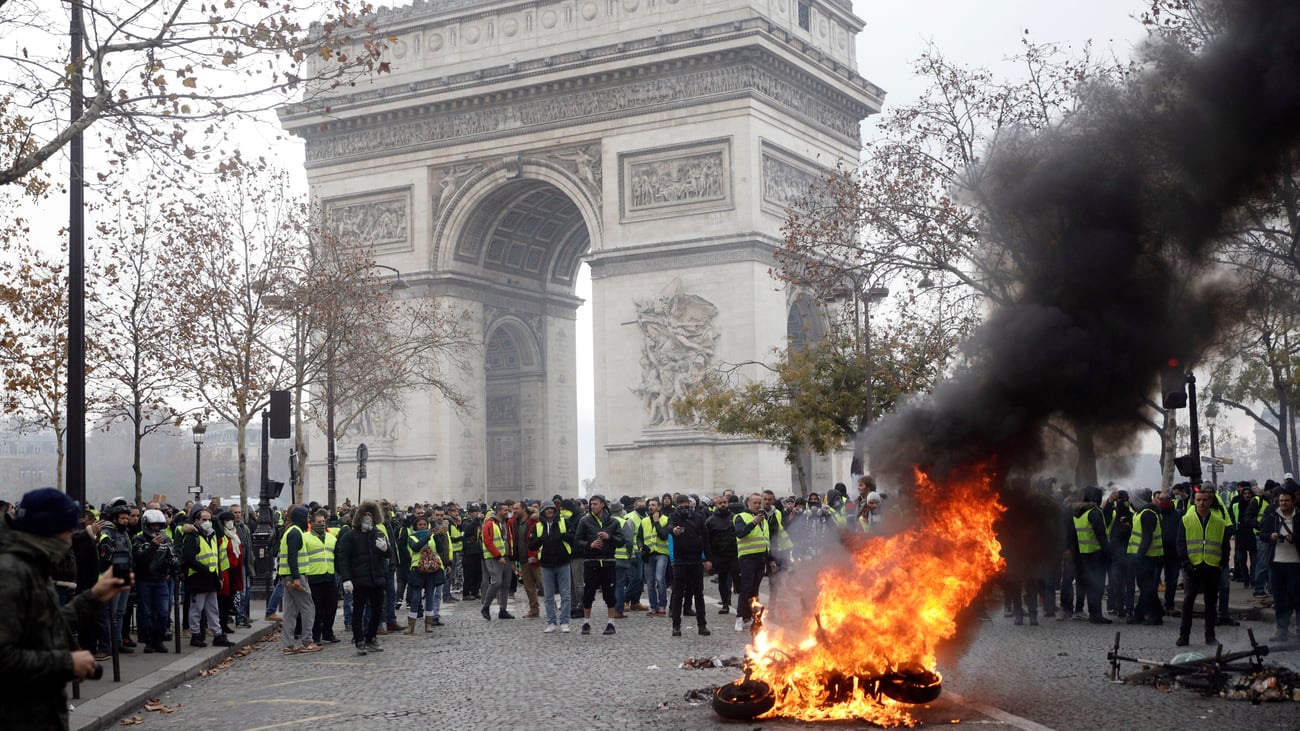
On March 17, the Paris criminal court gave suspended prison sentences of from six to 24 months to nine members of the CRS 43 riot police, who were found guilty of unjustifiably striking Yellow Vest protesters in a Burger King near the Arc de Triomphe in Paris on Dec. 1, 2018. The court recognized that the protesters hadn’t done anything to justify the officers’ violence.
A policeman who shot and killed a teenager in 2023 outside Paris, sparking nationwide protests, will stand trial for violence that led to death rather than murder, an appeals court said on March 5.
In January, thousands protested in Paris over the death in custody of El Hacen Diarra, 35, an immigrant worker. He died after passing out at a police station following his violent arrest.
Europe’s top rights court condemned France last year over its police discriminating against a young man during identity checks, in the first such ruling against the country over racial profiling.
On Tuesday afternoon, a woman stormed outside of the Paris Criminal Court, yelling at police officers over her shoulder. The case appeared unrelated to the trial about to begin.
“You think that because you’re wearing a uniform, you have authority!” she cried. “And you don’t even respect the law!”
A few minutes later, the three Brav-M officers were sitting next to each other inside. Jean-Sébastien C. wore a black sweater and jeans and mostly stared down at his hands. Franck H. wore a blue suit and brown loafers as he watched the judge intently, avoiding the gaze of the plaintiff. Loïc C.’s light gray suit clung to his body as he sat upright with widened eyes, often glancing around the room.
Donard opened the trial by reading the facts gathered by investigators. In 2023, the plaintiff walked away from a crowded Japanese restaurant close to a pension reform protest. His black hoodie and backpack — what he called his usual biking attire — prompted the police to identify him as a potential “instigator” of the protest and order a search.
In the courtroom, a projection screen was slowly lowered and the lights were dimmed.
In the video, the officer started running toward the plaintiff, who immediately put his hands up.
“Open your bag!” Loïc C. yelled. “Fast, fast, fast!”
The officers removed his bag forcefully and pushed him to the ground; he started screaming about his shoulder.
“Of course he’s being theatrical,” Jean-Sébastien C. says in the video.
“Fuck, he fractured my shoulder!” the plaintiff said.
“He didn’t fracture anything,” Jean-Sébastien C. replied.
When the plaintiff walked away, he muttered that the policemen were fascists.
“You said what?” one of the officers replied. “What did you say?”
“What, you’re going to beat me up another time?” the plaintiff asked before leaving the scene. He went to the hospital that night, where a doctor gave him injections for the pain and moved his shoulder back into place.
Donard called the plaintiff up and asked him to briefly describe his memories of that night. In a voice that trembled slightly but quickly gained confidence, the man said he didn’t understand what was happening and was terrorized because he didn’t know when it would stop. He added he thought the officers were going to kill him.
Although it wasn’t clearly visible in the video, the plaintiff said Loïc C. punched him in the head; the defendant said maybe his hand accidentally slipped.
“A punch isn’t launched on its own,” the plaintiff said. “I hope that they’ve become conscious of the crimes that they committed.”
Gérald Darmanin, former interior minister, created an outcry in 2025 when he said, “There is no police violence.”
“For years, the Ministry of the Interior took no action regarding these events,” Roché said. “Some police officers who committed violence were even decorated by Gérald Darmanin, they were clearly using violence against demonstrators.”
Donard’s tone was firm when he questioned the Brav-M officers.
“Does throwing punches seem normal … I mean, in your professional judgement?” he asked Franck H, who didn’t answer the question. The officer said in retrospect they should have taken more time to search the plaintiff.
Jean-Sebastien C. said, “I didn’t identify his injury as grave, for me it was not serious … With retrospect, yes, I know he was injured.”
 Follow @lilyradz
Subscribe to our free newsletters
Our weekly newsletter Closing Arguments offers the latest about ongoing trials, major litigation and rulings in courthouses around the U.S. and the world, while the monthly Under the Lights dishes the legal dirt from Hollywood, sports, Big Tech and the arts.