
 Search Articles


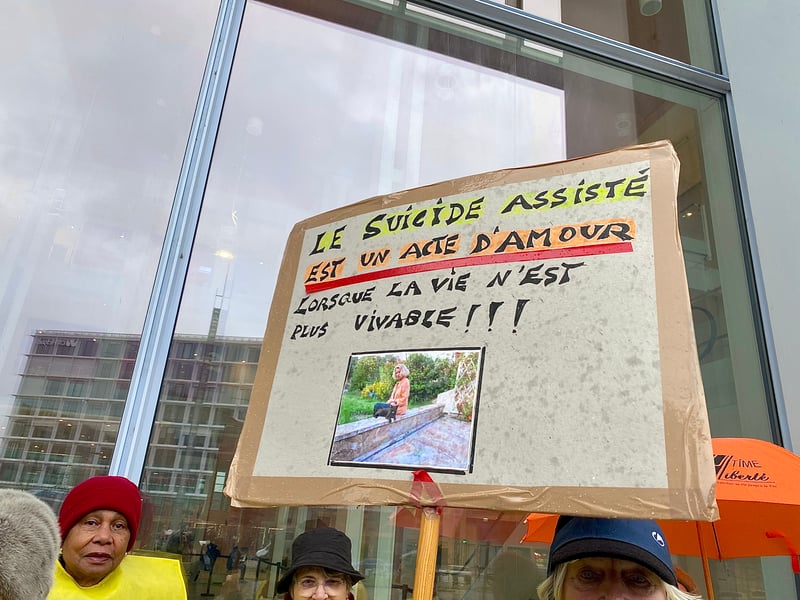
PARIS (CN) — On Friday morning at the modern Paris Criminal Court, Doris Hisch stood outside with a sign: “Assisted suicide is an act of love when life is no longer livable!!!” Below the text, a photo shows a blonde woman sitting peacefully outside with a black cat.
This was Hisch’s dearest friend, and the two had been active together in assisted suicide associations. After she contracted an illness that rendered her bedridden and morphine no longer eased the pain, she wanted to end her life. After one failed attempt, she asked Hisch to stay by her side in her home while she took sleeping pills.
“That’s what she wanted," she said. “That’s what as I did as a friend.”
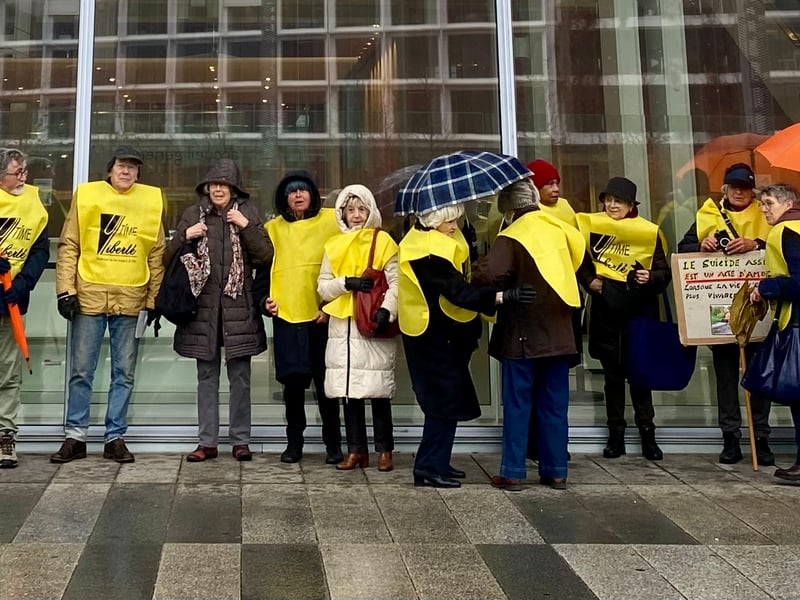
Hisch is an activist in Ultimate Freedom, a French group advocating for euthanasia legislation under the premise that assisted suicide is humanist and everyone has a right to end their own lives. On Friday, the group awaited a verdict in the trial of 12 members accused of trafficking pentobarbital, a euthanasia drug that is illegal in France.
The defendants, aged between 74 and 89, received a roughly $1,100 fine as the most lenient punishment and a 10-month suspended sentence as the harshest. There were collective groans throughout the packed courtroom as the judge read the court’s decision; Hisch shook her head and muttered, “disgusting.”
The 12 members helped people to obtain pentobarbital from Mexico.
“The person in Mexico, who was a retired veterinarian, was routing the product through the United States for reasons of caution, probably,” Pierre Blanchet, the general secretary of the association, explained ahead of the verdict. “And the American customs, apparently based on a tip, proceeded to seize products destined for the entire world.”
The contents of the packages didn’t match their descriptions, which were labeled as something along the lines of essential oils, according to Blanchet. French officials were alerted and tracked down the destination addresses of the packages, which led them into peoples’ homes. Later, they arrived at the Ultimate Freedom headquarters to seize files, computers and other objects.
“So, following that, [12 members] spent 48 hours in custody, in a cell,” he explained. “And then, they were charged with importation, aiding importation and possession of poisonous substances.”
Blanchet joined the association eight years ago. After dealing with a health scare, he started asking himself questions about what the end of his life would look like. His friend was a member of Ultimate Freedom, and he thought the association could offer a solution to the questions he was contemplating.
Blanchet laments that France has a political power that is “very fearful on the subject” of assisted suicide, which he believes is rooted in the strong influence of the Catholic Church. He said that the president usually consults religious representatives on the subject, despite France being secular.
A ’taboo’ topic
On Friday during lunchtime, Barbara Itoua — a parish secretary in a Catholic Church near the courthouse — sat at her desk, tucked away through a corridor near the altar. She explained that the subject of assisted suicide remains very “delicate” and “taboo.”
“The church already talks about it, but at the same time doesn’t talk about it too much because they’re quite categorical on the subject,” Itoua said. “We believe that science has the capacity to bring us many improvements, efficiency in treatments, because very often, the people who request assisted suicide are people who are in very complicated states of life — suffering, illnesses, physical as well as mental.”
For her, there’s a “glimmer that says ‘if I’m still here, if I’m still breathing, I have to keep going.’” She can see that people have a different relationship with the afterlife, but ultimately assisted suicide is a step too far for her.
“I think they should put their energy into finding ways to ease the suffering of people rather than that they die,” Itoua said. “It’s too radical for me — it’s a lack of hope and faith in life, not necessarily in God, but in life.”
But the view isn’t unanimous for practicing Catholics. A few doors down through the hallway, Geneviève Cuhr, an elderly volunteer at the church who takes care of registries, said in an almost-whisper that she completely supports the idea of assisted suicide.
“I’ve seen people around me suffer, suffer, suffer for nothing,” she said. “And I think that when you’re in your right mind and you know you’re going to die, you should be able to ask to go faster.”
Cuhr believes that assisted suicide should have been enshrined in the law a long time ago. But she keeps these views to herself.
“I’ve never talked about it with anyone from … you know, around here,” she said, laughing. “I don’t dare!”
‘Might as well do it right’
The members of Ultimate Freedom all have their own reasons for joining, although a common thread seems to be near-death experiences, stories of the suffering of loved ones or other moments confronting the idea of death head-on.
Anne Leroy, a 66-year-old lawyer, participated in a group demonstration ahead of the verdict. Speaking under heavy winds and rain outside of the courthouse, she said that when she was 38 and living in London, she was in a massive traffic accident that prompted her to think about death.
“I was run down by a truck and he stopped on my right leg,” she said, pointing to her thigh. The hospital wanted to amputate, which she opposed largely due to her background as an athlete. “It was the first time in my life that I had the feeling that everything could stop … and freedom starts here, you know, just with your own life and death.”
A few steps away, Josiane Abtroun, the 78-year-old co-president of Ultimate Freedom, echoed the same sentiment.
“Freedom first. Freedom of choice for each and every one,” she said. “If someone wants to die in bad conditions, that’s their business.”
Abtroun doesn’t want to perish violently, she explained, through other ways that people die by suicide when euthanasia solutions are not available. Behind her, members of the group sang Edith Piaf’s “Non, je ne regrette rien” — French for “No, I regret nothing.”
“We want to die gently in our life,” Abtroun said. “Just, we take a little something, we fall asleep and that’s it, it’s over. Goodbye everyone. Anyway, we’re going to die. Might as well do it right.”
If you are having thoughts of suicide, call or text 988, or call the National Suicide Prevention Lifeline at 1-800-273-8255 (TALK). VisitSpeakingOfSuicide.com/resources* for a list of additional resources.*
 Follow @lilyradz
Subscribe to our free newsletters
Our weekly newsletter Closing Arguments offers the latest about ongoing trials, major litigation and rulings in courthouses around the U.S. and the world, while the monthly Under the Lights dishes the legal dirt from Hollywood, sports, Big Tech and the arts.