
 Search Articles


MANHATTAN (CN) — Michael Kissling was 29 years old when he lost his leg.
Born with May-Thurner Syndrome, a condition that affects blood flow, Kissling is no stranger to blood clots. He got his first one at 15, and another two years later.
A third clot when he was 27 would end up rattling his daily life.
“I noticed that my leg was starting to feel heavy,” Kissling said. “I recognize when I had a clot, my leg became heavy and it became harder to move around and walk.”
Kissling’s doctors — three of them — recommended that he receive a stent in his leg to relieve the pressure caused by this newest clot. The stent could also prevent future clots by allowing for more normal blood flow in Kissling’s affected leg.
But Kissling said his insurance company, UnitedHealthcare, refused to cover the $3,000 procedure.
In the months that followed, his leg got worse. The prolonged clotting caused painful, non-healing wounds that Kissling said his insurer also refused to treat. After 17 months of delays and denials, he said the company finally greenlit his Apligraf treatment — a bioengineered skin graft.
“As soon as it was used, the wounds healed in two weeks,” Kissling said.
But according to Kissling, the clotting eventually returned, as did the wounds. UnitedHealthcare again refused another Apligraf treatment, this time for eight months. He and his wife were flummoxed.
“We knew it was the only thing that worked after 17 months of trying, and still they refused to acknowledge that,” he said.
Despite living his entire life with May-Thurner, Kissling said he’d never thought about the possibility of amputation. But battling the clots and non-healing wounds for around two years caused irreversible damage to his leg.
On Feb. 1, 2023, Kissling got it amputated.
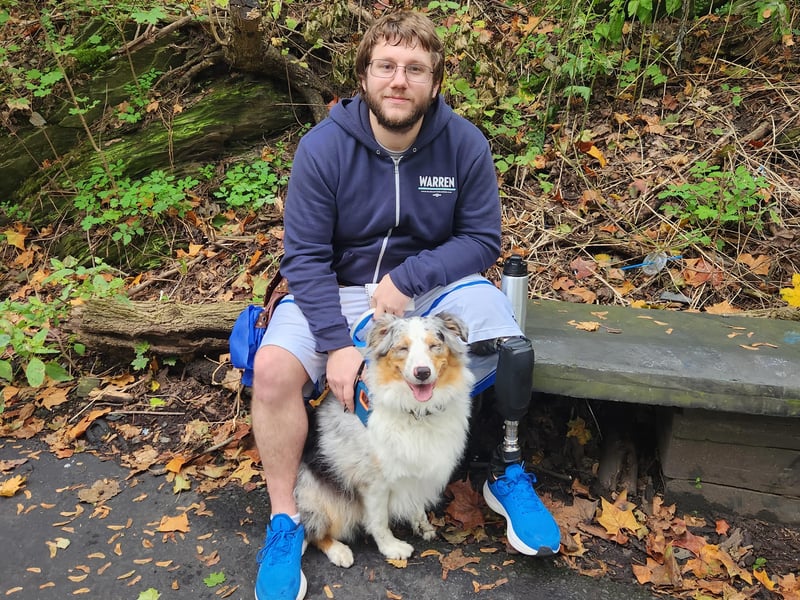
It was just the start of both his medical journey and active feud with UnitedHealthcare, the largest health insurer in the United States.
Using a learner leg, which is designed to precede a permanent prosthetic, Kissling had to teach himself how to walk again. He wasn’t able to jog, run or return to work on the learner, but he was able to return to living a relatively active lifestyle with his wife and daughter.
That was until UnitedHealthcare denied covering his permanent prosthetic. Kissling said he overrelied on his learner leg as a result, causing several falls.
“I was able to wear it for three, four months before it got to the point where it was like a fork prong that just kept on stabbing the connective tissue,” Kissling said.
That stabbing led to long-term nerve damage, bouts of psychosis and, eventually, a second amputation — this time higher up on the same leg.
Kissling, once an active machine operator, was left “completely wheelchair bound,” according to his wife Katelynn, who added that the initial $3,000 stent procedure could have saved precious time, money and her husband’s leg.
“They have spent millions of dollars because now he’s completely disabled,” she said of UnitedHealthcare.
Dec. 4, 2024
Brian Thompson’s shocking early-morning murder on the streets of downtown Manhattan spread like wildfire on social media.
Security footage captured a hooded assailant raising a silenced pistol and firing off rounds at the 50-year-old UnitedHealthcare CEO as he walked along West 54th Street towards the New York Hilton Midtown hotel, which was hosting an annual company investors’ meeting set to take place later that day.
Afterward, the internet was ablaze. Memes were made about the murder victim, whom many saw as a symbol for the for-profit health care system, while messages of support flooded in for the unknown shooter.
“It’s surprising it hasn’t happened sooner,” remarked one X user the day of Thompson’s killing.
Meanwhile, the phenomenon shocked law enforcement.
“I just can’t wrap my head around the notion that someone is celebrating this,” Manhattan District Attorney Alvin Bragg said at a press conference on Dec. 17, 2024.
But Dr. Betty Kolod told Courthouse News that her physician peers understood immediately.
“Health workers really get the outrage,” she said. “We are ourselves patients. Being a doctor doesn’t make me immune from medical debt or long waits to see a doctor.”
In addition to being a physician, Kolod is an activist for Physicians for a National Health Program, an advocacy group for single-payer health care.
As a specialist in addiction patients, Kolod has seen firsthand where the frustration with insurers like UnitedHealthcare comes from. In fact, she said she only treats patients part-time so she can pencil in more time “to fight with the insurance companies” to get those patients the care they need.
She spoke of one patient, a successful executive assistant with a history of heroin use, who was suddenly cut off from her opioid withdrawal medication by UnitedHealthcare.
“She was unable to get her medication one month,” Kolod said. “And nobody could even tell us what the problem was.”
Kolod said she and her patient spent days on the phone with both the insurer and its in-house pharmacy, Optum, before the problem appeared to resolve itself with no explanation.
Kolod denounced Thompson’s killing numerous times when speaking to Courthouse News, but she acknowledged that experiences like this could prompt extreme reactions.
“People are scared and they’re dying,” she said. “I mean, that’s what leads to vigilantism.”
The suspect
Thompson’s killing was already captivating a 24/7 news audience thanks to both the shocking crime being caught on camera and the societal status of Thomspon himself.
But when authorities announced they had arrested their suspect at a Pennsylvania McDonald’s, what could have been a standard Manhattan murder case hit new heights of public intrigue.
Luigi Mangione is not your average murder suspect. He comes from a wealthy Maryland family. He has an Ivy League education. And his looks had social media users swooning.
Prosecutors moved fast, charging Mangione in New York State court with first-degree murder as an act of terrorism, and extraditing him with a cinematic perp walk that Mangione’s lawyers blasted as “utterly political.”
The state argues that Mangione sought to intimidate other insurance executives and encourage civilians to engage in violence against them, citing journals they claim to be Mangione’s, which outlined an intent to “wack” a “parasitic” health care CEO.
That’s right around the time that Ico Ahyicodae, a sign language interpreter from Minnesota, started intently following the case.
A frequent at social justice protests in their home state, Ahyicodae told Courthouse News that the constant news coverage about Mangione, coupled with the growing movement behind the murder suspect, piqued their interest.
“This case is what led me into learning about health care injustice,” Ahyicodae said.
Ahyicodae co-founded People Over Profit NYC, an advocacy group “rallying for healthcare reform and justice for Luigi Mangione,” according to its website.
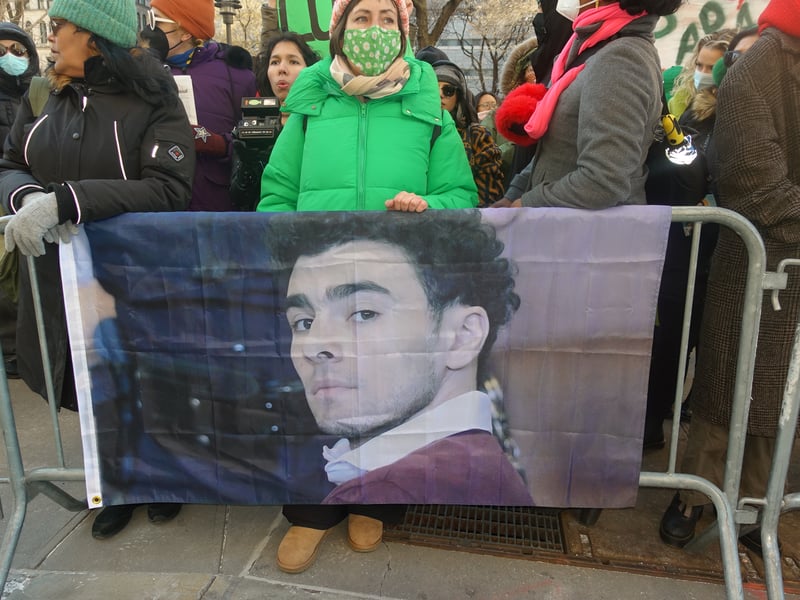
The group has already made a splash at protests outside of Mangione’s court hearings. They went viral for hiring LED billboard trucks, draped in gigantic photographs of Mangione, to drive around the demonstrations in Manhattan.
In addition to Mangione’s face, Ahyicodae said the truck’s screens also feature pictures of people wronged by their insurers, with a QR code for bystanders to scan and read their stories.
“I thought it would be great to have some of the health care horror stories, stories of how people have died from delays and denials,” Ahyicodae said. “We want to spotlight what should really be on trial, which is the predatory insurance industry and the way they kill so many thousands of Americans every year.”
Next time around, Kissling’s story will be featured on the trucks, Ahyicodae said.
#FreeLuigi
Ahyicodae’s group is just one of dozens of internet spaces that have formed around Mangione, as his supporters flock to social media to join like-minded communities.
“People are here for all different reasons,” said the anonymous Instagram user behind FreeLuigiNYC. “There are people who believe he is guilty but they support the actions that took place on December 4. There are people who think he’s innocent and he wasn’t the person who committed the crime. And there are people who are here just because he’s attractive.”
The user, who requested anonymity for safety concerns, runs the page in large part to spread information about jury nullification — an instance by which a jury acquits a defendant not due to a lack of evidence, but because they view the law to be unjust.
But on the largest Mangione-inspired community, r/FreeLuigi on Reddit, the roughly 40,000 members appear more focused on poking holes in prosecutors’ evidence. Discussion threads have scrutinized Mangione’s December arrest as unconstitutional; others claimed prosecutors are trying to bias the jury by selectively releasing information about the case in court filings.
Some members in the community told Courthouse News that they worry celebrating Mangione as a folk hero or advocating for jury nullification could imply unproven guilt. That could worsen his chances at trial, they fear, where the stakes are now higher than ever after his federal charges, which make Mangione eligible for the death penalty, were announced in April.
But the primary goal of r/FreeLuigi, according to one member, is to directly share information about the case.
“We share all the legal documents,” the Redditor, who only identified herself as a disabled veteran over the age of 30, told Courthouse News. “Whenever something is posted, we make sure it’s shared publicly.”
The group has become so influential that Mangione’s own legal team occasionally monitors it for chatter surrounding the case, some participants said.
Members were also quick to distance themselves from the case’s followers on X, where harassment runs rampant between anonymous accounts sporting Mangione’s in-court headshots as their profile pictures.
The Reddit group isn’t immune, though. Despite strict moderation, doxxing and harassment still hits the community. In March, prosecutors discovered a pair of notes stuffed in Mangione’s socks prior to a court appearance.
“We are rooting for you!” one note read.
The pink, heart-shaped paper was signed “from r/FreeLuigi,” enraging some members of the community who feared repercussions against Mangione. Finger-pointing ensued, personal information was exposed and the moderators had to release a statement:
“There are 37,000 members in the r/FreeLuigi community and any one of them could be the source of the alleged heart shape notes. The moderators of this community have no further comment on this matter.”
Incidents like this are one of the reasons members who spoke to Courthouse News requested anonymity. Others fear retaliation from the Trump administration, which famously called for the death penalty for Mangione before he was federally indicted.
One supporter, a United Kingdom resident, said she worried revealing her name would affect her ability to get in and out of the United States. Another, the aforementioned disabled veteran, fears her presence in federal databases would make her an easy target.
“I hold my tongue because of the current administration,” she said.
Presumed innocent
With Mangione expected to go to trial sometime in 2026, it will be months before the public gets a deeper view of prosecutors’ evidence against the 27-year-old. But whether he’s guilty is somewhat of an afterthought for the activists orbiting the polarizing case.
Regardless of Mangione’s involvement in the crime, Ahyicodae hopes the case sheds light on the “predatory insurance industry.”
And for some r/FreeLuigi participants, any perceived evidence against Mangione doesn’t affect their calls for him to receive a fair trial, nor their critiques of law enforcement for supposedly treating him differently than other murder suspects.
“In the end, it doesn’t matter to me. I still support him,” said one of the Redditors, a 36-year-old systems engineer from the Midwest.
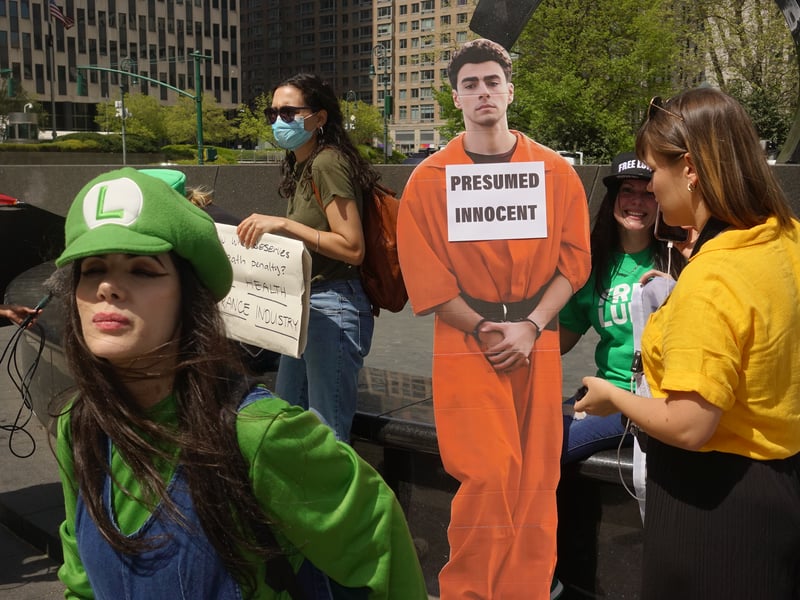
Kolod on the other hand, who has been advocating for health care reform long before Mangione’s case, has a narrower tightrope to walk. She said her fellow activists at Physicians for a National Health Program had a serious debate about whether they should attend protests outside of Mangione’s court hearings to distribute information about single-payer health care.
“Many of our members were really against it,” she said. “They felt that it was sending the wrong message, that we were sympathetic to the use of violence.”
But the group made an appearance anyway, and Kolod said she found the experience productive. By spreading the word about PNHP and the New York Health Act, a state bill to introduce single-payer health care, she said the group was able to direct the energy of Mangione’s supporters towards tangible outlets for change.
“I think people have been really excited to hear that there is somewhere they can channel their anger,” Kolod said.
Kissling has his own battles. He’s currently in the process of trying to find other people who believe they were wronged by UnitedHealthcare to file a class action against the company.
Of Mangione, Kissling said he was surprised that the government called for the death penalty before indicting him, calling it “a big red flag in terms of due process.”
But Kissling also distanced himself from the controversial murder case, making it clear that he’s solely focused on his own justice for the time being.
“I’m a Christian, and I believe that we’re not supposed to kill anybody,” Kissling said. “I think that killing somebody is just one life lost for another one. You’re not making much of a difference.”
While he welcomes the help of groups like POPNYC to circulate his story, he wishes others started paying attention sooner to people like him, who have been “crying out and calling for help" for years on this issue.
“There should have been a flashpoint long ago,” Kissling said.
 Follow @Uebey
 Follow @uebey.bsky.social
Subscribe to our free newsletters
Our weekly newsletter Closing Arguments offers the latest about ongoing trials, major litigation and rulings in courthouses around the U.S. and the world, while the monthly Under the Lights dishes the legal dirt from Hollywood, sports, Big Tech and the arts.