
 Search Articles


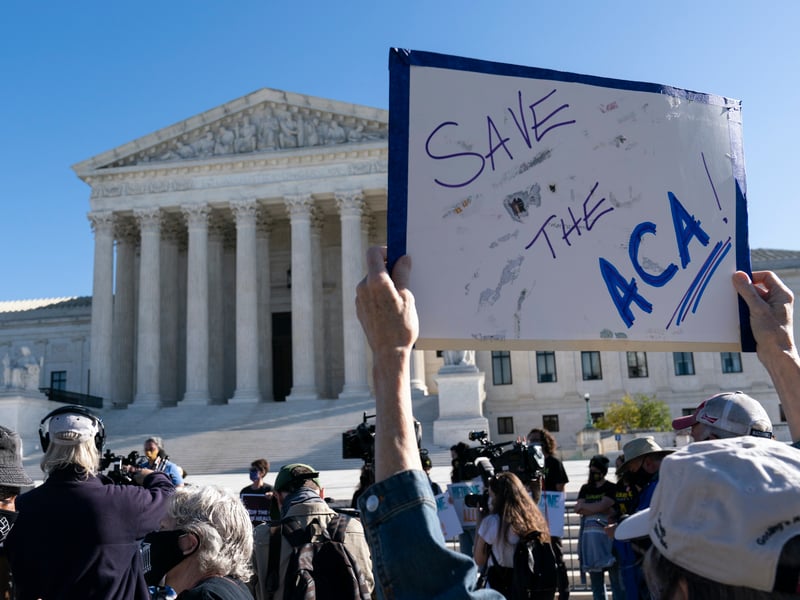
WASHINGTON (CN) — A cornerstone of the U.S. crusade to end the HIV epidemic could come crashing down at the Supreme Court next week in a challenge to the Affordable Care Act’s preventive health care mandate, bringing other services along with it.
Under the landmark law, insurance companies must cover the full cost of certain preventive care services without imposing copayments, deductibles or other cost-sharing measures. For now, cancer screenings, diabetes detection, medications to reduce the risk of heart disease and stroke, and HIV prevention drugs like pre-exposure prophylaxis, or PrEP, are all covered.
Patients’ no-cost access to those services could end, however, if the high court sides with business owners to limit insurance services based on their personal beliefs.
“The decision could reshape preventative health care coverage nationwide,” Jose Abrigo, senior attorney at Lambda Legal, said. “Essentially, most of the nation is facing the potential loss of guaranteed cost-free preventative services.”
According to the Centers for Disease Control and Prevention, about 1.2 million people in the U.S. have HIV, and around 30,000 people develop new infections every year. While there is no vaccine for HIV, PrEP is 99% effective in preventing infections.
In 2019, the United States Preventive Services Task Force added PrEP to its list of “Grade A” services. The independent nonpartisan panel comprises 16 volunteer experts from various medical fields who undergo a rigorous vetting process. Members serve four-year terms but can be removed at any time.
Increased access to PrEP led to fewer infections. The CDC reported a 12% drop in infections from 2018 to 2022. One study estimatedthat cutting Affordable Care Act coverage for PrEP would lead to thousands more infections every year.
“We finally have all the tools that we need in order to rein in new HIV infections after four decades of a devastating illness in our communities,” Jeremiah Johnson, executive director at PrEP4All, said. “This isn’t the time to back down.”
Conservative activist Steve Hotze’s firm, Braidwood Management, led the challenge against PrEP. Hotze has promoted false medical claims, including about the Covid-19 vaccine. He opposes equal rights for gay and transgender people, whom he calls “homofascists.”
As CEO of Hotze Health & Wellness Center, an alternative wellness center run by Braidwood in Houston, Hotze joined a group of Christians and conservative businesses challenging the preventive care mandate’s constitutionality in 2020.
Hotze refused to allow the company’s insurance plan to cover PrEP drugs because “these drugs facilitate behaviors such as homosexual sodomy, prostitution and intravenous drug use — all of which are contrary to Dr. Hotze’s sincere religious beliefs.”
Executive power
The business owners challenged the preventive care requirement under the Religious Freedom Restoration Act and the appointments clause. They claimed that the United States Preventive Services Task Force was unconstitutional because its members’ independence made them unaccountable.
According to the business owners, task force members need to be appointed by the president and confirmed by the Senate, like other agency appointees.
“An ‘inferior’ officer is ‘directed and supervised at some level by others who were appointed by presidential nomination with the advice and consent of the Senate,’” the business owners wrote. “That direction and supervision is absent here.”
The business owners prevailed on both arguments in the lower courts, but the Trump administration only appealed their appointments clause challenge.
President Donald Trump has claimed complete control over the executive branch since retaking office. Historically, independent agency heads operate independently of the president — an issue Trump is challenging in a separate case.
However, the task force members have no such protections, the government argues. Task force members can be fired by the president, and their recommendations have to be approved by the secretary of Health and Human Services.
“What matters is that the secretary, not the task force, is ultimately responsible for deciding what recommendations will have final, binding legal effect,” the Trump administration wrote.
If the appeals court ruling is upheld, all preventive care coverage would be at risk, not just PrEP. Health care policy experts said that would dramatically increase out-of-pocket costs for millions of Americans who rely on private insurance.
One avenue for increased costs could come from tiered plans. If insurers aren’t required to cover preventive services, companies would limit expensive ones.
“You pay more, you get more protection,” Kae Greenberg, an attorney with the Center for HIV Law and Policy, said.
Greenberg said preventive care leads to better health outcomes, but people are less likely to receive that care when costs go up.
“This is going to have a real cost in the quality of people’s lives and whether or not those lives are continued,” Greenberg said. He said the ruling could determine “whether or not people actually get access to the preventative care and get conditions caught soon enough that they can be treated, and people can continue to live with dignity.”
 Follow @KelseyReichmann
 Follow @kelseyreichmann.bsky.social
Subscribe to our free newsletters
Our weekly newsletter Closing Arguments offers the latest about ongoing trials, major litigation and rulings in courthouses around the U.S. and the world, while the monthly Under the Lights dishes the legal dirt from Hollywood, sports, Big Tech and the arts.