
 Search Articles


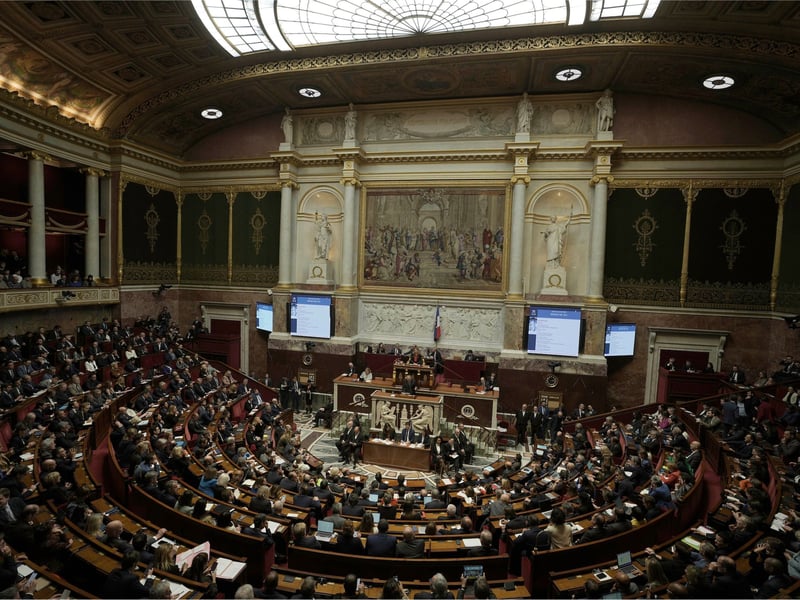
PARIS (CN) — France’s government is expected to collapse on Monday after Prime Minister François Bayrou called for a confidence vote that experts have equated to a suicide mission.
The crux of the issue has been the country’s debt crisis — its budget deficit reached roughly 5.8% of its GDP in 2024, or about $196 billion, which is worse than Greece, Spain and Italy. And this year, the national debt hit almost $3.9 trillion.
“Nothing is working — the budget levels are bad, and they’re doing nothing,” one man — who was working in a produce shop in the 11th arrondissement in Paris on Friday morning, and asked to remain anonymous — told Courthouse News, holding a watermelon in his arms. “There isn’t a government actually … I could talk about this all day, but I have to work.”
Bayrou — the country’s fourth prime minister in 2024 — was tasked with solving the fiscal problem, and finally passed the 2025 budget through Parliament on Feb. 6 after months of delay.

On Monday, he will present the 2026 proposal that would include cutting roughly $50 billion from the deficit through widely unpopular measures, like scrapping two public holidays and reducing public sector hiring.
The proposals prompted outcry across the political spectrum in late August, leading Bayrou to unexpectedly call for a confidence vote, which will also take place Monday. Both ends of the political spectrum have said they will take the opportunity to oust Bayrou and topple the government.
“In a vote of confidence, the prime minister would have to obtain an absolute majority. It’s impossible. Everyone knows that,” Pierre Allorant, historian and political scientist at the University of Orléans, told Courthouse News. “So he’s going to be overthrown next Monday — is it suicide?”
Luc Rouban, a senior research fellow at Sciences Po Paris, told Courthouse News that Bayrou’s logic was likely linked more closely to politics than fiscal policy. Although the centrist prime minster was appointed with hopes that he could bridge the gap between France’s political extremes, neither side looked ready to compromise throughout his tenure.
In Rouban’s view, the prime minister has been in a deadlock because his tax proposals were too high for the right and too low for the left.
“But also, behind this budget affair, you still have the intention of both the left and right to try to take power with a higher probability for the[extreme-right] National Rally, because it has a much larger electorate and a rightward shift in French public opinion,” Rouban said. “In fact, we’re in a purely political logic now — and I think he understood that there was no point in trying to debate purely economic and budgetary issues.”
Although the spotlight has been on the country’s deficit — which is expected to worsen after the vote — the collapse could have a significant impact on France’s political composition, which will most likely benefit the National Rally, known as RN.
French President Emmanuel Macron, who would be forced to appoint his seventh prime minister, has limited strategic options, according to Rouban. He’s unlikely to appoint another centrist. If the government collapses, he could rally his party to align with the left, but the left doesn’t want a coalition government with Macron’s centrist Ensemble! group. So the president could turn right.
“ It’s similar in terms of logic, stability and government, and it would be more likely to be a right-wing prime minister,” Rouban explained.
“The second scenario would be new legislative elections, but all the opinion polls show that voting intentions would go in the direction of the National Rally again — so we would end up with an RN that would remain the master of the game,” he said.
Although the National Rally has called for new legislative elections, Macron has been outspoken about avoiding that route.
“Macron also fears elections would boost the far-right RN or far-left NFP, further eroding Macron’s center-right and centrists,” Hall Gardner, professor of politics at The American University of Paris, told Courthouse News. “There is a real chance that a governmental collapse could push voters toward the RN, particularly as the RN is becoming normalized after former French President Sarkozy called it part of the ‘republican arc.’”

Marine Le Pen, the figurehead of the National Rally who was recentlyfound guilty of embezzlement, has been running a de-facto normalization for the party in recent years. It has clearly been working, largely due to her protégée Jordan Bardella, the 29-year-old, smooth-talking president of the party who has managed to appeal to young voters through a growing social media presence.
And while the extreme-right is on the rise, Macron’s popularity is at an all-time-low. On Wednesday, an opinion poll by the French organization ELABE found his approval rating at 15%.
“We’ve reached this crisis point because, since the dissolution of the government in June 2024, the legislative elections did not provide a stable majority for the government — or rather, Emmanuel Macron,” Rouban said. “This saw the strengthening of the National Rally and the right, and a strengthening of the left within the framework of the New Popular Front … . So, the two most radical oppositions have strengthened to the detriment of the presidential majority.”
On Friday morning, a woman who asked to remain anonymous was opening a cheese shop near the Place Voltaire. She’s tired of the constant shakeups and instability.
“The thing is, new legislatives — we already did it last year, and I’m not sure it would change anything to have new elections,” she told Courthouse News. “It would just be better to have a stable government.”
 Follow @lilyradz
Subscribe to our free newsletters
Our weekly newsletter Closing Arguments offers the latest about ongoing trials, major litigation and rulings in courthouses around the U.S. and the world, while the monthly Under the Lights dishes the legal dirt from Hollywood, sports, Big Tech and the arts.