Search Articles



PARIS (CN) — Jean-Luc Mélenchon, France’s far-left candidate for the 2027 presidential elections, is gaining strength in the polls despite hard-line pro-Palestine rhetoric that experts say borders on antisemitic.
“In his analysis of the ‘New France,’ Mélenchon acknowledged — and it is a pertinent analysis — that he has an electorate that has become radicalized since Oct. 7 [2023], and which can bring him many votes through an anti-Israeli and pro-Palestinian discourse,” Gilbert Casasus, a prominent political scientist, said. “Everyone observing, myself first and foremost, were surprised by the victories achieved by [Mélenchon’s party France Unbowed] in certain cities.”
The party had local electoral wins in March in the Parisian suburb of Saint-Denis and the northern city of Roubaix, though there were mixed results elsewhere.
Mélenchon has been rallying support behind his idea of the “New France,” defined by a young, diverse electorate who may not have been inspired to vote. However, a central part of his discourse has been anti-Zionist; critics have called Mélenchon radical, antisemitic and extreme for refusing to recognize Hamas as a terrorist organization after it attacked Israel in October 2023, triggering an ongoing regional crisis.
One year later, he called for a mass display of Palestinian flags across the country, which sparked controversy; people deemed the initiative insensitive to the almost 1,200 people killed by Hamas on that day in Israel. The Gaza Ministry of Health, generally considered reliable by the United Nations, reported 72,835 Palestinians have been killed since the war began through May 7.
Rima Hassan, a prominent French-Palestinian deputy from France Unbowed, added fuel to the fire in 2025 when she told the Sud Radio station that Hamas’ actions were “legitimate from the perspective of international law,” and justified “an armed struggle in a context of colonization.” However, Hassan repeated that she and France Unbowed viewed the attack as war crimes.
Her comments prompted then-Interior Minister Bruno Retailleau to report her to the Paris prosecutor.
“There are people within France Unbowed who continue to defend the idea that the Palestinian armed struggle, whether it be that of Hamas or other groups, is a legitimate reaction to Israel’s stance,” Jean-Yves Camus, a political scientist, researcher and author specialized in far-right movements across Europe, said. “Not to Israel’s stance after Oct. 7, but to Israel’s stance in general.”
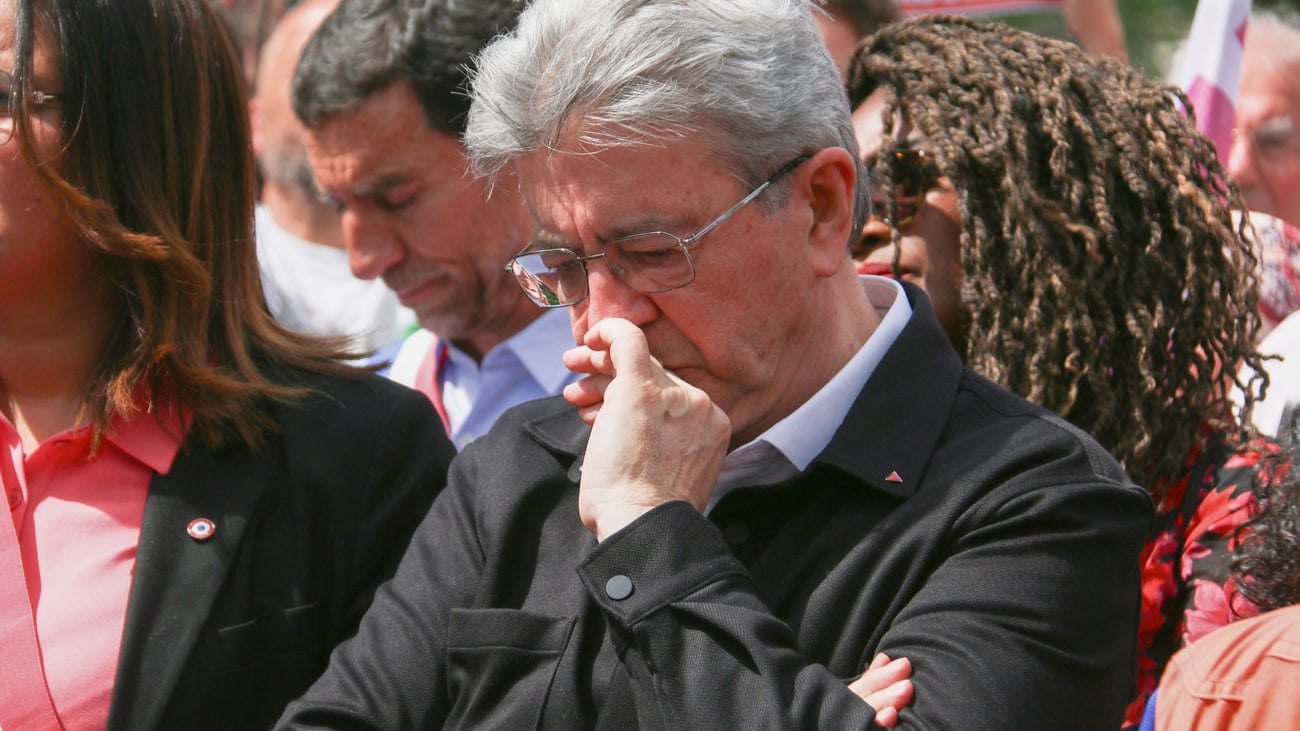
Mélenchon and his party are constantly making headlines over comments on the Israel-Hamas War. Experts say the strategy is deliberate, designed to attract a somewhat niche electorate that might not have previously voted.
And polls show to some degree, it’s working; Mélenchon is hovering at around 16% leading up to the 2027 election, just behind the center-right Edouard Philippe at 17%, though well behind the extreme-right Jordan Bardella’s 32%, according to a Odoxa-Mascaret poll for Public Sénat, a French parliamentary TV channel. That’s a 4-point bump for Mélenchon since March.
“What has really become increasingly clear since October 2023 — though it was already germinating during his previous presidential campaign in 2022 — is an internal strategy, linking his positions regarding the Middle East to his strategy of courting a young electorate … not exclusively young, but in any case, one originating from the Paris suburbs and elsewhere, let’s say from the Muslim community,” Pierre Allorant, historian and political scientist at the University of Orléans, said.
“This is an electorate that generally votes little but is now being mobilized very massively by him, which ensures — or at least this is his gamble — a very high first-round base that could allow him to qualify for the second round,” Allorant continued.
France’s presidential elections typically have two rounds. If a candidate receives more than 50% of the votes in the first, they are elected directly. If not, the top two face off in a second round. A common saying has it that people vote with their hearts in the first round and their heads in the second.
“This strategy is working because he reaches an identity-based electorate, and sometimes an intellectual one as well,” Casasus said. “And there are other things that must also be taken into account — Mélenchon today is one of the most intellectual, most gifted politicians in France … . He has charisma.”
Whether his strategy will ultimately help him become president is less clear.
“It’s a very good first-round strategy,” Allorant said. “His problem is that, given his highly divisive positions and above all, a very populist, demagogic style that flirts with antisemitism, we don’t see how he could win the second round of an election.”
Other polls show the far-right Bardella handily beating Mélenchon in a head-to-head second-round match-up.
Maxime Lefebvre, a diplomat and professor at the ESCP Business School in Paris, thinks Mélenchon’s approach could be finding more support in the public discourse amid widespread criticism of Israel’s conduct in Gaza, which the U.N. has called a genocide. However, his provocative tone risks alienating voters.
In February, Mélenchon was under fire for making fun of the pronunciation of sex offender Jeffrey Epstein’s name; critics argued the joke was rooted in antisemitism, while he said he was merely making fun of the media’s pronunciation.
“It’s a complex and sensitive issue, but the fact is that he had some words which remind us a little of what [Marine Le Pen’s father] Jean-Marie Le Pen was doing in terms of expression, jokes, using some antisemitic clichés, and he was very strongly criticized for that,” Lefebvre said. “So I would say that he’s playing with fire in this game.”
 Follow @lilyradz
Subscribe to our free newsletters
Our weekly newsletter Closing Arguments offers the latest about ongoing trials, major litigation and rulings in courthouses around the U.S. and the world, while the monthly Under the Lights dishes the legal dirt from Hollywood, sports, Big Tech and the arts.