
 Search Articles


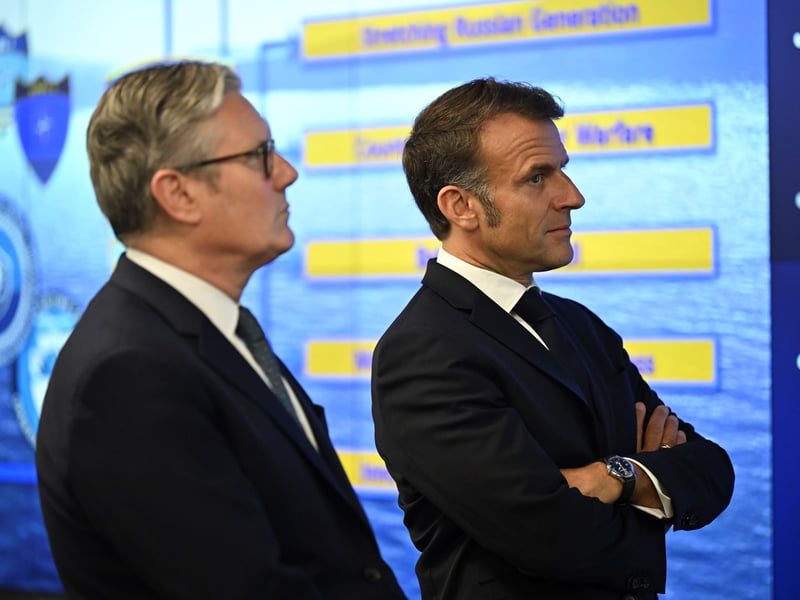
MARSEILLE, France (CN) — French President Emmanuel Macron and U.K. Prime Minister Keir Starmer announced a controversial “one in, one out” migration deal Thursday despite pushback from right- and left-wing politicians and humanitarian groups.
“Migrants arriving via small boat will be detained and returned to France in short order,” Starmer said Thursday afternoon. “In exchange for every return, a different individual will be allowed to come here via a safe route — controlled and legal — subject to strict security checks, and only open to those who have not tried to enter the U.K. illegally.”
Macron said earlier in the day: “We have often mentioned France is the last destination before Great Britain for these men and women who often journey through paths of misery and are exploited by traffickers. We will work with countries of first entry in Europe [as] our intention is also to engage all countries who share a responsibility alongside us.”
Thursday marked the end of a three-day state visit — the first by an EU head of state since Brexit — designed to honor French-U.K. relations. There was no shortage of pageantry throughout the week; Macron rode through Windsor in a horse-drawn carriage alongside King Charles before attending a banquet alongside Mick Jagger and Elton John.

The days progressed with less pomp and more business, with power-lunches and last-minute negotiations over the migration pact. Under the new deal, roughly 50 migrants would be swapped between the two countries each week. For every person France takes back, the U.K. would bring in an asylum-seeker who has a genuine link to the country, like family connections.
But the proposal has sparked mixed reactions among politicians, policy-makers and NGOs. While the negotiations were ongoing, English right-wing firebrand and third party Reform UK leader Nigel Farage called out France for bringing migrants into U.K. waters in a post on X.
Charlotte Kwantes, an advocacy manager at Utopia 56, a humanitarian organization with a post in Calais — the most common point of departure for migrants crossing the Channel — is appalled by the new deal, and doubtful that it will deter people from making the dangerous journey.
“I’m amazed to see that these are the ideas that come from people who are supposed to be specialists in public policy and international relations,” she told Courthouse News. “I’m shocked to see that people are treated like packages — that’s what it shows again.”
Since the beginning of this year, over 20,000 people have crossed the English Channel from France into the U.K. on small boats, up 56% from the previous year. Given those numbers, the deal is largely symbolic; exchanging 50 people per week would hardly make a dent.
“It’s not going to prevent alternative crossing networks from organizing departures, and therefore it’s not going to stop the fact that people risk dying, and de-facto die, in the Channel by saying that we are going to do exchanges of people,” Kwantes said. “You take one, I’ll take one.”
But Meghan Benton, the director of global programs at the Migration Policy Institute, thinks that the deal could be an effective way to address the dangers of crossing the Channel, where more than 80 people died last year.
“I think what makes it really promising is that it’s both telling people that if they arrive through an irregular channel, they will be returned,” Benton told Courthouse News. “So it’s creating a deterrent, but it’s also creating a viable alternative.”
That alternative, she explained, is that someone with ties to the U.K. coming from a country with a high asylum recognition rate could theoretically visit a processing center or launch an online application in France. Then, if selected, they would be safely transferred across the Channel.
“I think the challenge is that it’s become this kind of diplomatic set-piece and it might have been better to frame it as a small-scale pilot to get proof of concept, which might have had less reaction from the other EU countries,” she explained. “I think that the concerns there are that the U.K. is trying to cherry pick.”

The deal coincides with the migration debate resurfacing in the media, after a video showing French police slashing holes in migrant boats circulated on social platforms. Heidi Alexander, the U.K. transport secretary, said the videos were unpleasant to watch, but effective in preventing people from leaving French shores, and she supported it.
Kwantes argues that France is just catering to England’s expectations, and the videos don’t show the full picture.
“What it doesn’t say is that in the four days these videos were being filmed … there were more than 2,000 people who crossed the sea,” she said.
Although the French government is trying to pass this off as acceptable and effective, Kwantes said it’s neither — it’s dangerous. Police intervention has caused serious injury and death, according to Utopia 56, which has filed complaints in two cases.
“One of the cases is a person who remained in a coma for several days following the intervention of the police who pierced her boat, and she drowned,” Kwantes explained. “She was pulled out unconscious by the other passengers of the boat … She got out of the coma with after-effects due to the drowning, drowning caused by the direct intervention of the police.”
In the other case, a young man died in a canal feeding into the English Channel after police fired teargas, causing him to fall in and drown, she said. Kwantes said despite people’s calls for help, the police didn’t attempt a rescue.
She advocates for an official U.K. policy that would allow migrants to legally apply for a residency permit or asylum with safe passage into the country — like the hundreds of thousands of people who move in and out daily.
 Follow @lilyradz
Subscribe to our free newsletters
Our weekly newsletter Closing Arguments offers the latest about ongoing trials, major litigation and rulings in courthouses around the U.S. and the world, while the monthly Under the Lights dishes the legal dirt from Hollywood, sports, Big Tech and the arts.