
 Search Articles


PARIS (CN) — Although Mayotte — a former colony and overseas department of France — is officially part of the French Republic, new legislation is deepening the divide between citizenship rights in the island territory versus the mainland.
On Thursday, French lawmakers adopted a law that will further tighten the rules on birthright citizenship in Mayotte — located between Mozambique on Africa’s mainland and the island of Madagascar — building upon an initial 2018 reform. Now, a person can only get French nationality if both parents have resided legally in France for one year; before, it was one parent for three months.
Experts are sounding alarm bells over the text’s legal integrity and social consequences as right-wing politicians’ push to bring the bill to the mainland.
“We have increasingly restrictive policies and we have a far-right discourse that has managed to completely swallow up the discourse of the right and even the center right,” Marie-Laure Basilien-Gainche, a law professor and member of the Convergences Migration Institute, told Courthouse News. “Let’s say that there is a desire on the part of the extreme right and the far right to engage in politics in mainland France by using the law in Mayotte — it’s a question of responding, supposedly, to demands from the population in mainland France to limit immigration by playing on the standards applicable in this overseas department.”
Mayotte is part of the four-island Comoros archipelago in the Indian Ocean. Although Mayotte is French, it maintains close ties — language, religion and general culture — with the other islands, with family members sometimes spread across them.
Now, roughly one third of Mayotte’s 320,000 residents live there without legal residency. Experts argue this is partly due to France’s decision to restrict movement in the Comoros by imposing harsh visa restrictions for entry, a regulation that dates back to 1995.
“The visa effectively imposed the separation of family,” Françoise Vergès, a political scientist and author, told Courthouse News. “So you started to have what the French state called illegal immigration.”
The general law dictates that anyone born to at least one French parent automatically obtains citizenship, while children born to foreign parents have to prove five years of residency before the age of 18.
In the case of Mayotte, however, a 2018 law changed the rules to make the legal residency status of parents a deciding factor in birthright citizenship. At the time, the regulations held that one parent must have resided in France legally and continuously for three months by the time of the child’s birth.
Although the number of children who obtained French nationality in Mayotte fell from 2,829 in 2018 to 799 in 2022, Basilien-Gainche said that the law made no impact on illegal immigration there, which is on the rise regardless.
“So, the political discourse that we’re reducing access to French nationality to reduce irregular immigration is completely fallacious,” she said. “First, we haven’t had any impact studies of the 2018 law — then, the figures show that we have a decrease in the number of children who acquire French nationality, but we don’t have a decrease in the population in an irregular situation.”
There are also social consequences.
“For people in an irregular situation who are shown even more strongly as being undesirable, it will have a very important effect since it will make their situation even more precarious,” Basilien-Gainche said.
The new law united both poles of Parliament for opposite reasons.
Philippe Gosselin, a member of the right-wing Les Républicains party, spearheaded the initiative, saying the text is about limiting the attractiveness of French nationality as much as possible. The extreme-right National Rally backed the bill.
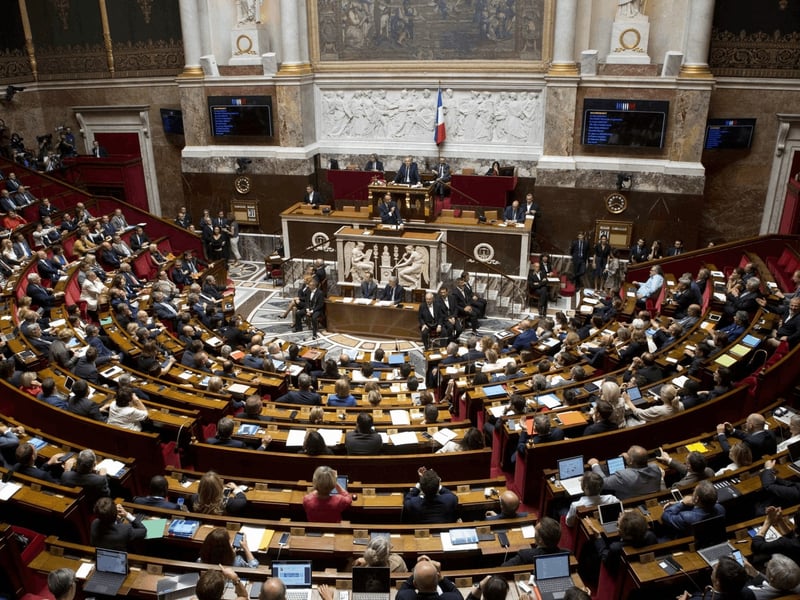
On Thursday, speaking from the National Assembly in Paris, right-wing deputy Bernard Chaix said “the migratory submersion is incontestable,” and that his political party will propose “pure and simple, the suppression of birthright citizenship in Mayotte.”
However, it wasn’t just the conservative side of the spectrum that got behind the bill.
Prime Minister François Bayrou — whose brand is hard centrist — said he was in favor of restricting birthright citizenship in Mayotte, but not mainland France. Other members of President Emmanuel Macron’s centrist coalition also supported the measure.
Conversely, it gave a fractured left the opportunity to display strength and unity against the bill.
The Socialists voiced concern that the law violates republican principles — a view that resonates with critics. There is some confusion as to how the law can be applied to select territories of the same country, which raises questions about the motivating factors behind the initiative.
“It’s a huge threat to one of the founding principles of the French Republic, which is that every child born on the soil of France is a French citizen,” Vergès said. “It’s deeply transforming the conception of citizenship in France … . The population of Comoros islands and of Mayotte is, I don’t know, 90, 95% Black and Muslim — so this is, for me, a racist measure.”
“Still today, in 2025, there is effectively discrimination by birth,” Vergès continued. “That’s why the question of childhood and birth is very important.”
 Follow @lilyradz
Subscribe to our free newsletters
Our weekly newsletter Closing Arguments offers the latest about ongoing trials, major litigation and rulings in courthouses around the U.S. and the world, while the monthly Under the Lights dishes the legal dirt from Hollywood, sports, Big Tech and the arts.