
 Search Articles


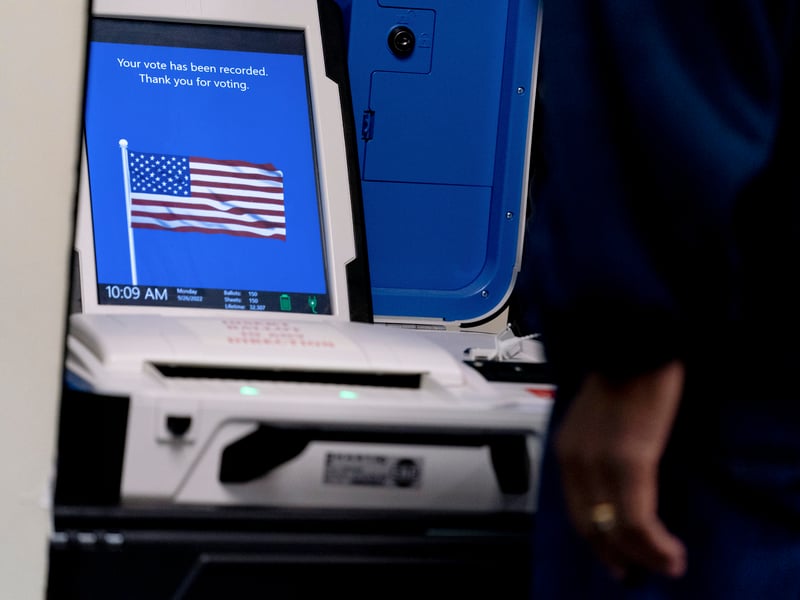
(CN) — A Fourth Circuit panel affirmed that a felon voter law in North Carolina was discriminatory against Black voters despite an amendment by the Republican-controlled General Assembly to salvage it.
The statute made it a crime for a convicted felon to cast a ballot before their voting rights have been restored. Critically, criminal intent was irrelevant — a person can be convicted even if they voted under the mistaken belief they were eligible to do so.
The Reconstruction-era law was struck down last year by U.S. District Judge Loretta C. Biggs, a Barack Obama appointee, who wrote in an opinion that the law was “enacted with discriminatory intent” and “continues to disproportionately impact Black voters.”
On Friday, the Fourth Circuit reached the same conclusion. U.S. Circuit Judge DeAndrea Gist Benjamin, a Joe Biden appointee, writes in a 25-page opinion that it’s impossible to separate the 1877 law from its racist origins.
The statute does not explicitly mention race, but it was “propelled by the same wave of racism and resentment” that led to constitutional changes in the 1870s banning interracial marriage and mandating school segregation, Benjamin writes.
And it continued to disproportionately impact Black voters, the court finds. Between 2015 and 2022, approximately 63% of the people who were investigated for violating the strict liability voting law were Black. Only 21 percent of the Tar Heel State population is Black.
“Today’s ruling confirms what we have known all along — that this law was born out of racism and has been wielded to intimidate and disenfranchise Black voters,” said Melvin Montford, executive director of the North Carolina A. Phillip Randolph Institute, a plaintiff in the suit. “The Fourth Circuit’s decision ensures that this remnant of Jim Crow can no longer be used as a weapon against our communities.”
North Carolina A. Philip Randolph Institute and Action NC sued to repeal the law in 2020, arguing it was unconstitutionally vague and racially discriminatory.
In response to the suit, the General Assembly amended the law to add intent as an element of the crime, which state officials argued made the issue moot in future elections. But the law was not repealed first, raising questions of whether it remained in effect.
During oral arguments in May, North Carolina Special Deputy Attorney General Elizabeth Curran O’Brien admitted that, based on how the amendment was written, residents who unintentionally cast a ballot before their voting rights are restored could still face prosecution.
Gist noted in the opinion that since prosecution was still possible under the original language, the issue was not moot.
“The (North Carolina State Board of Elections) characterizes continued prosecutions as ‘a possibility’ but not ‘a probability,’” Gist writes. “But this itself seems improbable, as it is unclear why the board would challenge the district court’s injunction against the challenged statute’s enforcement if not to allow enforcement of that statute.”
The judges seemed puzzled during May’s hearing as to why lawmakers did not repeal the old law.
“It seems to me, they should have repealed the old (law) and enacted the other one, and we wouldn’t be here,” U.S. Circuit Judge James Andrew Wynn, another Obama appointee, said.
An attorney for the voting rights organizations, Jonathan K. Youngwood of the New York-based law firm Simpson, Thacher & Bartlett, told the judges that uncertainty was part of the problem. Since there is no statute of limitation for felonies in North Carolina, the fear of prosecution for past acts looms over some voters and may make them less likely to vote in future elections.
A spokesperson for the The North Carolina Attorney General’s Office said the office was reviewing the decision.
U.S. Circuit Judge Pamela A. Harris, also an Obama appointee, rounded out the panel.
 Follow @SteveGarrisonPC
Subscribe to our free newsletters
Our weekly newsletter Closing Arguments offers the latest about ongoing trials, major litigation and rulings in courthouses around the U.S. and the world, while the monthly Under the Lights dishes the legal dirt from Hollywood, sports, Big Tech and the arts.