
 Search Articles


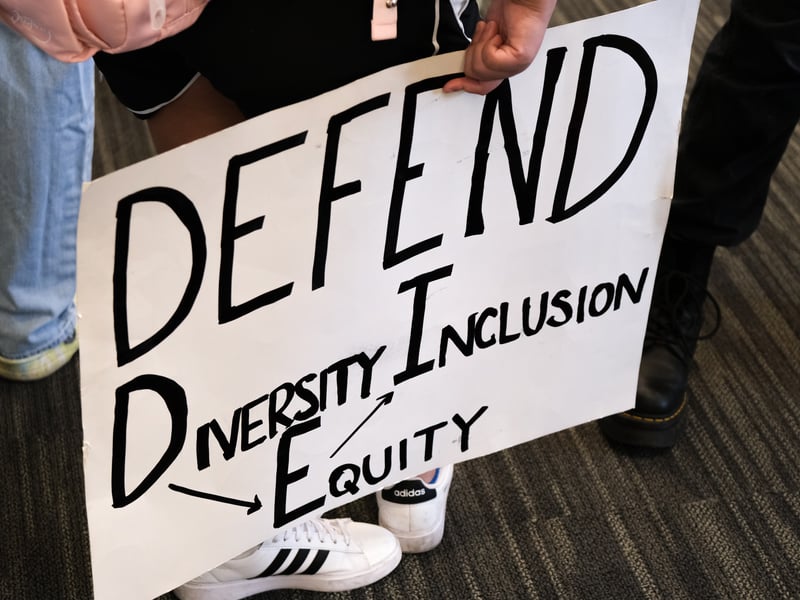
(CN) — A Fourth Circuit panel has overturned an injunction that had previously stalled President Donald Trump’s efforts to slash funding for diversity, equity and inclusion programs across the country.
In a 25-page opinion filed Friday, U.S. Chief Circuit Judge Albert Diaz, a Barack Obama appointee, said the plaintiffs had failed to establish that their free speech rights were violated by the president’s executive orders.
The orders do not regulate the private conduct of the grant recipients, which include institutions of higher learning and municipalities, and instead apply to the president’s cabinet, Diaz noted. And while recipients are required to certify compliance with federal anti-discrimination laws to receive funding, Diaz said that was a nonissue since the First Amendment does not confer a right to violate the law.
“President Trump has decided that equity isn’t a priority in his administration and so has directed his subordinates to terminate funding that supports equity-related projects to the maximum extent allowed by law,” Diaz wrote. “Whether that’s sound policy or not isn’t our call. We ask only whether the policy is unconstitutionally vague for funding recipients.”
In a separate concurring opinion, Diaz expressed concern about “programs terminated by keyword” and “valuable grants gutted in the dark.”
“For those disappointed by the outcome, I say this: Follow the law,” Diaz wrote. “Continue your critical work. Keep the faith. And depend on the Constitution, which remains a beacon amid the tumult.”
Calling DEI illegal and immoral, Trump issued two executive orders last January directing government officials to cut DEI programs from federal agencies while also canceling funding for similar initiatives in the private sector.
The orders directed Attorney General Pam Bondi to develop a plan to deter private sector DEI programs and to work with agencies to identify targets for “civil compliance investigations.”
Federal agencies responded to the order by canceling a slew of grants and contracts related to DEI, resulting a flurry of lawsuits as municipalities, nonprofits and universities have challenged the decisions.
Bondi has said the Department of Justice would investigate and penalize any “illegal” DEI programs. The Federal Communications Commission has likewise pressured private companies including Comcast and Disney to eliminate DEI programs and scrub related policies from their websites.
In February, the city of Baltimore challenged the executive orders in Maryland federal court. The city was joined by the American Association of University Professors and the National Association of Diversity Officers in Higher Education. A fourth plaintiff, Restaurant Opportunities Center United, ultimately withdrew its claims.
U.S. District Judge Adam B. Abelson, a Joe Biden appointee, granted a preliminary injunction in the case, finding the executive orders were unconstitutionally vague and infringed on the plaintiffs’ free speech rights.
In a 63-page opinion last year, Abelson wrote that the president failed to identify what “equity-related” grants or contracts should be terminated — leaving contractors and their employees alone to parse whether their work would be funded or not.
Further, the threat to initiate civil compliance investigations against anyone who promoted DEI principles unlawfully restricted protected speech, Abelson wrote.
That ruling teed off an appeal in the Fourth Circuit, where judges heard arguments in September.
Acting U.S. Assistant Attorney General Yaakov Roth said the president’s orders were simply about telling his subordinates within the executive branch what standard to use for awarding grants. Furthermore, he argued that grant recipients were not entitled to fair notice for the government’s funding decisions.
Attorney Aleshadye Getachew of the D.C.-based Democracy Forward Foundation argued the new certification requirements, combined with the FCC investigations and claims that DEI was “dangerous” or “immoral,” had a chilling effect on the speech of grant recipients.
With its ruling Friday, the Fourth Circuit panel has reversed that lower-court decision and sided with the government.
The appeals court cited the 1998 decision in National Endowment for the Arts v. Finley where the U.S. Supreme Court rejected a vagueness challenge to funding guidelines for the National Endowment for the Arts, finding that Congress enjoyed wide latitude when setting spending priorities that impact speech. Likewise, the court said president is granted wide latitude in defining what DEI initiatives he finds acceptable for funding in orders directed at his subordinates.
“Finley addressed Congress’s guidance to an independent agency about its funding decisions. But here, we’re reviewing the president’s directive to his subordinates about how they should allocate federal funding based on the president’s priorities,” Diaz wrote. “If the Supreme Court didn’t find vagueness concerns in the former, we’re hard-pressed to see how we could for the latter.”
U.S. Circuit Judge Allison Jones Rushing, a Trump appointee, wrote in a separate concurring opinion that she did not believe the certification requirement of the orders chilled the speech of the grant recipients. Nonetheless, she agreed the plaintiffs otherwise had standing to sue. Obama-appointed U.S. Circuit Judge Pamela A. Harris joined the majority opinion.
 Follow @SteveGarrisonPC
Subscribe to our free newsletters
Our weekly newsletter Closing Arguments offers the latest about ongoing trials, major litigation and rulings in courthouses around the U.S. and the world, while the monthly Under the Lights dishes the legal dirt from Hollywood, sports, Big Tech and the arts.