Search Articles


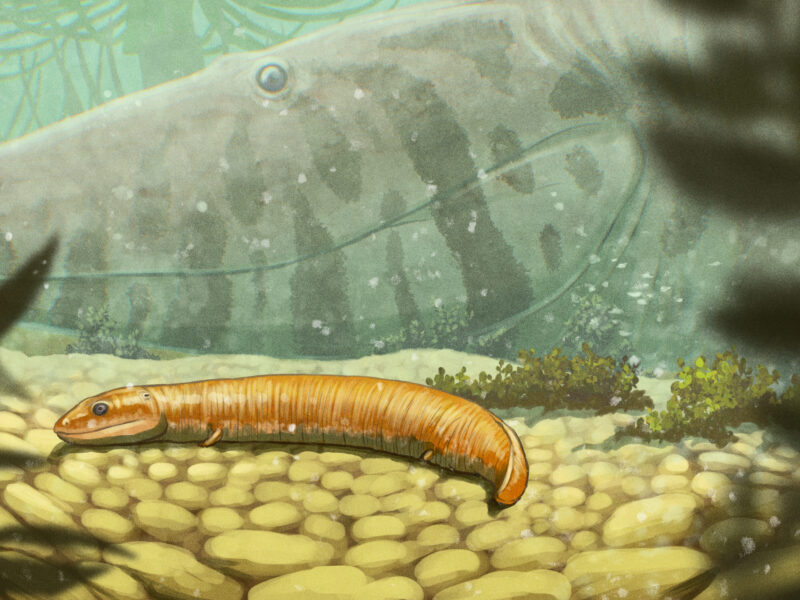
(CN) — New fossils from an Illinois site are forcing scientists to rewrite one of evolution’s biggest chapters: The first four-legged animals never went through a tadpole stage. They hatched from their eggs already looking like miniature adults and ready to feed, swim and survive.
For more than a century, paleontologists assumed the earliest tetrapods — the group that includes all amphibians, reptiles, birds and mammals — followed a life cycle similar to modern frogs and salamanders. That meant spending their early days as aquatic larvae with external gills before undergoing a dramatic metamorphosis into terrestrial adults. The idea seemed logical, as a larval stage would have allowed such animals to practice breathing air and moving on limbs gradually while still protected in water.
A study published Thursday in the journal Science shows that assumption was wrong. Researchers Jason D. Pardo of the Field Museum of Natural History in Chicago and Arjan Mann of the Lauer Foundation for Paleontology examined some of the best-preserved early post-hatching fossils ever found, from the Mazon Creek site about an hour south of Chicago.
They concluded direct development was the rule across the fin-to-limb transition. Such ancient animals hatched as functional mini versions of adults, with no evidence of a transient larval phase or the major tissue remodeling that defines amphibian metamorphosis.
The tiny specimens — including finned megalichthyids, snake-like aïstopods and early limbed embolomeres — show no trace of external gills. Many still carried yolk in their bellies, indicating they hatched with enough stored energy to start feeding almost immediately. Some even preserved gut contents. Their skulls and bones began hardening early, pointing to rapid, direct development straight into adult form.
“We looked at a number of different species that represent different lineages in the transition from fish to tetrapods, and what we found is that none of them have anything that looks remotely like a tadpole. And if you don’t have a tadpole, then you don’t have a metamorphosis,” Pardo said in a statement. “These early tetrapods’ life cycles are more like ours, or like those of fish, than they are like amphibians.”
The findings suggest the classic amphibian life cycle, with a dramatic larval-to-adult transformation, evolved much later, within the lineage leading to today’s amphibians. For the earliest tetrapods on both sides of the fin-to-limb transition, development was direct. They likely stayed in similar aquatic or semi-aquatic environments their entire lives.
“We were taught this simplified story of evolution: that some fish evolved into amphibians and some of those amphibians evolved into reptiles, and some of those reptiles evolved into mammals,” Pardo said. “And our study shows that this basic underlying premise, that the first four-legged vertebrates grew up like amphibians, is wrong.”
In contrast, the same Mazon Creek deposits contain early relatives of modern amphibians that do possess conspicuous external gills, exactly the structures missing from the stem tetrapods examined in the study. The research upends the long-held idea that metamorphosis played a starring role in helping vertebrates conquer land. Instead, it appears to have been a later adaptation tied to more fully terrestrial lifestyles.
“The story was that metamorphosis is the tool by which animals made the transition from fossil to land,” Pardo said. “That story doesn’t work anymore; it’s dust in the wind.”
 Follow @gabetynes
Subscribe to our free newsletters
Our weekly newsletter Closing Arguments offers the latest about ongoing trials, major litigation and rulings in courthouses around the U.S. and the world, while the monthly Under the Lights dishes the legal dirt from Hollywood, sports, Big Tech and the arts.