
 Search Articles


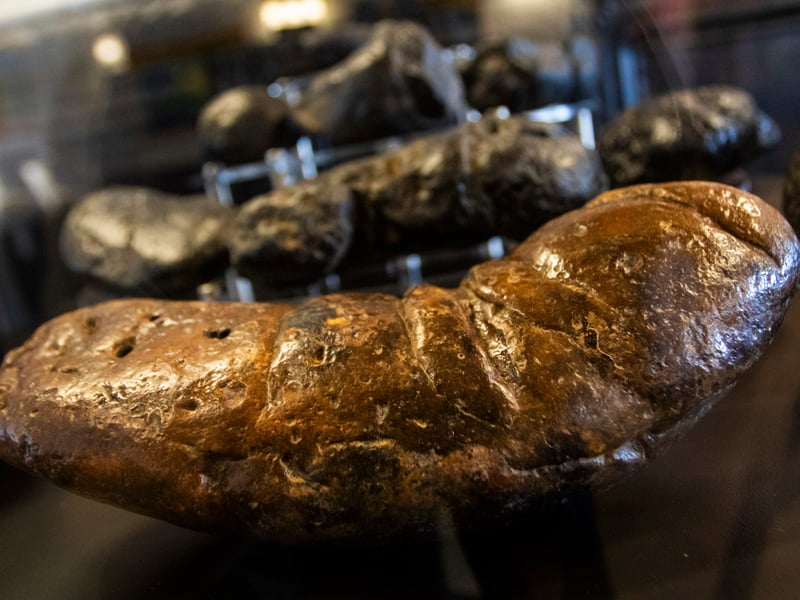
(CN) — Millions of years ago ancient reptiles, amphibians and mammals placidly occupied the top of Earth’s ecosystem until omnivorous dinosaurs usurped them. According to new research, the key to understanding why that revolution happened lies in analyzing the effects of a changing climate — and fossilized dinosaur poop from Poland.
By examining over 500 pieces of bromalites — the scientific term for fossilized vomit, feces and stomach and intestinal contents — from the Silesia and Holy Cross Mountains regions of Poland, researchers were able to reconstruct the eating patterns of early dinosaurs and the non-dinosaur tetrapods they shared the planet with in the Late Triassic to Early Jurassic periods.
What they found was not only larger pieces of bromalite over time, indicating how dinosaurs became larger, but also evidence that they had a more expansive, omnivorous diet, including burnt plants, than their non-dinosaur neighbors, according to the study published in Nature Wednesday.
“There were several surprises! For example, we discovered that the earliest dinosaurs had a diverse diet that included a significant amount of insects, among other things. A later theropod-like archosaur showed hyena-like behavior by chewing bones, even crushing its own teeth, which, along with the bones, ended up in its droppings,” Martin Qvarnström, a researcher in the Department of Organismal Biology; Evolution and Development at Uppsala University in Sweden, and the lead author of the study, said in an email.
Why does it matter that dinosaurs were less picky eaters than the species they shared the planet with? Because when the scientists compared their findings to existing research on the history of the climate and how it affected plant life, they found that the era of bromalites they analyzed were from a time of dramatic climate change and intense volcanic activity that turned modern-day Poland and Central Europe from seasonably arid to permanently humid.
That sea change led to a reconfiguration of the vegetation and food available. Dinosaurs, because of their omnivorous diet, were able to survive and thrive in those new conditions. Their non-dinosaur neighbors, who had a much more constricted diet, couldn’t adapt.
Over time, in the mid-late Rhaetian or the early Hettangian period, dinosaurs like sauropodomorphs and ornithischians took the spots of temnospondyl amphibians, procolophonid parareptiles, rhynchosaurs, phytosaurs and pseudosuchians on the top of ecosystems as non-dinosaurs became extinct.
Other scientists have in the past proposed a couple of different theories as to why dinosaurs took over the world millions of years ago. One theory suggested they simply outcompeted their non-dinosaur neighbors for food and resources, because they had more efficient physiologies. Another theory suggests dinosaurs took advantage of a diversity decline or total extinction of other life to rise to the top.
While it’s difficult to draw a one-to-one correlation between what impacts historical events had on the evolution of dinosaur diversity, the timing of the events suggests that there was some interplay between opportunism and anatomical differences that allowed herbivorous dinosaurs to adapt to environmental change, the researchers write in the study.
“Our results support the idea that stochastic processes coupled with a competitive advantage paved the way for the enormous evolutionary success of dinosaurs. In sum, the dinosaurs rose to supremacy in a stepwise fashion across 30 million years of evolution,” they add.
Although the study just analyzes fossils from a particular area of Poland, the researchers suggest that the process may explain global patterns of how dinosaurs came to dominance.
“I hope to test our proposed model in other regions with early dinosaur fossils,” Qvarnström wrote. “I have personally been studying dinosaur coprolites for a decade now, and I have no plans to stop anytime soon.”
Subscribe to our free newsletters
Our weekly newsletter Closing Arguments offers the latest about ongoing trials, major litigation and rulings in courthouses around the U.S. and the world, while the monthly Under the Lights dishes the legal dirt from Hollywood, sports, Big Tech and the arts.