
 Search Articles


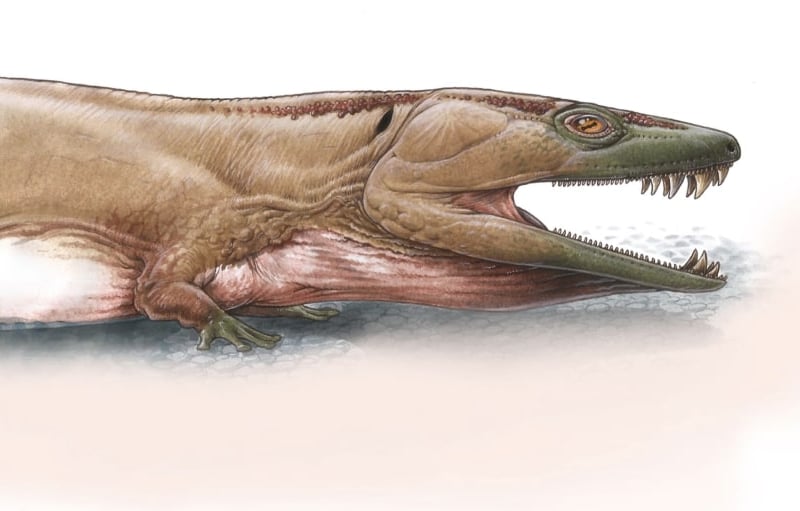
(CN) — A study published in Nature on Wednesday describes how scientists working deep in northwestern Namibia unearthed the bones of an archaic monster: Gaiasia jennaye, a large salamander-like animal.
With a basal skull length of about 60 centimeters, or 23.6 feet, the Gaiasia jennaye is the largest tetrapod — a four-limbed land vertebrate, like amphibians, reptiles, birds, and mammals — known at present.
Researchers say that the beast was an apex predator, or an animal at the top of its food chain without any natural predators or threats of its own.
“First of all it’s big,” said Claudia A. Marsicano, a professor of geology at the University of Buenos Aires, and one of the authors of the study. Gaiasia jennaye is twice the size of other tetrapods.
It’s also from a time when researchers thought similar tetrapods were already extinct, and, “it comes from an area where no one was supposed to find a basal tetrapod,” she added.
The modern southern African country of Namibia, situated between two large deserts, the Namib and the Kalahari, is not exactly known for its cool temperatures now, but back some 280 million years ago during the Permian period that area was a high latitude cold-temperate part of the Gondwana supercontinent.
Most of the fossil record for early tetrapods comes from coal-producing ancient equatorial wetland areas in what’s now Europe and North America, so finding an old tetrapod in an area that was colder and at a higher altitude “changes this scenario,” the researchers write in their study. It also fills a gap in the fossil record that point towards early tetrapods being more widely distributed than previously imagined.
“We expect more exhaustive sampling of southern high-latitude temperate zone faunas across the Carboniferous–Permian transition, of which Gaiasia is a part, to reveal previously unrecognized spatial and temporal patterns of tetrapod palaeodiversity across the supercontinent at the end of the great late Palaeozoic Gondwanan glaciation,” the researchers write in the study.
In modern Namibia, researchers found four incomplete fossils of Gaiasia jennaye.
Marsicano described the area where an international team of researchers worked as an environmentally protected area in the middle of nowhere, without any water, but brimming with fossils.
“It’s a very promising place that really, really, needs years of work,” she said.
It took years and serious effort to find and properly study the Gaiasia jennaye fossils, Marsicano said. With the publication of this study, she wants to show the world “how important it is to do field work.”
Subscribe to our free newsletters
Our weekly newsletter Closing Arguments offers the latest about ongoing trials, major litigation and rulings in courthouses around the U.S. and the world, while the monthly Under the Lights dishes the legal dirt from Hollywood, sports, Big Tech and the arts.