
 Search Articles


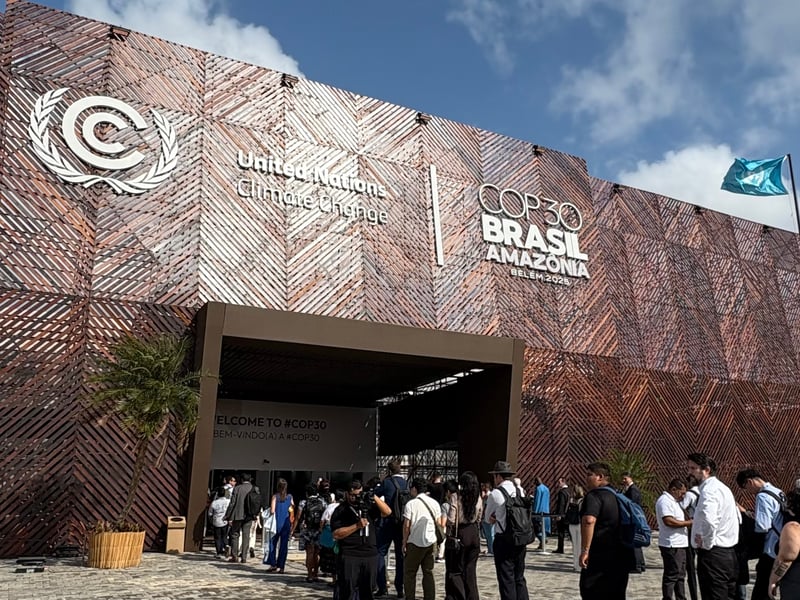
RIO DE JANEIRO (CN) — The COP30 presidency on Tuesday released a first draft that is expected to guide the final agreement of the U.N. Climate Summit in Brazil, due on Nov. 21.
The release came on the same day more than 80 countries pushed for the conference to adopt a formal mandate to craft a roadmap for phasing out fossil fuels — a proposal introduced by Brazil’s President Luiz Inácio Lula da Silva in his opening speech.
André Corrêa do Lago, Brazil’s diplomat and president of COP30, said during a news briefing that Tuesday was dedicated to receiving “inputs from the delegations.”
“We have the two categories, basically either very favorable and some very negative,” he said.
Marcio Astrini, executive secretary of Brazil’s Climate Observatory, said the countries backing the idea “want to see how and whether this roadmap can enter the formal texts in any way.”
“The countries that met today want to adopt the idea launched by President Lula on the first day — already repeated at the leaders’ summit — of leaving here with at least a mandate for the roadmap,” he said.
Astrini said the draft presented by Brazil does not establish such a mandate. The current formulation only encourages countries to progressively reduce their dependence on fossil fuels, without any binding language.
Corrêa do Lago said part of the friction at the conference stems from different interpretations of what must be included in consensus documents and what can already be implemented based on previous decisions.
He said it is not necessary to negotiate more texts to move forward with actions already agreed upon and that this difference in approach often divides countries.
Corrêa do Lago stressed that the energy transition requires solutions tailored to each national context and said Brazil has begun its own internal assessment of the economic and social impacts of phasing out fossil fuels across different regions. He said developed countries must lead the way and that the debate over a just transition is central to this summit.
Ciro Brito, a lawyer and senior climate policy analyst at Brazil’s Socio-Environmental Institute, said there has been no meaningful discussion on energy transition since the Dubai COP in 2023.
“This is the major issue we need to address because it is the driver of climate change,” he said.
Brito said repeating that countries should move away from fossil fuels and expand so-called clean alternatives — without defining when or how this should happen — does not guarantee real progress.
He said each country would need to produce its own roadmap if the dedicated energy transition declaration — expected Wednesday — is confirmed. In his view, this could become the main political outcome of the conference.
Finance appears in the draft as another sensitive point.
The COP presidency proposes that developed countries triple adaptation support by 2030 compared with 2025 levels and suggests creating an annual Belém Dialogue to track progress. On overall climate finance, the draft calls on all actors to work toward ensuring that developing countries receive “at least $1.3 trillion per year by 2035.”
The document again presses for clarity regarding the long-standing $100 billion annual goal. More than one option appears in the draft: one suggests the goal has been met; another says it has not and points to the absence of a common methodology for counting contributions.
The draft includes subtle messages aimed at tariff policies imposed by Trump’s administration, with passages defending multilateralism and criticizing failures to honor agreements.
Despite progress in some areas, the document leaves much of its content open. Multiple alternative formulations appear across issues such as finance, fossil fuels, energy targets and trade rules, signaling that the conference has yet to reach consensus.
Brazil’s proposal attempts to tie together the core pillars of the Paris Agreement. It “resolves to join efforts in a mutirão global against climate change,” calling on governments and other actors to “significantly accelerate and scale up climate action” during this decade. The Portuguese word “mutirão”, of Tupi origin, refers to collective work and has become a recurring expression at this year’s conference.
Harjeet Singh, an activist with India’s Satat Sampada Climate Foundation, said the draft “fundamentally weakens the commitment to equity and common but differentiated responsibilities,” shifting the weight of climate action onto developing countries already facing energy poverty and debt crises.
Singh argued that it fails to require wealthy nations to meet their legal public finance obligations, elevates markets and concessional loans, undermines the proposal to triple adaptation funding by placing highly concessional finance on par with grants and uses weak language on fossil fuels by referring only to “inefficient” subsidies.
For him, replacing concrete commitments with more roundtables and dialogues risks producing a political outcome incapable of keeping the 1.5 degrees Celsius goal within reach.
Despite the split views, the draft reaffirms key principles in its opening paragraph, recognizing that “climate change is a common concern of humankind” and stating that climate policies must respect human rights, Indigenous rights, gender equality and the protection of vulnerable groups.
It also stresses that impacts will be “significantly lower” if global warming is limited to 1.5 degrees Celsius instead of 2 degrees Celsius.
Ambassador Liliam Chagas, Brazil’s chief climate negotiator, said many delegations were surprised to receive a draft so early, noting that such proposals typically appear only at the end of the conference.
She said the acceleration was intentional: The presidency asked countries to work in task-force mode to speed up the process.
Chagas said the “mutirão” decision is expected to be voted on Wednesday as part of a package that includes adaptation indicators, the mitigation work program and the technology implementation program.
“If we approve the mutirão decision, the whole package goes through. If it’s not possible, we still have time to finalize everything,” she said.
Subscribe to our free newsletters
Our weekly newsletter Closing Arguments offers the latest about ongoing trials, major litigation and rulings in courthouses around the U.S. and the world, while the monthly Under the Lights dishes the legal dirt from Hollywood, sports, Big Tech and the arts.