
 Search Articles


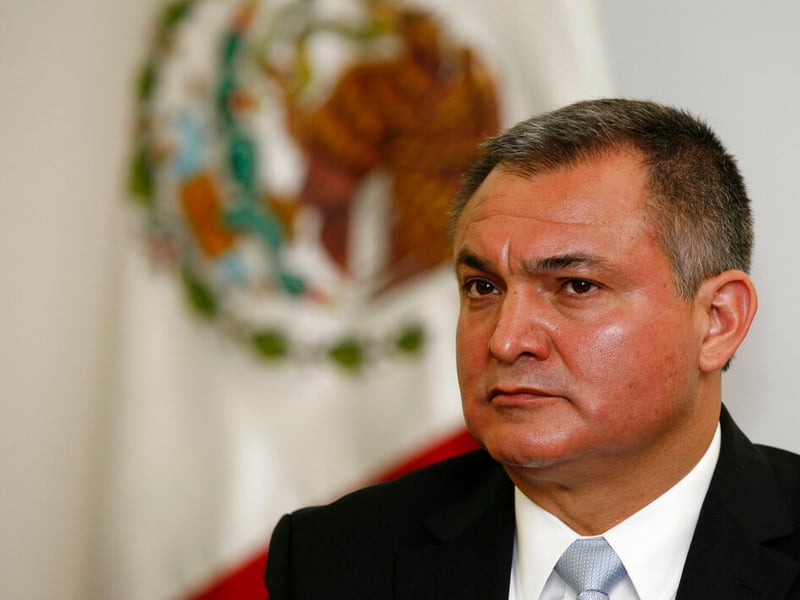
BROOKLYN (CN) — Mexico’s former secretary of public security was sentenced to 38 years in prison Wednesday for accepting millions of dollars in bribes for helping the violent Sinaloa drug cartel push thousands of tons of cocaine into the United States.
Last year, a Brooklyn jury found Genaro García Luna had engaged in a continuing criminal enterprise, conspired to possess and distribute cocaine and made false statements to the U.S. government, delivering a guilty verdict on all counts against the ex-official.
“The offense here is so overwhelming that it does suggest a real need to send a message to public officials, particularly those who are enablers of this level of criminal activity,” U.S. District Judge Brian M. Cogan said Wednesday.
García Luna, 56, lost his bid for a new trial in August after Cogan found he tried to bribe fellow inmates into giving false testimony.
Prosecutors say the top public safety official offered other inmates at the Metropolitan Detention Center as much as $2 million to make false statements to the government, and asked one inmate to persuade another to say he’d overheard a phone conversation involving a government witness about creating a false claim of having bribed García Luna.
“One such inmate supplied recorded conversations and contemporaneous notes to the government of his meetings with the defendant, which reveal explicit instructions from the defendant to others to concoct false allegations,” prosecutors said in their sentencing memo.
García Luna maintained his innocence at sentencing and urged Cogan, a George W. Bush appointee, to grant him a lesser sentence, seeking to “return as soon as possible to my family and rejoin the beloved society to which I respect and belong.”
“I have not committed any of these crimes,” García Luna said.
In a letter filed prior to sentencing, he said he has always “repudiated and rejected” drug use and trafficking.
“When I had the responsibility of combating drug trafficking, I was relentless against the criminals who produce them, they traffic and profit from it,” García Luna wrote in his letter to the judge. “I have never used drugs, I don’t have any vices.”
García Luna also pointed to his contributions to the Metropolitan Detention Center as an inmate, saying it’s been “a reflection of my life.” He has become a GED instructor with the Education Department and leads drug prevention programs that seek motivate inmates to seek treatment while incarcerated.
“It’s extraordinary how he’s gained the trust of the facility,” Cesar De Castro, García Luna’s attorney, said Wednesday.
But Saritha Komatireddy, an assistant U.S. attorney, said García Luna’s contributions at the detention center only reflected his “double life.”
She added that he had every chance to eliminate the cartel’s activity but “he chose to ally with them instead.”
Cogan agreed.
“Aside from your very pleasant demeanor and your articulateness, you have the same kind of thuggish-ness as El Chapo,” Cogan said. “It just manifests itself in a different way.”
During a monthlong trial in early 2023, cooperating witnesses who worked for the billion-dollar cartel said they paid off law enforcement officials from the local to federal levels in exchange for information about the upcoming raids, free access to sea and airports and to carry out investigations against rivals. Some also said they attended meetings in which briefcases and duffel bags stuffed with cash were paid to García Luna, whose cabinet position put him at the head of Mexico’s federal police force.
The group even recorded million-dollar payments to Mexico’s security chief in its ledgers, said one accountant for the cartel once led by infamous kingpin Joaquín “El Chapo” Guzmán.
In return, prosecutors say García Luna provided intelligence about the investigations against the cartel, information about rival cartels and safe passage of massive quantities of drugs. He also provided federal police uniforms, federal police badges, cars bearing federal police insignia and police bodyguards for protection.
“In exchange for millions of dollars, the defendant furthered a conspiracy responsible for the deaths of thousands of American and Mexican citizens,” prosecutors wrote. “It is difficult to overstate the magnitude of the defendant’s crimes, the deaths and addiction he facilitated, and his betrayal of the people of Mexico and the United States.”
While García Luna’s was in power from 2001 to 2012, about 62,000 Americans died from cocaine-related overdoses, and cartel-related violence resulted in roughly 60,000 killings in Mexico, the government said.
In addition to his other crimes, prosecutors say García Luna lied to the U.S. government on his naturalization application when he claimed he never committed a crime, arguing that his active involvement in the Sinaloa cartel and his assistance in importing massive quantities of drugs into the United States demonstrates that was a lie.
García Luna was also ordered to pay $2.5 million to the Mexican government by a Florida judge as a result of a civil lawsuit that accused the former public security leader of stealing $250 million from the Mexican government and laundering money through bank accounts in Barbados and the United States — including through the purchase of real estate in Miami-Dade County, Florida.
The ex-official isn’t the only person with ties to the Sinaloa cartel facing criminal charges in Brooklyn. In September, Ismael “El Mayo” Zambada García pleaded not guilty to charges of drug manufacturing and distribution, in addition to engaging in a continuing criminal enterprise.
Zambada co-founded the cartel with El Chapo and was paramount in building it to be one of the largest drug trafficking organizations in the world. He’s slated to appear in court Friday for a status conference in his case.
 Follow @NikaSchoonover
Subscribe to our free newsletters
Our weekly newsletter Closing Arguments offers the latest about ongoing trials, major litigation and rulings in courthouses around the U.S. and the world, while the monthly Under the Lights dishes the legal dirt from Hollywood, sports, Big Tech and the arts.