
 Search Articles


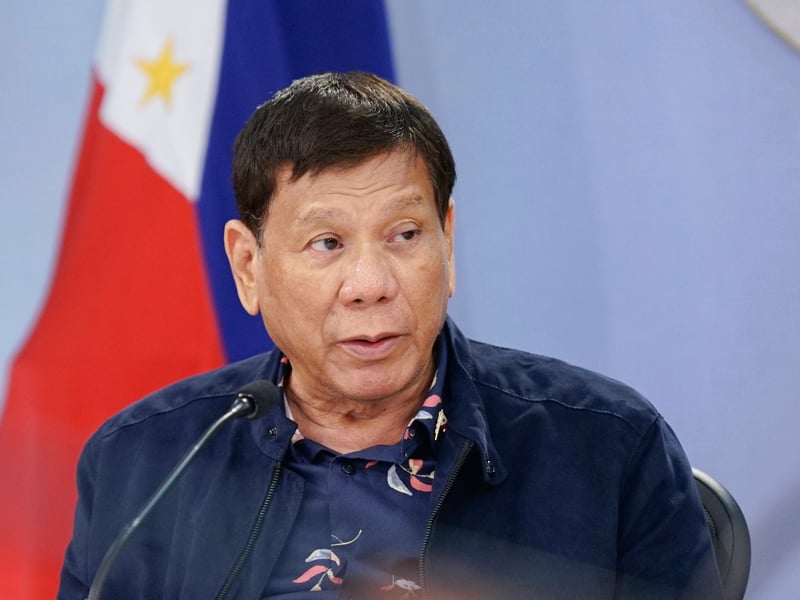
THE HAGUE, Netherlands (CN) — Former Philippine President Rodrigo Duterte won’t appear in court next week after judges at the International Criminal Court agreed Friday to let him skip his confirmation hearing on charges of crimes against humanity .
At this stage, judges are not deciding guilt. The hearing is meant to determine whether prosecutors have presented enough evidence to justify sending the case to trial. Duterte is charged with three counts of crimes against humanity, involving at least 76 murders between 2013 and 2018.
Duterte, now 80, led the Philippines from 2016 to 2022 after years as mayor of Davao City, where he built his reputation on tough anticrime policies and blunt, combative speeches. He carried that image into the presidency, promising a sweeping, ruthless war on drugs.
The crackdown left thousands dead in police operations and vigilante-style killings, many of them in poor urban neighborhoods. Human rights groups and United Nations experts have described the campaign as a systematic attack on civilians, arguing authorities either enabled the violence or failed to rein it in.
Attendance at the confirmation of charges hearing is normally expected. But the court’s rules allow a suspect to step aside, as long as the decision is informed and voluntary. The judges found that Duterte knowingly made that choice.
Duterte filed a signed request earlier this week formalizing that decision. In it, he wrote: “I understand the consequences of my waiving this right which has been thoroughly explained to me by my counsel and I trust him and his team to challenge the sufficiency of the prosecution’s evidence on my behalf.”
After reviewing the filing, judges concluded that “in the present circumstances of the case, it is appropriate to proceed with the hearing on the confirmation of charges in the absence of Mr. Duterte.”
In his submission, he rejected the court’s authority, described his transfer to The Hague as a kidnapping, and dismissed the accusations against him as politically motivated lies. He wrote he did “not wish to attend legal proceedings that I will forget within minutes,” calling himself “old, tired and frail.”
Prosecutors opposed the move, arguing Duterte is “available, fit and should attend the hearing in person,” and insisting there was “no reasonable cause for Mr. Duterte not to appear in person in court at the confirmation hearing.” They said his health had already been examined by independent experts and there was no medical barrier to his appearance.
The chamber ultimately granted the waiver, pushing the case into its next phase.
Duterte’s lead defense counsel, Nicholas Kaufman, welcomed the decision.
“Despite the desire of the prosecution and the legal representatives to force the former president into court, the judges ruled that granting the waiver was procedurally appropriate,” Kaufman said.
The Office of the Prosecutor offered a brief response, saying it “respects the decision of the chamber.”
The International Criminal Court, established in 2002, serves as a court of last resort for war crimes, crimes against humanity and genocide, stepping in when national governments are unwilling or unable to prosecute those responsible. Israel, Russia, China and the United States are not members of the court.
In 2021, amid mounting international criticism, the court opened an investigation after concluding Philippine authorities were not genuinely pursuing accountability.
Judges later allowed the probe to move forward, and in March 2025 they issued an arrest warrant. Duterte was transferred to The Hague days later and has remained in detention since.
After his transfer, his health became a point of contention. Defense lawyers pointed to his age and medical condition, arguing he should not be required to appear in court. In January 2026, after reviewing medical reports and submissions from both sides, the chamber ruled Duterte is physically and mentally fit to participate in the proceedings.
Joel Butuyan, Gilbert Andres and Paolina Massidda, legal representatives of victims in the Duterte case, said the developments matter for those who have long waited for accountability.
“For years, victims and their families have carried the weight of immense loss, fear and silence,” the representatives said. “The confirmation of charges hearing is a significant step for the victims in their pursuit of justice.”
Citing the judges’ earlier finding that Duterte is able to participate, they underscored what they called “a simple truth: No individual, regardless of power or position, is beyond the reach of the law.”
The confirmation hearing is now set to begin Monday before the pre-trial judges, who will decide whether the case advances to a full trial.
Meanwhile in Manila, the political fallout continues. His daughter, Vice President Sara Duterte, announced this week she plans to run for president in 2028, even as she faces renewed impeachment efforts and corruption issues at home. She has blamed President Ferdinand Marcos Jr. for her father’s detention. The former running mates are now on opposite sides of a widening political divide.
Courthouse News reporter Eunseo Hong is based in the Netherlands.
Subscribe to our free newsletters
Our weekly newsletter Closing Arguments offers the latest about ongoing trials, major litigation and rulings in courthouses around the U.S. and the world, while the monthly Under the Lights dishes the legal dirt from Hollywood, sports, Big Tech and the arts.