
 Search Articles


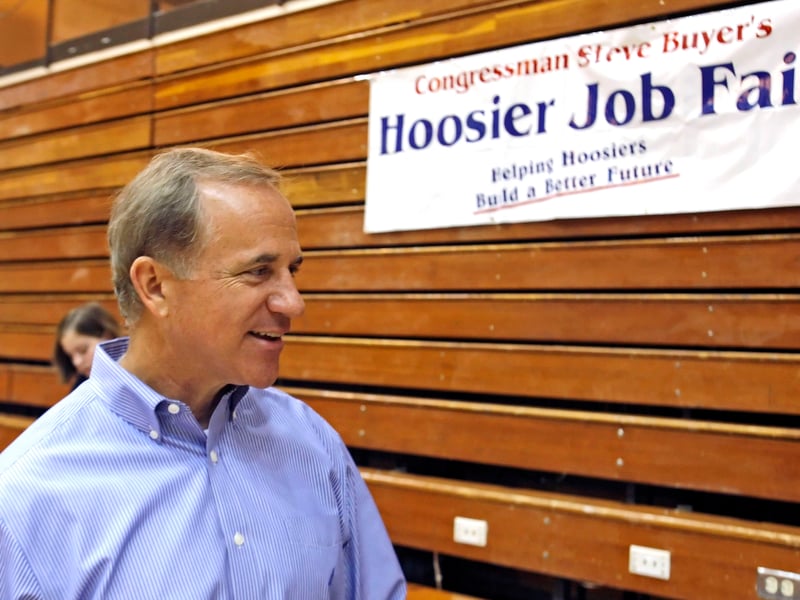
MANHATTAN (CN) — A federal appeals court on Wednesday upheld the insider trading conviction of Stephen Buyer, a former U.S. representative for Indiana’s 4th Congressional District who was convicted over profiting $350,000 from illegal telecommunication stock purchases based on inside information after he left office.
A three-judge panel for the Second Circuit court of appeals rejected Buyer’s appeal of his conviction, ruling in a summary order that he failed to timely object to the admission of challenged evidence and thus did not preserve his objections for appeal.
Federal prosecutors and regulators said Buyer, while working as a consultant and lobbyist, bought shares of Sprint stock after a T-Mobile executive told him during a golf outing about the company’s then-non-public plan to acquire Sprint in $26.5 merger.
Jurors in Manhattan convicted him on four counts of securities fraud for misusing non-public consulting client information for insider trades. He was sentenced in September 2023 to 22 months in prison.
Buyer’s indictment also included charges for a separate scheme involving illegal trades with Navigant Consulting when his client Guidehouse was set to acquire it in a publicly disclosed deal weeks later.
Buyer, a House Republican from 1993 to 2011, was ordered to forfeit $354,027, representing the amount of illegal gains, and to pay a $10,000 fine.
On appeal before the Second Circuit, Buyer argued that his conviction was the result of trial testimony that should have been excluded, like that of Jessica Volchko, an FBI digital forensic examiner who testified about a forensic analysis on a cellphone that belonged to Christopher Stansbury, the sales director at Guidehouse and Buyer’s main contact at the government consulting firm.
The appeals panel was not persuaded to overturn the conviction.
“Combined with Buyer’s incriminating message to Stansbury after he was interviewed as part of Guidehouse’s internal investigation of merger-related insider trading, and the testimony of Buyer’s business partner regarding statements Stansbury made at a dinner on June 19, 2019, ww conclude that the evidence offered exclusively through Volchko’s testimony ‘was unimportant in relation to everything else the jury considered on the issue in question’,” they wrote in their summary order.
“Accordingly, we conclude that any error in the district court’s admission of Volchko’s testimony is harmless.”
The Second Circuit also rejected Buyer’s appeal that the Southern District of New York was the improper venue to try his case.
“We conclude that this evidence is sufficient to establish by a preponderance of the evidence that Buyer’s fraudulent trades were ‘continued’ or ‘completed’ in SDNY, and affirm the district court’s conclusion that SDNY was a proper venue for Buyer’s criminal trial,” they wrote.
The panel was made up by U.S. Circuit Judge Guido Calabresi, a Bill Clinton appointee; U.S. Circuit Judge Dennis Jacobs, a George H.W. Bush appointee; and U.S. Circuit Judge Debra A. Livingston, a George W. Bush appointee.
When Buyer testified in March 2023, he provided false explanations for his trades. During sentencing, U.S. District Judge Richard M. Berman found Buyer’s statements to constitute an obstruction of justice.
During his stint in Congress from 1993 through 2011, Buyer represented parts of central Indiana and served on committees with oversight of the telecommunications industry.
 Follow @jruss_jruss
Subscribe to our free newsletters
Our weekly newsletter Closing Arguments offers the latest about ongoing trials, major litigation and rulings in courthouses around the U.S. and the world, while the monthly Under the Lights dishes the legal dirt from Hollywood, sports, Big Tech and the arts.