
 Search Articles


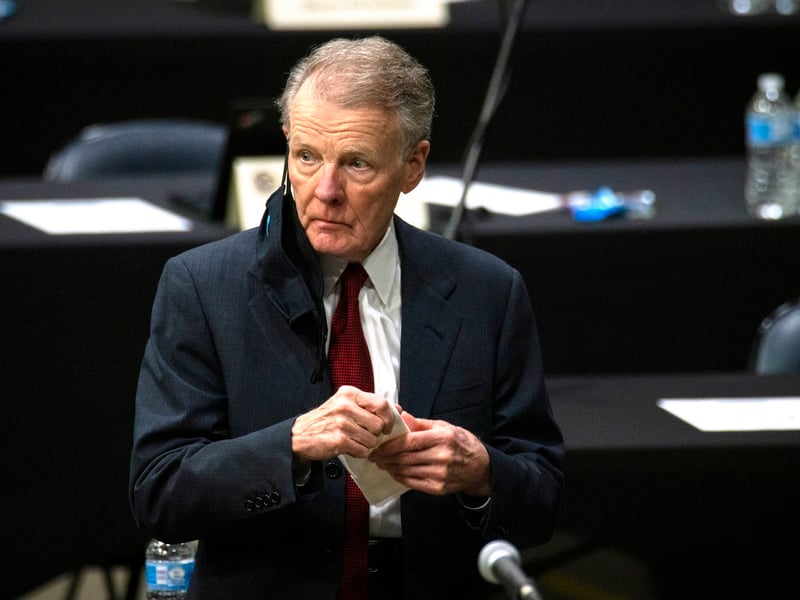
CHICAGO (CN) — Ex-Illinois House Speaker Mike Madigan took the stand in his own federal corruption trial on Tuesday. The surprise move came in the middle of Madigan’s defense case, and upturned estimates of when jurors might begin deliberations.
Several family members attended Madigan’s testimony, including his daughter, Lisa Madigan, who once served as Illinois’ attorney general. Before he took the stand, the family gathered for a meal in the federal courthouse cafeteria.
It can be risky for criminal defendants to testify in their own defense, as, among other concerns, it opens them up to cross-examination under oath. Madigan nevertheless told the court he understood his right to testify and his duty to testify honestly. He took the stand despite the risks involved with waiving one’s Fifth Amendment rights.
As to those risks, there was some ambiguity about whether Madigan could testify in this trial and retain his right not to testify in the forfeiture proceedings that would follow a guilty verdict. U.S. District Judge Robert Blakey provisionally decided he could, after hearing arguments on the issue from prosecutors and defense attorneys, despite a dearth of relevant case law.
Before placing Madigan under oath, the judge told attorneys he was “pushing the pause button on the bench trial,” referring to those potential forfeiture proceedings.
The former speaker’s testimony began with a biography. He recounted his childhood on Chicago’s south side, his early years in state politics, and how he started a family. He claimed his relationship with his “adamant” pro-union and short-tempered father impacted his personal politics and his approach to political work.
“Avoid conflict. Avoid confrontation. That carried over to my years in the legislature,” Madigan told jurors.
From there, Madigan’s attorney Dan Collins began addressing the content of the 23 counts of bribery, fraud, racketeering and conspiracy on which the government indicted him in March 2022. One of the prosecution’s overarching accusations against Madigan was that he spent years as a political kingpin in Chicago and Springfield; the head of the so-called “Madigan Enterprise” which exerted major influence over state politics.
Prosecutors also claim Madigan, through his network, had employers like AT&T Illinois and energy company ComEd arrange jobs and contracts for his associates — like former state Representative Eddie Acevedo, former Chicago 13th Ward political worker Ed Moody and former 13th Ward Alderman Frank Olivo, among others — in exchange for his office’s favor in the Illinois Legislature between 2011 and 2019.
Guided by Collins, Madigan repeatedly denied that accusation. The former speaker didn’t deny that he tried to help his allies find work, or that between 2011 and 2019 he made job recommendations to employers. But he insisted his recommendations were just that: recommendations.
“Throughout your career in politics did people ask you for help?” Collins asked early in Madigan’s testimony.
“Yes,” Madigan responded.
Collins followed up by asking Madigan, if he ever traded his public office for private gain.
“No,” the former speaker said.
Madigan also brought up the involvement of his codefendant Mike McClain, who, besides being a longtime Madigan ally, spent years working as a ComEd contract lobbyist in Springfield. McClain was one of the “ComEd Four” whom federal jurors convicted in May 2023 for their roles in facilitating ComEd’s admitted efforts to influence Illinois legislators between 2011 and 2019 — efforts that prosecutors say revolved around Madigan.
The former speaker told jurors on at least two occasions that when individuals approached him for help finding work between 2011 and 2019, he passed their names to McClain. Madigan added he was surprised to learn — as part of this case — that AT&T Illinois set up an apparent do-nothing contractor job for Eddie Acevedo.
Previously in the trial, jurors saw evidence that McClain sent AT&T lobbyist Robert Barry one email on Valentine’s Day 2017 asking if there was “even a small contract for Eddie Acevedo.”
Earlier in the day, Madigan directly contradicted one bit of testimony that Ed Moody gave in November. Moody told jurors, while on the stand for the prosecution, that he ran into Madigan while canvassing around the speaker’s house in Chicago’s 13th Ward ahead of the 2018 elections. During that encounter, Moody said he expressed concern to the speaker that he wasn’t doing much actual work for John Bradley, the ex-Illinois state representative whose law firm purportedly subcontracted Moody on behalf of ComEd.
“What you’re doing right now is what I want, what he wants, what ComEd wants,” Moody said Madigan told him in response.
On the stand himself, Madigan flatly denied this exchange ever took place.
“Did you have that conversation?” Collins asked Madigan.
“No,” Madigan responded.
Madigan’s testimony is set to continue Wednesday, with Collins predicting he could be done with Madigan’s direct examination by “late morning.” The speaker’s testimony nevertheless throws a wrench into the schedule of a thus far 12-week trial that otherwise appeared to be nearing its end. Prosecutors rested their case in chief against Madigan in December; attorneys for Madigan’s codefendant and longtime ally Mike McClain also rested last month.
Madigan’s own defense team had already questioned seven witnesses before Madigan took the stand, and as late as Monday the court estimated closing arguments could begin as early as next week. With the government’s possible rebuttal case considered, Blakey estimated Tuesday afternoon that jurors won’t begin deliberations until the last week of January.
 Follow @djbyrnes1
Subscribe to our free newsletters
Our weekly newsletter Closing Arguments offers the latest about ongoing trials, major litigation and rulings in courthouses around the U.S. and the world, while the monthly Under the Lights dishes the legal dirt from Hollywood, sports, Big Tech and the arts.