
 Search Articles



PARIS (CN) — Former French President Nicolas Sarkozy and his ex-campaign manager Claude Guéant continued Wednesday to dispute the details of their dealings with former autocratic Libyan leader Moammar Gadhafi’s inner circle.
“I’m not saying he’s lying, I’m saying his memory has changed,” Sarkozy exclaimed in a hot courtroom Wednesday morning. Guéant, who also served as interior minister, gave statements to the court that have contradicted the Sarkozy’s version of events point by point.
The highly publicized falling-out has not only weakened Sarkozy’s defense, which has hinged on his insistence that Guéant acted completely independently of his former boss — a scenario that experts deem improbable. The feud could also damage his image in the public sphere.
“I wouldn’t want to be Sarkozy … He’s really in a fine mess — or rather, in deep trouble,” said Gilbert Casasus, a political scientist and professor of European Studies at the University of Fribourg. “For me, it is Sarkozy-ism that is collapsing.”
Roughly six months ago, both men were found guilty of criminal conspiracy in what has been nicknamed a “corruption pact” linked to the financing of Sarkozy’s successful 2007 presidential campaign. Prosecutors say Guéant helped funnel roughly $58 million from Gadhafi into the campaign in exchange for diplomatic leverage.
According to prosecutors, Gadhafi himself told media outlets that he funneled the millions into Sarkozy’s campaign. Other Libyan officials, including Gadhafi’s son and a prime minister, made similar statements.
The money was never found, but corroborating testimony was enough to convict the pair and six others involved in the case. Sarkozy maintains his innocence — in the morning, he threw his arms in the air and looked incredulously around the room, insisting that “not one cent” of money went into his campaign.
“You can do whatever you want, you can put your feet up against the wall, there is no Libyan funding,” Sarkozy added later in the day.
The conviction sent Sarkozy to prison, marking the first time a French head of state was incarcerated. He was released 20 days into his five-year sentence, ordered to pay roughly $120,000 and banned from public office for five years.
In addition to criminal conspiracy, Guéant was found guilty of corruption, passive influence peddling, forgery and use of forged documents. He was sentenced to six years in prison and a roughly $35,000 fine.
Now, both are appealing the charges in a trial set to run through June 3.
But Sarkozy’s defense strategy has taken a notably different turn from the original trial, where he framed himself as the victim of a political witch hunt. This time, he has been shifting blame onto his former associates, and Guéant — who is not attending the trial for health reasons — has been fighting back in statements issued to the court on April 11 and 26.
“Nicolas Sarkozy denies having known me before 2002,” he wrote bluntly in the most recent address, questioning the ex-president’s timeline of events. “I must say that, despite his exceptional memory (he readily describes himself as hypermnesic), Nicolas Sarkozy is mistaken. We met before 2002. He knew me.”
Abdullah Senoussi, Gadhafi’s former brother-in-law and No. 2 — the mastermind behind a 1989 plane bombing that killed 54 French citizens — has been a recurring figure in Sarkozy’s case. In his April 26 statement, Guéant says his former boss asked him to look into Gadhafi’s request to have Senoussi’s international arrest warrant lifted, which could have been a condition of the corruption pact.
“I maintain that Nicolas Sarkozy called me to hear the concern Gaddafi had just expressed to him, namely his desire to see Senoussi’s arrest warrant lifted,” Guéant wrote in the second letter. “And it was at that moment that he said to me: ‘Claude, look into this.’ I have a very clear memory of the scene.”
Guéant added there were never any steps taken to lift the warrant.
“First, I confirm what Mr. Guéant says; neither he nor I ever did anything for Senoussi, neither he nor I ever gave the Libyans the impression that we were going to do anything for Senoussi,” Sarkozy said on Wednesday morning, when head Judge Olivier Géron questioned him over the statements.
He said he has been fighting against these “implausible accusations” for 10 years. He continued by expressing sympathy for Guéant’s condition.
“Personally, it saddens me that Claude Guéant can’t be here because of his fragile health,” he said. “It saddens me that he’s suffering from a situation where his health is being called into question.”
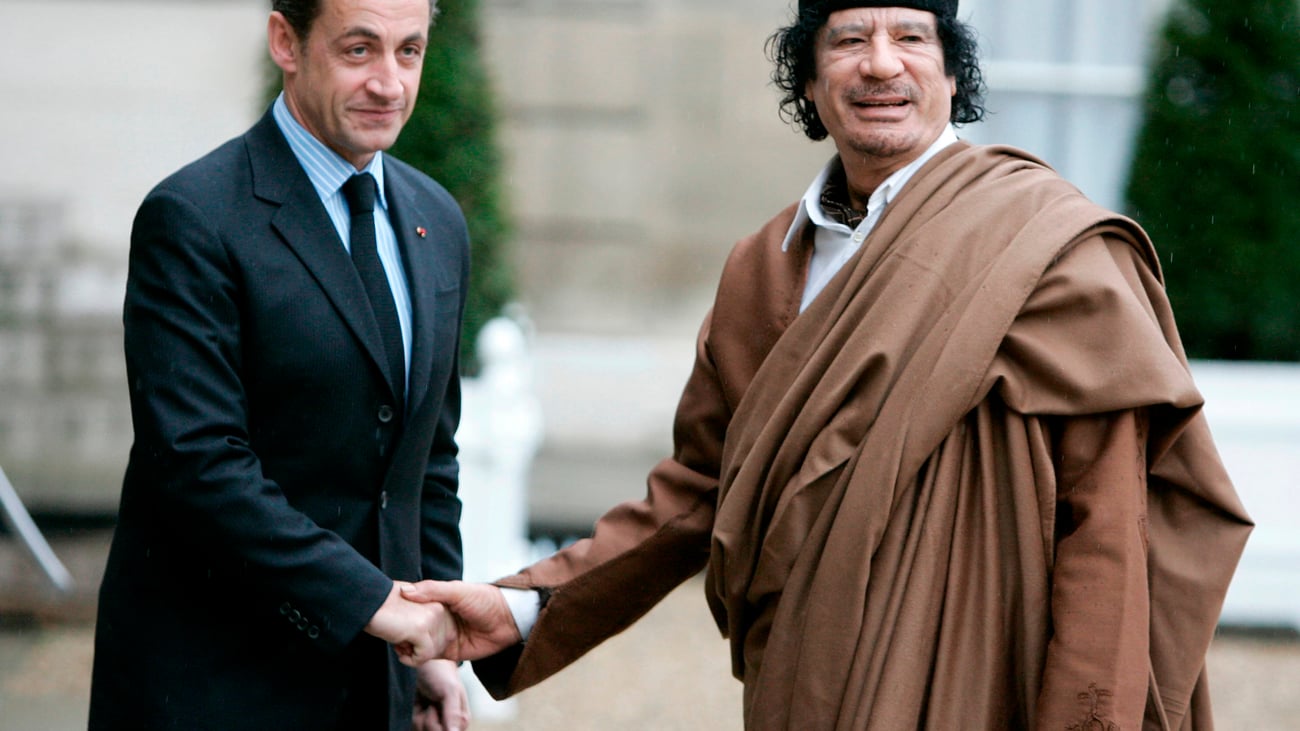
For Pierre Allorant, a historian and political scientist at the University of Orléans, this clash will be the main takeaway from the appeal as a whole.
“I find it truly fascinating because there is a sense of wounded pride, perhaps a betrayal of friendship — or at least a breach of trust,” he said. “Given that Nicolas Sarkozy had shifted the blame onto him, as well as onto his childhood friend [and co-defendant] Brice Hortefeux, by claiming he himself was not involved and that his staff had erred by taking their own initiatives, which was hardly plausible.”
In Allorant’s view, the tactic will complicate any chances of a reduced sentence, since the written testimonies have “methodically and systematically destroyed Sarkozy’s arguments.” He thinks judges could believe the former president instigated the entire scheme.
“It might have been plausible as long as his associates or accomplices remained silent and could maintain the illusion that they had indeed acted alone, but now the house of cards is collapsing,” Allorant said. “This is therefore an extremely difficult moment for Nicolas Sarkozy and his defense team, and I don’t see what ammunition they have left to dismantle the prosecution today — they no longer have an alternative strategy.”
Casasus believes that the appeal could lead to lasting reputational damage for Sarkozy, because the “betrayal” paints him as only looking out for his own interests.
“Look at a bit of French history: Sarkozy — at the beginning of the 21st century — was truly the figurehead, the epitome of the French right,” he said. “And today, he is alone.”
 Follow @lilyradz
Subscribe to our free newsletters
Our weekly newsletter Closing Arguments offers the latest about ongoing trials, major litigation and rulings in courthouses around the U.S. and the world, while the monthly Under the Lights dishes the legal dirt from Hollywood, sports, Big Tech and the arts.


