
 Search Articles


SAN DIEGO (CN) — A California trade association asked a federal judge on Wednesday to block provisions of a new recycling law aimed at improving recycling efforts across the state.
Senate Bill 343 would require food producers and manufacturers to meet new guidelines under the state’s recycling authority in order to legally put a recycling label, the chasing arrows, on its products.
But the California League of Food Producers and 20 other plaintiffs claim the law is too vague, bans protected commercial speech and will result in less recycling as food producers remove the recycle label altogether rather than face potential liability.
Attorney Trent Norris, representing the food producers, asked U.S. District Judge William Hayes for a preliminary injunctionblocking enforcement of the law, also referred to as the Truth in Recycling law. It is scheduled to go into effect on Oct. 4.
“We’re here because we’re challenging a variety of provisions that makes recycling less likely to happen," Norris told Hayes. “Our member companies are removing their labels as quickly as they can from their products because the Oct. 4 deadline does nothing to solve California trash problems, especially in regard to plastics.”
As a result, fewer Californians may actually be inclined to recycle their products, Norris said.
According to the association, the law as it’s written is too vague for food producers to know what products they can label as recyclable and what products might open them up to liability for civil penalties or criminal misdemeanors.
In particular, Norris took aim at the recycling guidelines mentioned in the Association of Plastic Recyclers. These guidelines include four categories a product could fall into, all of which are open to interpretation and subject to change, the plaintiffs argue.
“This is an evolving set of standards,” Norris said, likening the guidelines to a Wikipedia article that can be edited or changed at a whim. “Something can change in the APR design guide that now makes your label illegal.”
The government, consumers and recycling centers decide on product materials without the knowledge of the producers, Norris said.
“The product manufacturer, who is liable, has no idea what’s happening downstream,” he added. “What’s the obvious response to that? I just go and take the recycling label off the product."
For a manufacturer to use the label, the recyclable product must meet four criteria: at least 60% of California residents must have access to recycling the product; the product is sorted into streams in facilities represented by 60% of the recycling programs in the state; the product is not rendered non-recyclable by the APR; and does not include heavy metals or PFAS at 100 parts-per-million.
Hypothetically, if a recycling organization goes out of business or changes its policies, it could put a food manufacturer out of compliance with the law, Norris said.
“We’re forced to guess,” Norris said. “It can also change at a moment’s notice … There are many alternatives that the state can make and they haven’t. For that reason, we’re asking that SB 343 be struck down for vagueness and First Amendment claims.”
But California Deputy Attorney General Megan Richards argued that the law was enacted to end consumer confusion, increase recyclability among products and prevent businesses from greenwashing products.
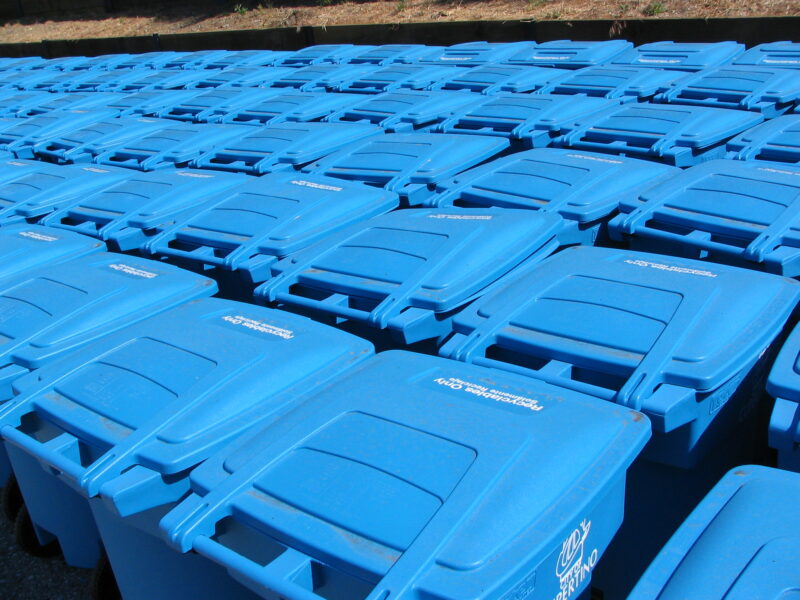
“Californians rely on recycling symbols to know when to put a product in a blue bin,” she said. “California has robust recycling, but it seems that there is still an issue. A lot of that is due to contamination. The Legislature was concerned with keeping these contaminants out of the stream because they are very hard to remove.”
The government’s goal is ultimately to get those contaminants out of the recycling stream, she said.
“It won’t be enough to just choose a material that might be recyclable and make your product out of that regardless if it’s actually recyclable,” she said.
However, Hayes, a George W. Bush appointee, questioned whether the law actually increased what products went into the landfill instead. He asked if a product falls below one of the 60% criteria, whether 100% of that product would go into the landfill.
Richards confirmed that would be the case under the law.
“Maybe you could see a drop in products being recycled next year, but maybe in two years you will see these products come back,” she said. “Overall, it will improve recycling by simplifying it.”
“But initially it’s unclear if the volume will increase or decrease,” Hayes said.
Hayes took issue with the possibility that the new standards relied on geographical locations of the products sold and the fluctuating commercial viability of the materials used. He also took issue with the use of ambiguous language around the enforcement of the law.
“Is that just left to the eye of the beholder?” he asked.
Richards agreed that there are situations where the law could be vague.
“But it’s not so vague that it needs to be enjoined,” she added.
Richards said the attorney general’s office would concede the law’s 60% sorting requirement for purposes of the preliminary injunction.
If the judge grants the preliminary injunction, Richards asked that he strike only the portions of the law he finds vague.
“This is extremely difficult for business to conform to what the law requires when it’s not clear what the law does require,” Norris said in his rebuttal.
Subscribe to our free newsletters
Our weekly newsletter Closing Arguments offers the latest about ongoing trials, major litigation and rulings in courthouses around the U.S. and the world, while the monthly Under the Lights dishes the legal dirt from Hollywood, sports, Big Tech and the arts.
Additional Reads

 Florida lawsuit enjoined for bad-faith filing June 3, 2026

 Religious discrimination or punishment for bigotry? June 3, 2026