
 Search Articles


(CN) — A federal judicial panel in the conservative Fifth Circuit Court of Appeals expressed reservations Thursday about upholding a 2023 ruling from a lower court, which temporarily outlawed the Obama-era immigration program known as Deferred Action for Childhood Arrivals or DACA.
The panel — primarily led in questioning by U.S. Circuit Judge Stephen A. Higginson, a Barack Obama appointee — repeatedly cited the U.S. Supreme Court’s 2023 decision in United States vs. Texas , which determined states cannot challenge the federal government’s authority to establish immigration priorities.
More specifically, Higginson said the 8-1 decision, authored by Donald Trump-appointed Chief Justice Brett Kavanaugh, amounted to a rebuke of the Fifth Circuit for previously allowing district courts to usurp federal immigration policy without first finding a “history and tradition of courts being empowered to decide cases of … U.S. foreign policy.”
He said the case was further complicated by the Supreme Court’s failure to specifically address what, if anything, lowers the bar for states to establish legal standing.
At issue Thursday was whether states could claim indirect injury from DACA program recipients in the form of taxpayer-funded services like healthcare and education. In light of new precedent, Higginson suggested the state had a narrower but still-existent path to assert these claims.
Representing the Department of Homeland Security and other federal defendants, attorney Brian Boynton argued the SCOTUS decision does indeed undermine Texas’ case. He said the state’s points were further weakened by the admission of vague and insufficient data, along with an improbable theory that DACA recipients would voluntarily uproot their lives and move to countries they’ve never known if their protections were rescinded.
“The fiscal injuries that Texas points to have no direct tie to DACA,” he said. “They think that if DACA is rescinded, it will decrease the population of Texas, and therefore their expenditures will go down.”
Boynton and two other attorneys representing intervenors also emphasized that the nation itself will face a greater injury if the program is ruled unlawful.
DACA currently supports more than 535,000 young immigrants, along with some 250,000 of their dependent children. Approximately one in six DACA recipients live in Texas, according to testimony.
President Barack Obama established DACA in 2012 through an executive order after more expansive immigration legislation died in a divided Congress.
The order allows certain applicants under the age of 31 to lawfully live, work and attend school in the United States for two years, after which they can reapply for status. It was not intended as a permanent program or path to citizenship.
In September 2023, U.S. District Judge Andrew Hanen, a Texas federal judge and George W. Bush appointee, issued a ruling declaring the program illegal.
His ruling — effective nationwide — allowed current DACA recipients to remain in the country until their eligibility expired. However, a stay was imposed as the case was appealed.
During oral arguments Thursday, Judge Edith Brown Clement, a George H. W. Bush appointee, asked Boynton his thoughts on limiting the order to Texas only, rather than upholding its nationwide jurisdiction. Boynton said any injunction should be narrowly crafted to allow the DHS to wind down the DACA program on its own terms, rather than over judicial mandates.
Also sitting on the panel was U.S. Circuit Judge Jerry E. Smith, a Ronald Reagan appointee.
For the state of Texas, Attorney Mr. Joseph N. Mazzara ask the panel to affirm the lower court order by ignoring the immigration priorities case as irrelevant and rejecting the DHS’ attempt to regain authority.
But for the third time in a hearing that lasted 71 minutes, Higginson said the Supreme Court’s 2023 ruling represented a “sea change” in immigration policy cases. He urged Mazzara to focus on the state’s alleged injuries.
Mazzara repeatedly pointed to a state-sponsored survey of 3,000 DACA recipients indicating they would “self-exile” if the program was rescinded.
Higginson suggested that evidence was scant — and that such a theory was unlikely. He pressed Mazzara on whether he could point to a “history and tradition” of such litigation before 2015. Mazzara admitted he could not.
But Mazzara argued that unlike in the 2023 Supreme Court case, Texas is not challenging federal authority to enforce immigration.
Rather, the state was challenging the DACA rule itself and its effects on the state, he said. Still, he acknowledged the effect an affirmation from the panel would have on other states that are not seeking similar relief.
“Texas’ position is that the trial court should be affirmed and then the case be remanded to the trial court for reconsideration of how to wind down DACA,” he said.
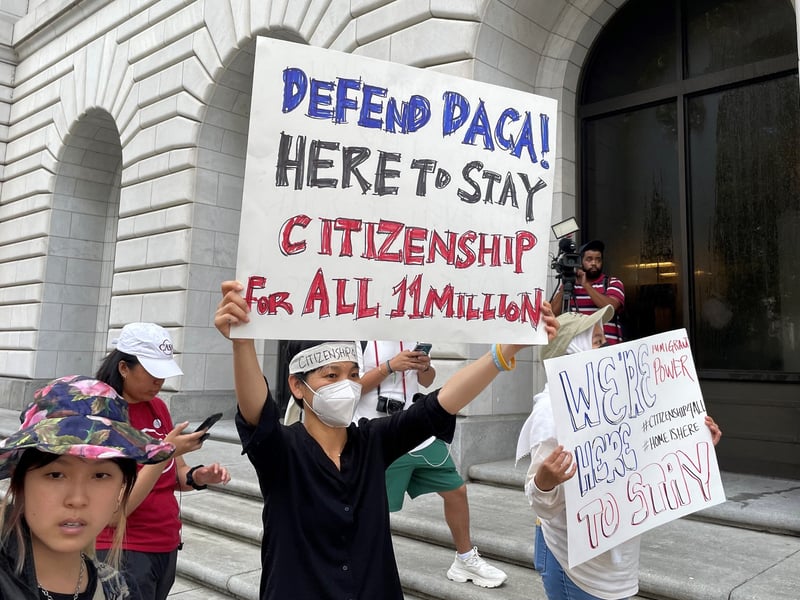
In the courtroom and outside alongside Lafayette Square, hundreds of DACA recipients and supporters were present to rally on behalf of the program.
Andrea Tecpoyotl Tepale, a DACA recipient and legal rights organizer for Alliance San Diego, said the program protected her from deportation as she became the first in her family to graduate from college and build a future.
Now Tepale has a one-year-old daughter but still feels in limbo due to legal threats to the program. While she realizes DACA wasn’t meant to be permanent, she had hoped Congress would have allowed a path to citizenship for those who have used the program to its potential.
“There’s a lot at stake. I built my entire career and life here, so there’s a lot to lose,” she said. “I think that as a DACA recipient, we bring so much to the table to this country and if we lose it, the country would be doing a huge disservice to all of our DACA recipients.”
 Follow @gabetynes
Subscribe to our free newsletters
Our weekly newsletter Closing Arguments offers the latest about ongoing trials, major litigation and rulings in courthouses around the U.S. and the world, while the monthly Under the Lights dishes the legal dirt from Hollywood, sports, Big Tech and the arts.