
 Search Articles


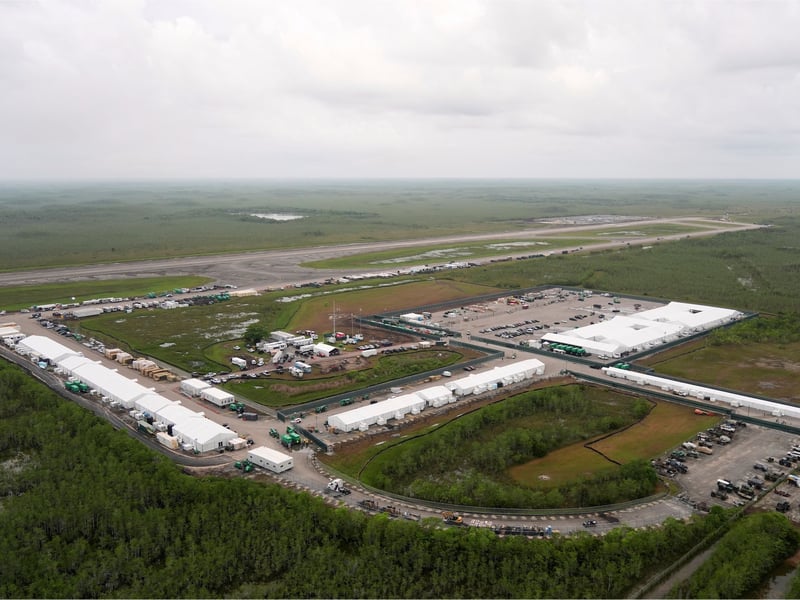
MIAMI (CN) — All new construction must stop for two weeks at the Florida migrant detention center known as “Alligator Alcatraz,” a federal judge ruled on Thursday.
After two days of testimony by environmentalists and the Miccosukee Tribe, U.S. District Judge Kathleen Williams ordered state and federal officials to halt any new filling, paving, lighting or new structures on the site surrounded by wetlands. The order, however, does not pause operations at the facility, including deportations.
Williams, a Barack Obama appointee, announced the order from the bench but followed up with a written order later in the day.
Granting a temporary restraining order, Williams wrote that “the harm to defendants from briefly suspending expansion of the facility is minimal, especially given that the court is not enjoining continued operations of the site nor even preventing additional detainees from being brought to the site if current capacity allows.”
“Meanwhile, if the site is expanded over the next several days, ‘it is difficult to change that course’ if the court eventually decides [National Environmental Policy Act] statements are required,” she added.
In the order, the judge also noted that “because plaintiffs do not seek to ’enjoin or restrain the operation’ of any immigration statute,” a law governing judicial review of removal orders does not apply.
The restraining order will last 14 days or until the court rules on a preliminary injunction.
In late June, the Center for Biological Diversity and Friends of the Everglades sued the U.S. Department of Homeland Security, U.S. Immigration and Customs Enforcement, the Florida Division of Emergency Management and Miami-Dade County in the Southern District of Florida.
The groups contend construction of the migrant detention center occurred without any environmental review as required by the National Environmental Policy Act and the Endangered Species Act. The Miccosukee Tribe joined the lawsuit shortly afterward, citing interest in sacred land.
State and federal officials argue that the facility is run by the Florida Division of Emergency Management, on a piece of land formerly owned by Miami-Dade County, so a federal environmental review does not apply.
“Today’s ruling by an activist judge will have no impact on immigration enforcement in Florida,” said Alex Lanfranconi, communications director for Governor Ron DeSantis. “Alligator Alcatraz will remain operational, continuing to serve as a force multiplier to enhance deportation efforts.”
Tricia McLaughlin, DHS assistant secretary for public affairs, also panned the judge’s decision.
“This lawsuit ignores the fact that this land has already been developed for a decade,” she said. “It is another attempt to prevent the president from fulfilling the American people’s mandate for mass deportations. These environmental activists and activist judge don’t care about the invasion of our country facilitated by the Biden administration, but the American people do.”
Six weeks ago, in response to President Donald Trump’s immigration crackdown, DeSantis and Florida Attorney General James Uthmeier proposed the idea of a detention center in the Everglades and used emergency powers to acquire the Dade-Collier Training and Transition Airport, a small runway surrounded by the Big Cypress National Preserve and Everglades National Park.
Within days, trucks carrying prefabricated housing, generators, security lighting and fill dirt entered the area and workers hastily set up tents and trailers to house those arrested by ICE and state law enforcement over suspected immigration violations.
Trump visited the facility on July 1 — the day before the first detainees arrived — and told reporters, “We’re going to teach them how to run away from an alligator if they escape prison.”
Since then, environmental activists, indigenous tribes, Democratic state lawmakers and members of Congress have decried the detention center as inhumane and detrimental to the ecosystem, pointing to reports of flooding, pest infestations, sewage backups and light pollution.
“We welcome the court’s decision to pause construction on this deeply concerning project,” said Talbert Cypress, chairman of the Miccosukee Tribe, in a statement. “The detention facility threatens land that is not only environmentally sensitive but sacred to our people. While this order is temporary, it is an important step in asserting our rights and protecting our homeland.”
Williams has yet to rule on a request by Kevin Guthrie, director of the Florida Division of Emergency Management, to move the litigation to the Middle District of Florida.
Guthrie said all the detention facilities and paving lies in Collier County, which falls under the Middle District of Florida.
“Within the site, only a tiny sliver of unpaved runway is situated in Miami-Dade County,” he said in a recent court filing. “No portion of the detention facility lies on that sliver of extended runway.”
The detention center faces another lawsuit brought by the American Civil Liberties Union and immigration advocacy groups in July that contests the lack of attorney access to those kept in the remote facility. On Thursday, state officials asked the judge in that case to deny a preliminary injunction request because they claim detainees have had access to legal counsel for the past few weeks following “initial delays.”
“More meetings are taking place every day and there have been no complaints," Nicholas Meros, counsel for the state, said in the latest filing. “In fact, since the meetings began on July 15, the state defendants have granted every single request for a detainee to meet with legal counsel.”
 Follow @alexbpickett
Subscribe to our free newsletters
Our weekly newsletter Closing Arguments offers the latest about ongoing trials, major litigation and rulings in courthouses around the U.S. and the world, while the monthly Under the Lights dishes the legal dirt from Hollywood, sports, Big Tech and the arts.