
 Search Articles


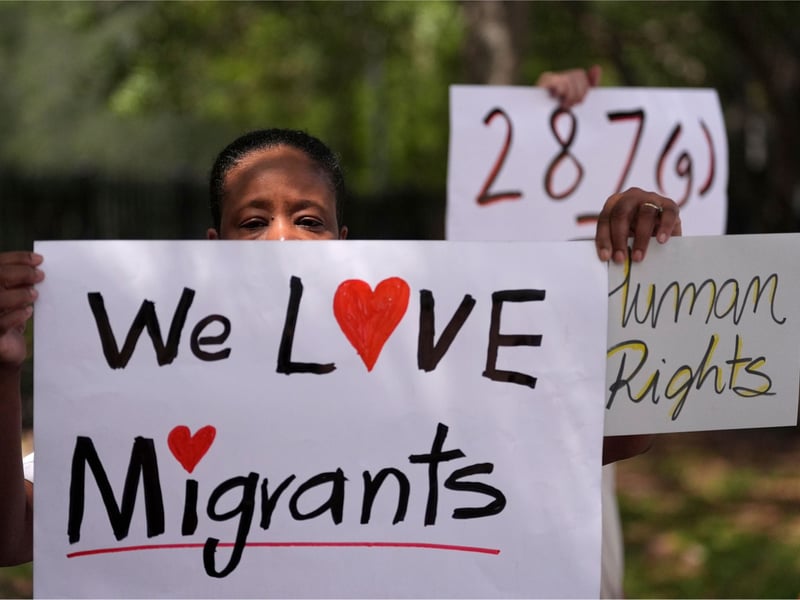
ATLANTA (CN) — Immigration advocates on Thursday asked an 11th Circuit panel to keep a block on a law that targets people who are in the U.S. illegally and find their way to Florida.
“The dominant federal interest here is that, for 150 years, the Supreme Court has made clear that there is an exclusive federal authority over entry into the United States,” American Civil Liberties Union attorney Cody Wolsy told the three-judge panel. “This is a scheme that has been addressed in a bunch of different ways, all the different values and policies and interests that the federal government might have in a particular case of a person entering without inspection. And it gives the federal government a lot of different tools. Some of them are much more punitive, like the criminal provisions that are duplicated here.”
In February, the Republican-dominated Florida Legislature passed Senate Bill 4-C, which created two new criminal statutes for immigrants who enter the state after “eluding or avoiding examination or inspection by immigration officers” at the U.S. border. Republican Governor Ron DeSantis immediately signed the legislation.
Immigration advocates, including the Florida Immigrant Coalition and Farmworker Association of Florida, responded with a federal lawsuit in April claiming SB 4-C unconstitutionally encroaches on the duties of federal officials to implement immigration law. The lawsuit names Florida Attorney General James Uthmeier and state attorneys across Florida.
Within days, U.S. District Judge Kathleen Williams of the Southern District of Florida issued a restraining order barring any enforcement of the law and directing Uthmeier to inform local law enforcement of her decree. After news of continuing arrests, the judge extended the restraining order.
Uthmeier previously asked the 11th Circuit and the U.S. Supreme Court to stay the injunction so arrests could continue while the litigation proceeded, but both courts declined.
During Thursday’s hearing, Wolsy of the ACLU reiterated that the federal government’s control over immigration preempts laws like SB 4-C.
“Congress in this very unique federal realm has given the president a bunch of tools and then left them at the president’s discretion,” he said. “The state can’t come in and say, ‘Well, we’re now going to take that discretion for ourselves and make the decisions for ourselves.’”
Wolsy said the law picks “winners and losers among immigrants and immigrant communities,” pointing to statutes allowing Cuban refugees, asylum seekers and victims of human trafficking to stay in the country, at least temporarily, after entering illegally.
Wolsy also argued that SB 4-C in some cases is more punitive than federal law, including withholding bail and more lengthy mandatory sentences.
“It’s another example of the state here making its own immigration policy,” he said.
U.S. Circuit Judge Barbara Lagoa pushed back slightly about preemption between federal and state policies by bringing up marijuana.
“So let me ask you a question about, let’s say marijuana, because that’s sort of a drug choice where the states are allowing legalization of marijuana and the federal government still has that as an illegal substance, but it’s choosing not to, in most cases now, prosecute for marijuana possession,” said Lagoa, a Donald Trump appointee. “I mean, it sort of goes to the issue of the federal government is choosing not to prosecute for illegal entry, but the state of Florida decides, well, we’re going to prosecute for illegal entry of someone who’s illegally in the country, but also in Florida.”
Wolsy said the two can’t be compared.
“I think that this statutory scheme is very different from just saying possession of marijuana,” Wolsy said. “Here we’re saying there is a complex problem at the border that we’re dealing with, which is there are people who are coming in between ports. We both want to deter that, but we also want to acknowledge foreign policy considerations, humanitarian considerations, connections with U.S. citizens. How do we figure that out? We have one sovereign make the decision about which tools are going to be deployed, and that’s the federal government.”
Jeffrey DeSousa, the attorney representing Uthmeier and state prosecutors, argued SB 4-C is not preempted by federal law.
“It’s very particular,” he told the judges. “It says that if the federal government has granted lawful presence or discretionary relief, either temporarily or permanently, that is enough to absolve a person of liability under our statute.”
Lagoa interrupted.
“So you could be picked up," Lagoa said. “And then the way I read the statute, I think it’s a mandatory hold. So it’s sort of like a stand your ground immunity argument. You have to then move to dismiss the information and assert a defense.”
“I think that could happen,” DeSousa explained. “That would be one route. I mean, again, we’re in the pre-enforcement posture.”
Lagoa expressed skepticism. “It seems like a strange way to handle it,” she said. “It causes me some concern.”
U.S. Circuit Judge Adalberto Jordan took issue with how SB 4-C would be prosecuted.
“Under the Florida law, my understanding is that entry is a continuous offense and you can be prosecuted anywhere you’re found,” Jordan, a Barack Obama appointee, said. “It doesn’t say, neither provision says where you can be prosecuted, right?
“That’s correct,” DeSousa responded. “I want to emphasize that because this is a pre-enforcement challenge, we don’t yet have a great sense of how Florida state courts are going to interpret the term ‘entry’ here.”
DeSousa also took issue with the overly broad nature of the injunction that requires the attorney general to monitor arrests made by state law enforcement agencies to ensure they are complying with the restraining order. DeSousa said those agencies are not part of the litigation and thus “we have monitoring and oversight obligations that we should not have.”
“So that’s a diversion of our resources as an agency, where our lawyers spend time having to consult with those non-party law enforcement officers to ensure their compliance,” DeSousa said. “The situation only exists because of the overbroad nature of the injunction. We otherwise would not be engaged in that practice, because we don’t actually exercise any control under Florida law over law enforcement.”
Lagoa agreed.
“I’m speaking for myself only, I think the district court erred,” she said. “I don’t think that you have the ability to order someone who is not a party to you, where the person you’re ordering someone who does not have control over that individual to have them do something. I mean, I don’t have to affirm legal error.”
Wolsy of the ACLU said the injunction only required the attorney general to give notice of the lower court’s order.
“He didn’t have to agree with it,” Wolsy said. “He didn’t have to command them to do anything.”
Uthmeier initially complied with the order, notifying state agencies of the judge’s order. But five days later, he sent a letter to police agencies across the state, telling them “there remains no judicial order that properly restrains you from doing so,” according to court documents.
The lower court then held the attorney general in contempt for defying the order.
U.S. Circuit Judge Charles Wilson jumped on that point.
“It’s not a situation where the attorney general just didn’t do what he was ordered to do, which was provide notice of the ruling,” Wilson, a Bill Clinton appointee, said. “He went beyond not complying and suggested, and I’m using the word kindly, suggested to law enforcement officers that there was no valid order and they could go about their business enforcing these statutes.”
The panel did not indicate when or how it will rule.
 Follow @alexbpickett
Subscribe to our free newsletters
Our weekly newsletter Closing Arguments offers the latest about ongoing trials, major litigation and rulings in courthouses around the U.S. and the world, while the monthly Under the Lights dishes the legal dirt from Hollywood, sports, Big Tech and the arts.