
 Search Articles


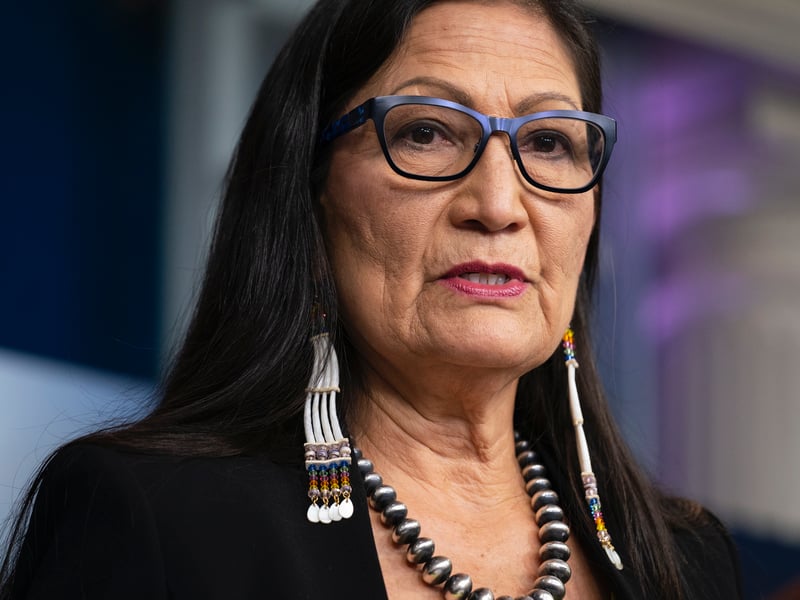
PHOENIX (CN) — Former Secretary of the Interior Deb Haaland discussed sovereignty, water rights and other crises faced by tribal communities in a lecture promoting more Indigenous representation in the legal and political spheres.
Hosted by Arizona State University’s law school, the first Indigenous presidential cabinet secretary encouraged students in the audience to pursue law degrees while criticizing Trump administration actions she says suppress Indigenous voices and tribal sovereignty.
“As we can see, not all leadership is beneficial,” Haaland, who served in President Joe Biden’s cabinet, said Tuesday afternoon at the Beus Center for Law and Society. “Leadership quality matters even more than just having someone who will take the helm because of ego or self-interest.”
Encouraging Indigenous students to pursue law and politics means a government that reflects the values of the nation’s first stewards and oldest democracies, she said.
“Indigenous leadership should ensure that the adults in the room work hard to leave generations to come with a sustainable future,” she said.
In 2018, Haaland and Kansas Democrat Sharice David became the first Indigenous women elected to Congress. Native Americans make up only 0.7% of Congress, and only 0.5% of practicing lawyers and judges, despite accounting for more than 2% of the population.
“Through it all, I recognize the importance of being present in places that were designed to keep us out,” Haaland said. “The courts are one of those places. And it’s why each of you has a role to usher in an era in which Native lawyers are not rare.”
As a U.S. representative, Haaland rang the alarm bells on the crisis of missing and murdered Indigenous women across America, sponsoring the Not Invisible Act of 2019, signed by President Donald Trump in 2020. The act tasked a commission of law enforcement, tribal leaders, survivors and federal stakeholders to make six recommendations to solve the ongoing crisis. In February, the Trump administration deleted the commission’s report from the Department of the Interior’s website.
Haaland, who’s running for governor of New Mexico in 2026, said she will use her state power to hold the federal government accountable and demand it release the report.
“This administration is working hard to bury anything from anyone’s past that doesn’t uplift the current president,” she said.
Similarly, Haaland criticized the Trump administration for removing funding from other Indigenous projects, including a native language revitalization program, an oral history project in partnership with the Smithsonian Museum and the Federal Indian Boarding School Initiative.
Spearheaded by Haaland, the initiative’s goal was to investigate long-standing abuse in the now-defunct residential boarding schools that Native American children were forced into under the 1819 Civilization Fund Act.
The seven western states and 30 sovereign tribes reliant on the Colorado River, including Arizona and New Mexico, are locked in a stalemate over post-2026 river water allocations, and are running out of time to reach a consensus. Though the tribes rely collectively on nearly a quarter of the river’s flow, their voices have been largely ignored.
“Prior to my being at the Department of the Interior, no tribes were ever invited to negotiations for the Colorado River,” Haaland said. “To me, it seemed imperative, and it was amazing how tribes from here in Arizona added value to those talks.”
In Biden’s cabinet, Haaland supported the designation of national monuments, including Baaj Nwaavjo I’tah Kukveni – Ancestral Footprints of the Grand Canyon. The monument’s designation is still under legal challenge from Arizona Legislative Republicans.
As Secretary of the Interior, she also defended the federal government from lawsuits seeking to protect tribal lands, like a 2024 challenge to the Biden administration’s 550-mile Sunzia transmission line, which, when finished, will disrupt hundreds of miles of historic and cultural sites in southern Arizona while delivering renewable energy to Arizona and California.
While she wholly supported the Biden administration’s clean energy goals, Haaland opposed the construction of a copper mine on the Apache holy ground, Oak Flat.
Haaland ended her lecture on a hopeful note, restating her desire for more Indigenous civic participation and, in turn, a greater focus on community and fairness.
“A new era of Indigenous leadership is changing the way our country looks at its communities,” she said. “Just because Native people have been left out of the conversations and decision-making rooms doesn’t mean we don’t belong there.”
 Follow @JournalistJoeAZ
Subscribe to our free newsletters
Our weekly newsletter Closing Arguments offers the latest about ongoing trials, major litigation and rulings in courthouses around the U.S. and the world, while the monthly Under the Lights dishes the legal dirt from Hollywood, sports, Big Tech and the arts.