
 Search Articles


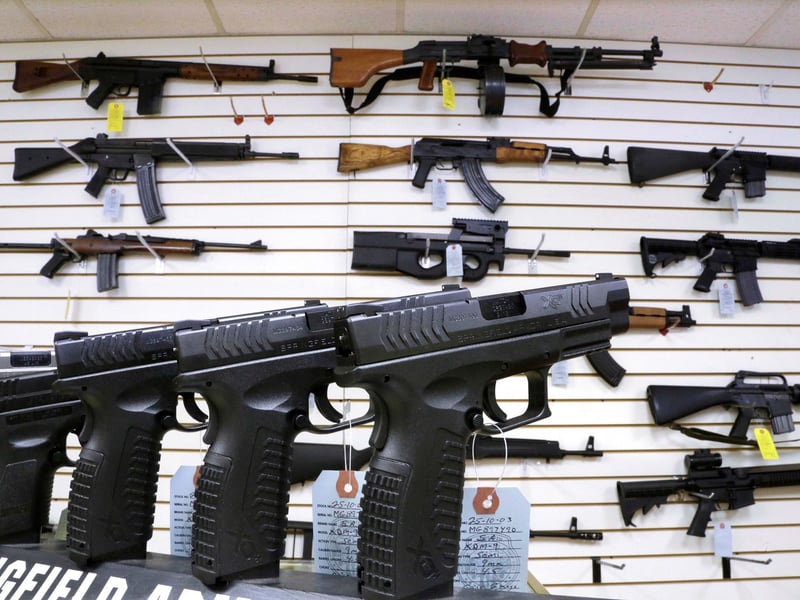
BOSTON (CN) — A Massachusetts law banning assault weapons has been left in place by the First Circuit, despite a challenge under the Second Amendment.
The appeals court upheld the denial of a preliminary injunction against the law in a 36-page ruling released late on Thursday.
Assault weapons are currently banned in 10 states — California, Connecticut, Delaware, Hawaii, Illinois, Maryland, Massachusetts, New Jersey, New York and Washington — as well as the District of Columbia.
The Massachusetts ban was challenged by the National Association for Gun Rights, a Colorado-based group whose website boasts 4.5 million members and vows “no compromise” on gun control, in contrast to what it sees as the more moderate National Rifle Association.
A lower court denied a preliminary injunction against the ban, finding that weapons such as the AR-15 are “dangerous and unusual.” But the plaintiffs claim the AR-15 isn’t “unusual” because almost 25 million of them are in circulation, and as of 2018 similar firearms comprised 35% of all new guns sold in the U.S.
The gun advocates also say the weapons aren’t dangerous because, according to the state’s own figures, they are responsible for only 0.002% of homicides, or one in every 50,000.
Back in 2022, the U.S. Supreme Court held that a state can’t ban guns unless the ban is “consistent with the nation’s historical tradition of firearm regulation.”
A year ago, the First Circuit ruled that a Rhode Island ban on large-capacity magazines appeared to pass this test, concluding that “our historical tradition of regulating arms used for self-defense has tolerated burdens on the right that are certainly no less than the (at most) negligible burden of having to use more than one magazine to fire more than ten shots.”
The court now suggests that the same is true for assault weapons, or at least the plaintiffs didn’t make enough of a showing to justify a preliminary injunction.
For one thing, the weapons are in fact highly dangerous, said Judge Gary Katzmann of the U.S. Court of International Trade, who was sitting by designation.
Even without large-capacity magazines, “semi-automatic rifles cause an average of 40 percent more deaths and injuries in mass shootings than regular firearms,” he wrote.
Historically, “states have routinely regulated, and sometimes outright banned, specific weapons once it became clear that they posed a unique danger to public safety,” he said, including gunpowder, trap guns, Bowie knives and sawed-off shotguns.
Katzmann, a Barack Obama appointee, also said the argument that Americans need AR-15s for self-defense was misplaced.
The Massachusetts ban “does not impose a heavy burden on civilian self-defense,” he wrote. “For one thing, appellants do not demonstrate a single instance where the AR-15 — or any other banned weapon — has actually been used in a self-defense scenario.”
In general, it “seems reasonably clear that our historical tradition of regulating arms used for self-defense has tolerated burdens similar to those posed by an assault weapons ban.”
The ruling doesn’t end the case, but it means that the weapons ban will stay in place while it proceeds. With both the trial judge and the appeals court having expressed serious doubts about the constitutional merits, the plaintiffs’ prospects don’t appear to be very bright.
Katzmann’s opinion was joined by U.S. Circuit Judges Gustavo Gelpí and Julie Rikelman, both Joe Biden appointees.
Subscribe to our free newsletters
Our weekly newsletter Closing Arguments offers the latest about ongoing trials, major litigation and rulings in courthouses around the U.S. and the world, while the monthly Under the Lights dishes the legal dirt from Hollywood, sports, Big Tech and the arts.