
 Search Articles


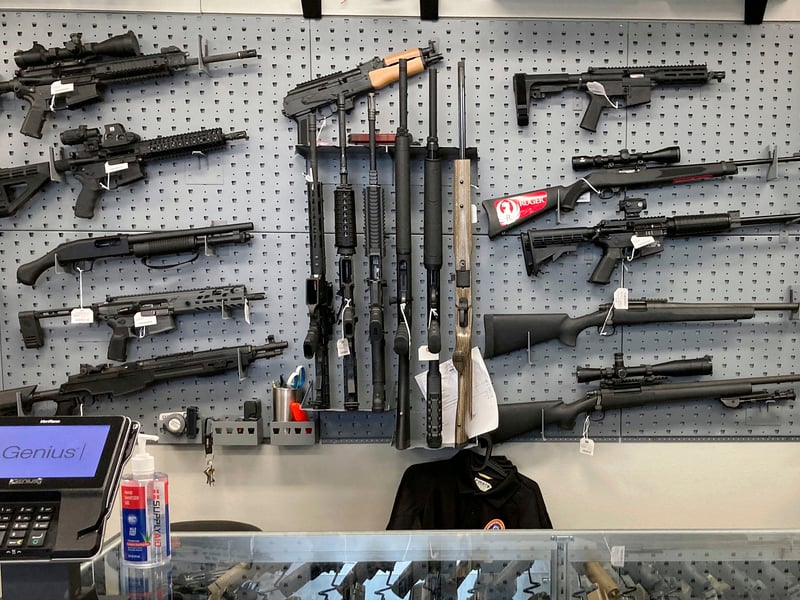
BOSTON (CN) — A man convicted of felony meth possession told the First Circuit Thursday that a federal law that prohibits him from owning a gun violates the Second Amendment, and the court struggled at oral argument to figure out whether he’s right.
Several gun-control statutes have come under attack since the Supreme Court decided in 2022 that such laws are invalid unless they’re consistent with the country’s history and tradition of firearms regulation going back to the Founding era.
Following his methamphetamine conviction, Jason Levasseur was arrested again in Maine in 2022 for violating the federal felon-in-possession law after he went deer hunting and police found a rifle in his truck. Levasseur claims that, while there’s a historical tradition of depriving people of firearms if they’re dangerous or violent, his simple drug possession didn’t prove that he was dangerous or violent.
On appeal, the First Circuit struggled to find analogies between the felon-in-possession law, which Congress passed in the 1930s, and the colonial era.
“Is there a historical tradition of disarming people for drug possession?” U.S. Circuit Judge Julie Rikelman asked the government’s lawyer, Brian Kleinbord.
Kleinbord said no; drugs are a modern problem. But “there were drugs at the time of the Founding,” Rikelman, a Joe Biden appointee, observed.
Kleinbord argued that even nonviolent felons were often strictly punished in early America, including being put to death or deprived of all their property. But the judges said that was different from disarmament.
“If I did my time, and had my forfeiture, could I now buy a gun?” asked U.S. Circuit Judge David Barron, who was appointed by Barack Obama.
“I don’t know,” Kleinbord admitted.
Rikelman was dubious that 18th-century felony punishment included permanent disarmament, saying that “it doesn’t seem like it did.”
Kleinbord had better luck arguing that the felon-in-possession law was a ban on a class of people, and colonial-era laws often banned entire classes of people from owning weapons, including African Americans, Native Americans, Catholics and British loyalists.
Loyalists “were a real danger” because they might revolt, suggested U.S. Circuit Judge Seth Aframe, also a Biden appointee. “Now the problem is individual people using guns on the street. The problem has changed, but the idea of risk hasn’t changed. We can’t have the law in amber. Don’t we have to evolve?”
But the Founding-era class bans “weren’t a punishment for a crime,” said Levasseur’s lawyer, Scott Hess of Augusta, Maine. “That’s different.”
Hess added, “Felonies existed back in the day, but disarming wasn’t an option. … If a societal problem existed, and it wasn’t addressed through disarmament, we can’t change that now.”
Aframe then asked Hess how, if nonviolent felons could possess a gun, the court should determine who was nonviolent.
“We can’t get into everyone’s personal history,” he said. “Some drug possessors are more dangerous than others. Some are so poor they’re likely to rob a bank or bring a gun to a drug deal; others won’t. What do we do with that?”
Hess suggested that the court should analyze the elements of the felony offense, not the specifics of each defendant’s background.
Barron took the point but also worried that a felony-by-felony analysis could open a can of worms. Drug dealing, as opposed to possession, could be empirically connected to dangerousness, he said. “And do we care what the drug is?”
Subscribe to our free newsletters
Our weekly newsletter Closing Arguments offers the latest about ongoing trials, major litigation and rulings in courthouses around the U.S. and the world, while the monthly Under the Lights dishes the legal dirt from Hollywood, sports, Big Tech and the arts.