
 Search Articles


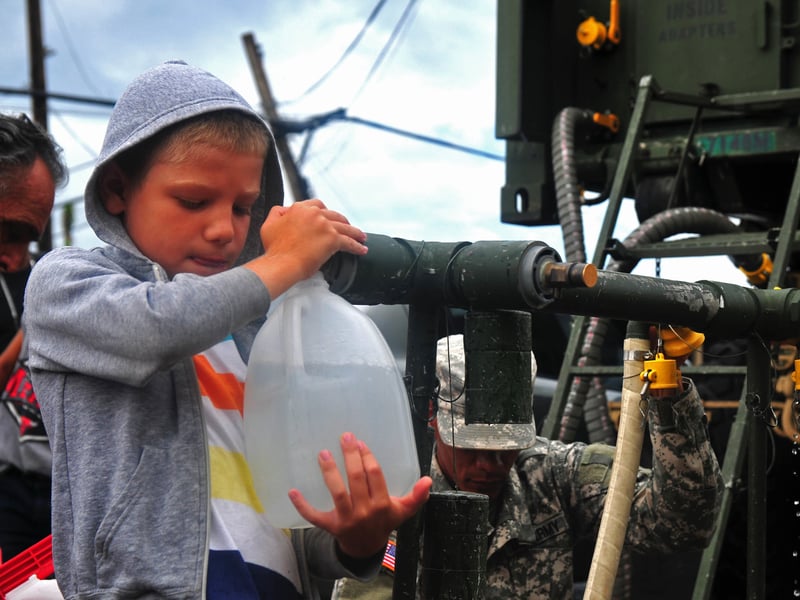
BOSTON (CN) — A town in Puerto Rico that hasn’t had running water for most of the last eight years told the First Circuit Tuesday that this violates the U.S. Constitution, but while the judges were sympathetic to the citizens’ plight, they were circumspect about constitutionalizing a remedy.
Morovis is a town in central Puerto Rico with a population of 28,000 and a severe water problem. Despite paying regular monthly bills to the island’s water authority, called PRASA, the town has had no running water most of the time since 2017. It once went 42 days without the taps running.
PRASA has offered a number of explanations, including heavy rainfalls, blocked water intakes, broken water lines, mechanical failures and power outages. But the town says these are just excuses and PRASA is deliberately indifferent to its needs.
Morovis has spent more than $1 million on residential water tanks and distribution trucks and claims that the lack of water violates due process rights under the Constitution.
This appears to be the first case of its kind in the country, although in 2019 the Sixth Circuit found a potential constitutional violation in the distribution of contaminated water by the city of Flint, Michigan.
To win, the town has to show that it has a property interest in the water and the deprivation “shocks the conscience.” German Rieckehoff, PRASA’s lawyer, began by claiming that the citizens had no property interest, but that didn’t go well.
“There’s nothing in the statute that guarantees available water at all times or even most of the time,” Rieckehoff insisted.
“Well then, what are they paying for?” U.S. Circuit Judge O. Rogeriee Thompson asked.
Rieckehoff replied that a property interest was “not recognized by any legal authority.”
“What about the contract where they pay you every month for water and don’t get it?” Thompson, a Barack Obama appointee, shot back.
U.S. Circuit Judge Julie Rikelman joined in: “They’re paying for water; why under Puerto Rico law don’t they have a property interest?”
“No court has ever recognized this,” Rieckehoff insisted.
“But they’re asking us to recognize it,” Rikelman said.
“Is there any precedent saying we can’t recognize it?” asked U.S. Circuit Chief Judge David Barron, and Rieckehoff was forced to say no.
“Well then,” Barron replied.
But whether the lack of water shocks the conscience was a tougher issue. Rieckehoff said PRASA was at most guilty of mere negligence, and “I don’t want to sound like I don’t have empathy, but it falls woefully short” of conscience-shocking.
Arguing for PRASA’s executive director, attorney Omar Figueroa said “I don’t see any possible deliberate indifference here” because “both PRASA and the executive director are hands-on on this issue and it’s a very complex issue.”
He argued, “Sometimes it’s just nature, like a lot of clogging or stuff there; it’s sometimes out of control and nature just makes it difficult.”
The town’s lawyer, Andres Gorbea-Del Valle, said the lack of water itself shocked the conscience. But the judges said that wasn’t enough and pressed Gorbea-Del Valle to provide facts that would establish deliberate indifference on PRASA’s part.
Gorbea-Del Valle then reported that a former PRASA employee hired by the town discovered that PRASA was ignoring simple fixes that would solve the problem — for instance, the lack of water was often due to PRASA shutting down a generator or simply refusing to open a valve.
“The valves in water station are closed, and all they have to do is open them, but they won’t,” he complained. “There’s always a different excuse. There’s a 200,000-gallon tank in Morovis that hasn’t been used for years. There’s no water when there’s no hurricane, no nothing, and the sun is really bright. For weeks.”
Gorbea-Del Valle also said the town could easily connect to a “super-tube” water conduit nearby, but PRASA won’t allow it.
Barron, a Barack Obama appointee, sounded amenable. “If they’re trying hard, that might not be conscience-shocking,” he said. “But if they just decided not to give them water, that might be.”
There was some indication that the lack of water was a form of retaliation because the mayor belongs to a different political party from the Puerto Rico government, and a lower court threw out the case and suggested that it should have been brought under the First Amendment instead.
But Gorbea-Del Valle said the plaintiffs didn’t want to take that route. “Puerto Rico has a lot of political discrimination cases,” he said, but “we did not allege politically motivated actions by PRASA. The lack of water affects everyone, not just some political parties.”
And Rikelman, a Joe Biden appointee, suggested that the townspeople might not be able to bring a First Amendment claim instead if the retaliation was directed at the mayor and not at them personally.
Subscribe to our free newsletters
Our weekly newsletter Closing Arguments offers the latest about ongoing trials, major litigation and rulings in courthouses around the U.S. and the world, while the monthly Under the Lights dishes the legal dirt from Hollywood, sports, Big Tech and the arts.