
 Search Articles


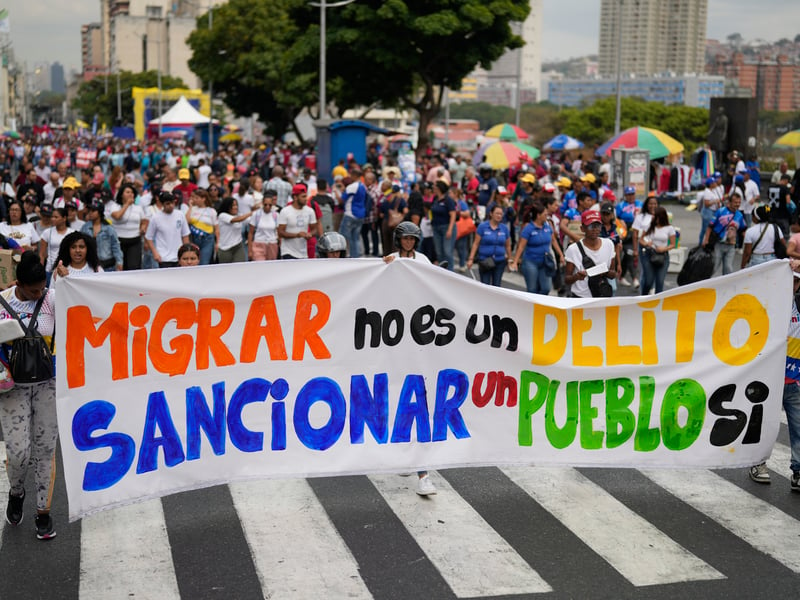
BOSTON (CN) — A First Circuit panel telegraphed Tuesday that it’s inclined to give four immigrants additional safeguards against “third-country” deportations, but balked at extending those protections to other immigrants generally in defiance of the Supreme Court.
“Third-country” deportations have been controversial because many immigrants are being sent to countries such as South Sudan and Libya, where they say they fear torture or death. The Trump administration insists that if immigrants’ own countries won’t take them back, it should be allowed to deport them to another country that will.
In addition, the Trump administration’s policy is to give many immigrants only 24 hours’ notice — and in some cases, only six hours’ notice — to raise a complaint and articulate reasons why they wouldn’t be safe in a given foreign country.
Under former President Joe Biden, immigrants were typically asked if they feared torture in a particular country, but that policy is “likely to produce a lot of false claims,” complained the government’s attorney, Sarah Welch, at oral argument.
“Torture is unusual and an extremely high bar,” she said. “People make astonishing allegations.” She said people who have a genuine reason to fear reprisals already have some relationship to the foreign government and “are likely to know right away.”
But U.S. Circuit Judge Seth Aframe, a Biden appointee, wasn’t so sure. “Say I’m a gay person and I’m sent to a country and I don’t know if they torture gay people unless I research it. I don’t think you’re right that I always know if they’re going to harm me.”
Welch responded that the government is allowed to rely on diplomatic assurances from other countries that deportees won’t be tortured. But “these diplomatic assurances aren’t worth the paper they’re written on,” argued Trina Realmuto, executive director of the Boston-based National Immigration Litigation Alliance.
“Some people were deported to Ghana, and Ghana in turn sent them to the very country they were afraid of being tortured in,” Realmuto claimed.
This particular case has been remarkably contentious. The Trump policy of deportations was enjoined nationwide in April 2025 by U.S. District Judge Brian Murphy, a Biden appointee who was confirmed by the Senate just weeks before Trump was sworn in for his second term. In June 2025, the U.S. Supreme Court stayed Murphy’s injunction by a 6-3 vote.
Murphy issued an order later that day stating that a related emergency restraining order pertaining to certain immigrants would remain “in full force and effect” despite the high court’s guidance. The Trump administration went back to the Supreme Court, which issued another order in July 2025 overruling Murphy as to the emergency restraining order. Justice Sonia Sotomayor dissented, commenting bitterly that “the administration has the Supreme Court on speed dial.”
According to the administration, the immigrants in this case have been convicted of murder, child sexual abuse and sexually abusing a woman with the mental capacity of a 3-year-old. It says that in the past, many immigrants whose countries refused to take them back have stayed in the U.S. for years causing more harm — in this case, one immigrant who was ordered removed 25 years ago went on to commit armed robbery and kidnapping while another who was ordered removed 12 years ago was convicted afterward of attempted murder.
In an argument that ran more than twice as long as scheduled, the First Circuit judges repeatedly expressed concern that the immigrants weren’t being given adequate due process. But they also felt constrained by the Supreme Court’s order.
“It would seem like a stretch to say, oh, they didn’t know what they were doing; we’re going to do something else,” Aframe said. “That would be an odd thing to do.”
But since the government raised numerous objections to Murphy’s injunction, and since the Supreme Court majority didn’t say which of them it found persuasive, the judges seemed to settle on a narrow jurisdictional argument that would allow them to affirm the injunction for the four individual plaintiffs but not for all other immigrants as a class.
“We would prefer” that outcome to a classwide injunction, Welch said, although she still argued for dismissing the injunction altogether.
Realmuto seemed resigned to the result in part because she expects the case to eventually go back to the Supreme Court, but she said that even the additional due process for the four named immigrants was problematic.
As to one of them who is fighting going to Mexico, “if we win on fear of Mexico, he’s still on the merry-go-round,” Realmuto said. “The government is sending people to Cameroon right now, and next he’ll have to prove fear of Cameroon.”
U.S. Circuit Judges Lara Montecalvo, a Biden appointee, and Jeffrey Howard, who was appointed by George W. Bush, rounded out the panel.
Subscribe to our free newsletters
Our weekly newsletter Closing Arguments offers the latest about ongoing trials, major litigation and rulings in courthouses around the U.S. and the world, while the monthly Under the Lights dishes the legal dirt from Hollywood, sports, Big Tech and the arts.