
 Search Articles


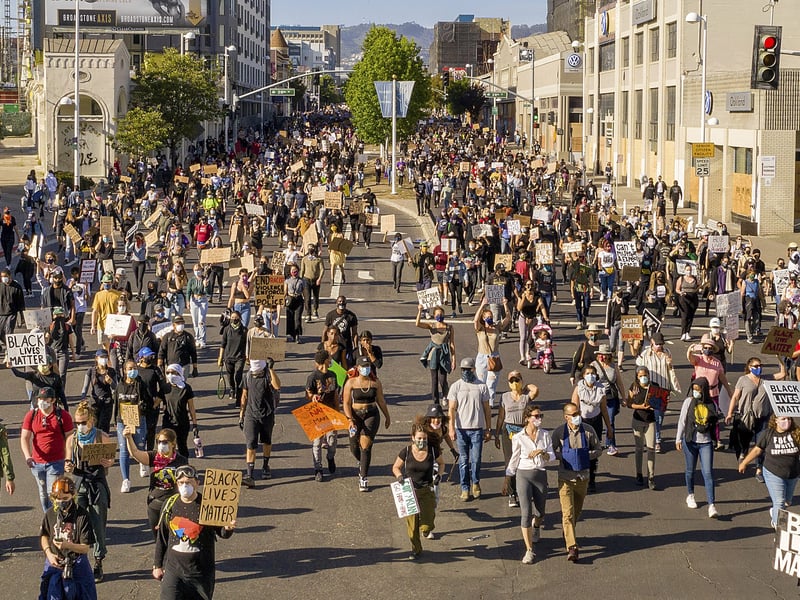
(CN) — Oregon protesters who claim police violated their free speech rights and used excessive force against some participants during a 2020 racial justice march scored a victory Friday in their suit against the city of Springfield and its officers.
The ruling stems from a lawsuit by Black Unity and individual protesters who say Springfield police blocked their march, wrongly declared it an unlawful assembly and chilled their First Amendment rights by ordering them to disperse and using force.
The city and officers asked U.S. District Judge Ann L. Aiken to grant summary judgment on all claims, but she denied the request Friday. Aiken granted the plaintiffs partial summary judgment on 16 of the defendants’ affirmative defenses.
Protesters said police erected a barricade during their July 29, 2020, march, sparked by George Floyd’s death in Minneapolis, ordered them to remain behind it, then declared the gathering unlawful and told them to leave. Officers arrested and struck a man who stepped past the barricade to speak with police.
“Plaintiffs allege that [police] and the city used a number of impermissible tactics to ‘restrict and stifle the First Amendment rights of protesters critical of police . . . and (critical of) race-related violence at the hands of law enforcement,’” the Bill Clinton appointee said in her ruling.
The protesters asked the court to discard the city’s and officers’ affirmative defenses, while Springfield sought dismissal of the case entirely.
The judge largely sided with the marchers, rejecting the defendants’ arguments and allowing the lawsuit to proceed.
She also rejected claims that the protesters lacked standing and that officers had no duty to retreat.
“’No duty to retreat’ is not an affirmative defense to a § 1983 claim,” the judge said, referring to the federal statute that enables people to sue government officials for violations of their constitutional rights.
The judge noted a duty to retreat involves situations when a citizen could use deadly force, not a police officer.
Aiken also discarded the city and officer arguments that “officer safety” and “good faith” were affirmative defenses. They cited two Ninth Circuit cases — *Scott v. Henrich,1992, and Forrett v. Richardson,*1997 — though the judge said the defendants in those cases didn’t claim officer safety or good faith as defenses. Instead, they argued the force used was “objectively reasonable.”
“Defendants here may choose to do the same, but such an attack is not an affirmative defense,” Aiken said.
The judge ruled against the protestors on two affirmative defense claims.
Aiken then turned to the city and officers’ motion to dismiss the protesters’ claims, ruling against them.
The protesters have argued that their First Amendment rights to speak and assemble were curtailed by the blockade. The defendants have countered that the protest violated Covid-era restrictions and that the marchers hadn’t applied for a permit.
“The government’s ability to permissibly restrict expressive conduct in a public forum is very limited,” the judge said. “This is especially true where the government seeks to restrain speech in advance of expression.”
Referring to a video of the event, Aiken noted that counter-protesters could speak and assemble on both sides of the blockage. Also, they filmed from the police side of the barrier and cheered the officers.
“On this record, a reasonable jury could find that the barricade was enforced only against the marchers, but not the counter-protesters, because of the content of the marchers’ speech,” Aiken said.
The judge also disagreed with the officers’ arguments against excessive force claims brought by one protester, who said he was punched while others restrained him. Aiken noted that although he insulted an officer, he posed no threat and that officers failed to consider “less intrusive tactics,” leaving a jury to decide whether the force was unreasonable.
Aiken also questioned the conduct of two undercover officers who photographed and filmed protesters. While the officers said their actions did not violate state law barring political surveillance without a criminal basis, Aiken said their depositions contradicted that claim.
“Plaintiffs provide evidence that [the officers] participated in the collection and maintenance of information about the political views, associations, or activities of Black Unity members in the absence of any criminal investigation or reasonable suspicion of criminal activity,” the judge said.
Two attorneys for the defendants had automated email messages stating they were unavailable Friday.
Representing the protesters, attorney Marianne Dugan noted in an email that the ruling was 120 pages. She didn’t anticipate her team would comment until Monday.
Subscribe to our free newsletters
Our weekly newsletter Closing Arguments offers the latest about ongoing trials, major litigation and rulings in courthouses around the U.S. and the world, while the monthly Under the Lights dishes the legal dirt from Hollywood, sports, Big Tech and the arts.