
 Search Articles


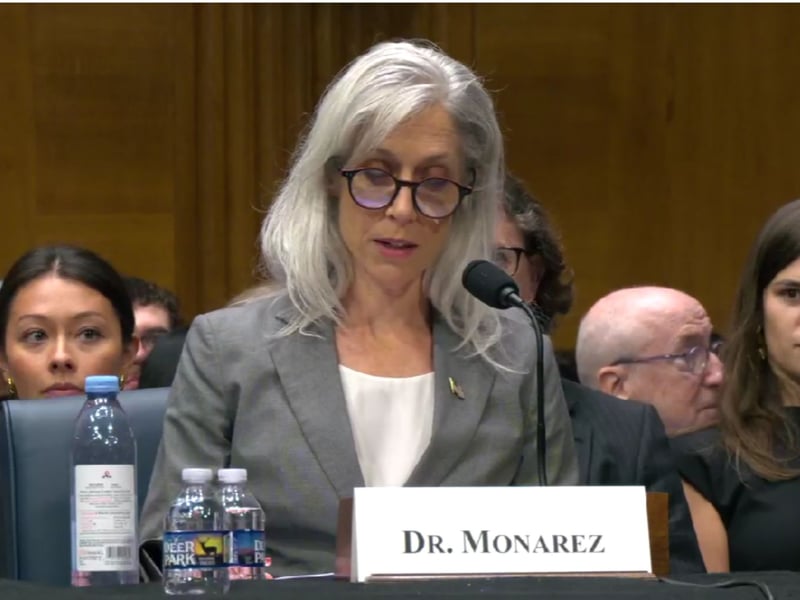
WASHINGTON (CN) — The head of the U.S. Centers for Disease Control and Prevention told the Senate on Wednesday that she was fired by the Trump administration for “holding the line” on the scientific consensus supporting childhood vaccine recommendations.
And Susan Monarez, who was removed in August by Health and Human Services Secretary Robert F. Kennedy, Jr, contradicted the White House official’s own testimony about the circumstances of her ouster.
The CDC director’s appearance before the Senate Health, Education, Labor and Pensions Committee is the latest installment in a growing conflict between Kennedy and Monarez over what she says was her refusal to commit to approving changes in U.S. vaccine policy, particularly for children. The secretary has accused Monarez of lying, telling lawmakers in September that the ousted CDC director was “untrustworthy.”
But Monarez doubled down on Wednesday, telling the Senate that Kennedy had asked her during an Aug. 25 meeting to make commitments that were “inconsistent” with her oath of office and the ethics requirements of a public official.
The CDC director reiterated claims that she made earlier this month that Kennedy demanded she agree in advance to approve every recommendation of the agency’s Advisory Committee on Immunization Practices, the body in charge of developing vaccine recommendations. The Health and Human Services secretary over the summer dismissed the committee’s 17 members and replaced them with new appointees, some of whom he has admitted served as paid expert witnesses against vaccines.
Kennedy also directed Monarez to fire career vaccine policy officials without cause, she said. “He said that if I was unwilling to do both, I should resign,” she told senators. The CDC director made assertions about vaccines that she argued were not clearly aligned with scientific evidence related to vaccine safety.
“He stated that CDC had not collected the data and that there was no scientific evidence associated with these vaccines,” Monarez testified. “He said that the CDC had failed in its duties to be able to appropriately evaluate safety and efficacy.”
After she refused to make such commitments, Monarez recalled that Kennedy became “animated” and made comments about the CDC and its employees that she found to be “hurtful and disparaging.” She told lawmakers that the Health and Human Services secretary called the country’s infectious disease response organization “the most corrupt federal agency in the world,” and that its employees were “horrible people” who were under the thumb of the pharmaceutical industry.
“The conversation seemed to change points very quickly,” Monarez said. “It was hard sometimes to follow the logic that he was putting forward — again, he was very upset, very animated.”
During his own hearing before the Senate Finance Committee, Kennedy framed Monarez’s removal as part of a staffing “shake-up” at the CDC, arguing that the agency had “failed their responsibility miserably” during the Covid-19 pandemic.
“That’s why we need new blood at CDC,” the secretary said at the time. “That’s also why it’s imperative that we remove officials with conflicts of interest and catastrophically bad judgment and political agendas.”
Kennedy testified that he had “never” had a private meeting with Monarez and that she had lied about his demands that she rubber-stamp changes to vaccine guidelines. He claimed that he had asked the CDC director that she was trustworthy and that she had replied ‘no,’ a statement that shocked lawmakers.
Monarez on Wednesday contested Kennedy’s account, saying that it was the secretary who had told her that she was untrustworthy. “I told the secretary that if he believed he could not trust me, he could fire me.”
The CDC director warned that the stakes were high for proposed changes to vaccine schedules, pointing out that the U.S. has already seen its largest measles outbreak in 30 years and that reducing immunization requirements could lead to the resurgence of other preventable childhood diseases such as polio, diphtheria and whooping cough.
“The question before us is whether we will keep faith with our children and grandchildren, ensuring they remain safe from the diseases we fought to hard to defeat,” Monarez testified. “Undoing that progress would not only be reckless, it would also betray every family that trusts us to protect their health.”
The reformed Advisory Committee on Immunization Practices is set to meet Thursday to discuss childhood vaccines. It is widely expected that it will recommend lower immunization requirements.
Kennedy has long been a controversial figure as head of the Trump administration’s Health and Human Services Department, largely due to his own vaccine skepticism. The lawyer and onetime Democratic presidential candidate has previously suggested that vaccinations are dangerous, despite longstanding scientific consensus that they are safe and effective.
A key vote in Kennedy’s confirmation was Louisiana Senator Bill Cassidy — a physician and chairman of the Senate’s health care committee — who ultimately supported his nomination despite concerns about his views on vaccines.
Cassidy has since expressed reservations about the secretary’s proposed changes to vaccine guidelines, telling him at the Finance Committee’s September hearing that he was “effectively” denying people vaccines. On Wednesday, the Louisiana Republican said that lawmakers had an “obligation” to get to the bottom of Monarez’s firing.
“It may be impossible to learn who’s telling the truth, but this hearing is an initial step in trying to answer why the top leadership of the CDC was fired,” he said. “Turmoil at the top of the nation’s top public health agency is not good for the health of the American people.”
Monarez served as the CDC’s director for just under a month, after receiving bipartisan support in the Senate over the summer. She was the first director of the infectious disease response agency to require Senate confirmation.
The ousted CDC director insisted to lawmakers Wednesday that her refusal to unquestioningly approve new vaccine guidelines was not a political statement, but one rooted in her desire to make public health decisions based on science.
“On Aug. 25, I could have stayed silent, agreed to the demands and no one would have known,” Monarez said. “I could have kept the office, the title, but I would have lost the one thing that cannot be replaced: my integrity.”
 Follow @BenjaminSWeiss
Subscribe to our free newsletters
Our weekly newsletter Closing Arguments offers the latest about ongoing trials, major litigation and rulings in courthouses around the U.S. and the world, while the monthly Under the Lights dishes the legal dirt from Hollywood, sports, Big Tech and the arts.