Search Articles


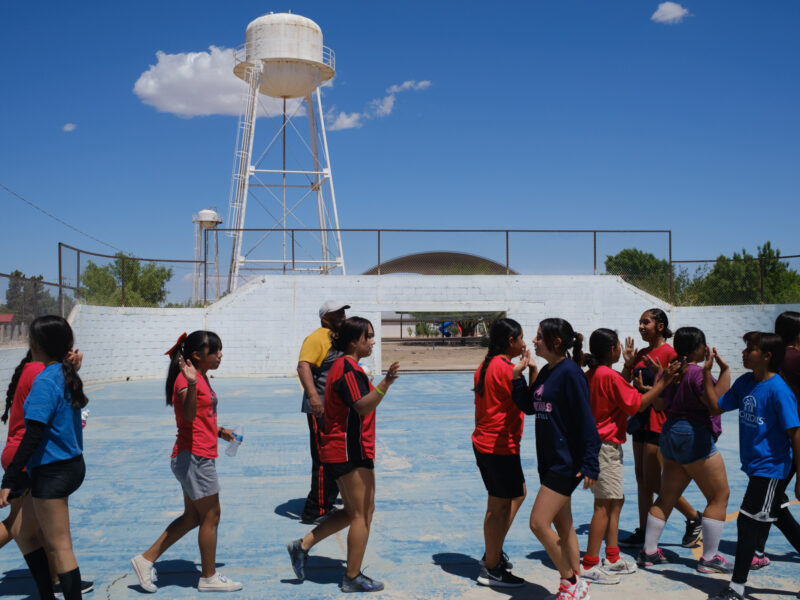
CHIHUAHUA, Mexico (CN) — Two months before the world fixes its sights on June’s opening World Cup match in Mexico City, a group of girls aged 11 to 16 zeroed in on their own game on the concrete pitch of the small Colonia Modelo soccer field in the municipality of Ascensión, Chihuahua.
That afternoon’s match was between a team from Colonia Modelo and one from Entronque Ejido 6 de Enero, both from the same area.
The teams played under a water tower, while Coach José Luis Pérez yelled out instructions as the match unfolded.


“Come on, get it, get it. Turn the ball around. Give it a boot!” he yelled from his coach’s cage off the side of the pitch.
“So, we’re getting on three years now doing this. I’ve been coaching three years with the girls, they’re progressing. And so we joined forces with the squad from Entronque, so we could compete because there are hardly any girls to play with. So, we try to keep things going so we can maybe raise the level of sports in the area,” said Luis Pérez, who added sports are an avenue to excel in larger areas of life.
“Sport in general is an outlet for children and young people to see that with sport we can go very far. Right now, there are many opportunities to continue studying through sport,” he said while intently watching his group of young players. “This is what we’re encouraging now.”
Luis Pérez said his greatest hope is that from here he’ll have two groups competing with each other to play at the university level.
“We’re going to pave the way and hope the next generations have that opportunity and take advantage of it,” he said. “Then, with that, we can continue studying and raise the socioeconomic potential here in the region. These are opportunities that we have presented to us right now.”
Though it may sound simple, Pérez noted that because most jobs in the area are agricultural, many families move in and out of the towns based on the temporary or seasonal nature of the work.
“We still don’t get groups together to play very often. And then someone moves to another town, and we lose everything. Then we have to start all over again,” said Luis Pérez as a ball ricocheted off the wall with a deep thud.
Margarita Vivanco González, Luis Pérez’s wife, sat on the bleachers cheering on the team from Colonia Modelo, which their two daughters play for.
“We’re from Veracruz. We’ve been here now for 10 years, all of us. Carla, the youngest, I brought her when she was just nine months old, and my oldest sons lived in the U.S. and went to high school there. Now they’re back living here, but my oldest works in California,” said González as she watched the match. “Before, it was all boys, and now, instead of them drinking or doing drugs, they’re involved in other things. So, it’s better that they have something to practice, right? And they get a lot of support. They have more opportunities.”
González’ oldest daughter, Aimara Pérez Vivanco, received a scholarship to play soccer at the Universidad Tecnológica de Paquimé.
“So, now she can continue her studies just based off this alone,” González said.
Pérez Vivanco was exhausted after the match when she put her arm around her friend and teammate, Nayeli Barrios Terrazas, after shaking hands with the other team, as is customary after a match in Ascensión.
“It was very beautiful playing, very tiring but beautiful. Besides having fun, I get to hang out with the girls and learn new things every day,” said Pérez Vivanco.
“I’ve been backed to play over at the university in Casas Grandes, so soon I’ll be headed there to study,” she said before offering some words of advice to girls and boys her age: “Give it your all. And if your dream is to play, then don’t get hung up on negative things and just always follow your dreams, that’s all.”

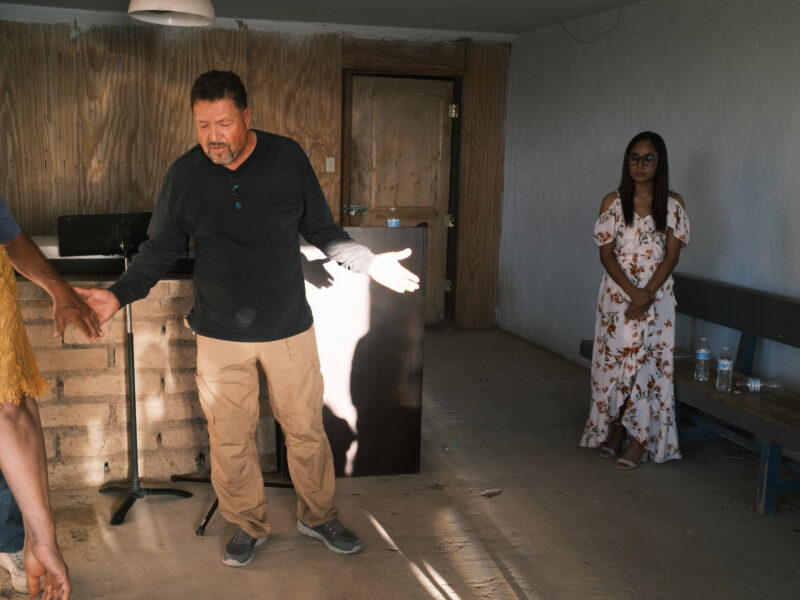
That afternoon, Pastor Rosalío Sosa packed some supplies into his pickup to take to one of his shelters in Ascensión.
He went into a convenience store and picked up snacks, water and a copy of El Diario de Juárez.
The headline of the newspaper read: “Deportations through Juárez grow by 92%.”
Sosa has another shelter in Juárez, the border city 110 miles away, but another world away from Mexico’s three biggest cities hosting the World Cup in June: Mexico City, Monterrey and Guadalajara.

Residents of Mexico’s capital specifically have been protesting the World Cup because they believe the government has been ignoring their needs in favor of tourism and displacement brought on by the massive event.
And in Guadalajara, searchers for missing people have decried what they see as the government’s priority of urban image over human rights.
Out here in the borderlands, though, where resources are scarce and life a bit more precarious, Sosa said a mass event like the World Cup still generates a lot of attention and wealth for the area, which he sees as a positive.
Sosa explained that the people he sees coming to this area arrive for vastly different reasons than the World Cup, and more resources would go a long way.
He pointed from the driver’s seat of his pickup truck toward the Chihuahuan Desert. It was mid-afternoon, four days after Holy Week, and deep white puffs of clouds hung over the desert.
“If we’re walking through the desert, me and you, after days of walking, and we’re about to die, we’re really happy to see that. We can’t even believe it,” Sosa said.
He motioned to a pool of water that formed off Federal Highway 2.
“Where did it go?” Sosa slyly grinned as he put up one hand in mock confusion. The truck rambled on under the desert sun. The water disappeared.
Sosa said that’s how migrants die in the desert.
“They get so overwhelmed with happiness that they’re going to finally survive. But once they reach that water, they just can’t imagine it’s not there. But it’s not, it’s just a mirage, and then they can’t go on anymore,” he said, turning deeply serious.
“We’re predicting a lot of people coming through now. It’s going to get busy. Before, the shelters were more about waiting to get into the United States, but now it’s more for people coming from the United States who have been deported,” Sosa said, turning over the engine after spitting out a couple of sunflower seeds into the parking lot.
Sosa, a Chihuahua native, pointed out as he drove the workers in the alfalfa fields who came for seasonal work from all over the country.
“It’s chiles, onions and alfalfa farms, mostly agricultural and farming and cotton fields with some private gold and silver mines thrown in between,” said Sosa. “It’s one of the poorest municipalities in the state, but it’s also one of the largest by land. There’s just not a lot of people.”
Sosa drove into the outdoor Ascensión sports complex. The small crowd, including Ascensión Municipal President Ivonne De La Hoya Venzor, was buzzing in the bleachers, watching a soccer game between a team of farm laborers originally from Guerrero and a team from Veracruz.
“Here in our municipality of Ascensión, we have a lot of sports in almost all disciplines —both men and women’s, children and adults. So, we believe that physical activity, well, it entertains them, keeps their minds occupied and they get physically tired. They’re doing something worthwhile, learning rules, learning to live with other classmates, to respect them, to know that they’re not alone, but that they’re a team, to share the ball, to not be selfish,” said De La Hoya Venzor.


De La Hoya Venzor said Mexico’s hosting of the World Cup this summer is important to the people in her municipality, even though it may be far away from the big host cities like Mexico City, Guadalajara and Monterrey.
“The World Cup gives us great representation before the world,” she said. “And the kids, well, they learn a lot and they have their idols. So, it’s great that they see we have the tournament here in the country and that there’s going to be a lot of publicity. You know, kids admire certain athletes, the professional players whose jerseys and numbers they wear. And that motivates them. It makes them want to go as far as the players and stay focused on what they want.”
De La Hoya Venzor said she’s noticed that at the end of children’s and teens’ games, they always shake hands, something the adults no longer do.
“They have a mentality. This mentality of respect, of not saying bad things to each other, of having to arrive early to games and practices, of high-fiving their teammates even if they’ve lost. But when we’re adults, I don’t know what happens; it’s like that part of us breaks down. And then, well, we allow ourselves to surrender things we shouldn’t have,” she said.
The match ended in a loss for the Guerrero team.
“We’re from Guerrero, but we live and work here for now, planting chiles,” said Jesus López Moreno, a member of the Guerrero team. “We lost, but it’s okay, we’ll get it back next time. We play because we want to represent where we come from.”
His teammates watched him speak and smiled in agreement, taking his words to heart, as the sun set in Ascensión.


Subscribe to our free newsletters
Our weekly newsletter Closing Arguments offers the latest about ongoing trials, major litigation and rulings in courthouses around the U.S. and the world, while the monthly Under the Lights dishes the legal dirt from Hollywood, sports, Big Tech and the arts.