
 Search Articles


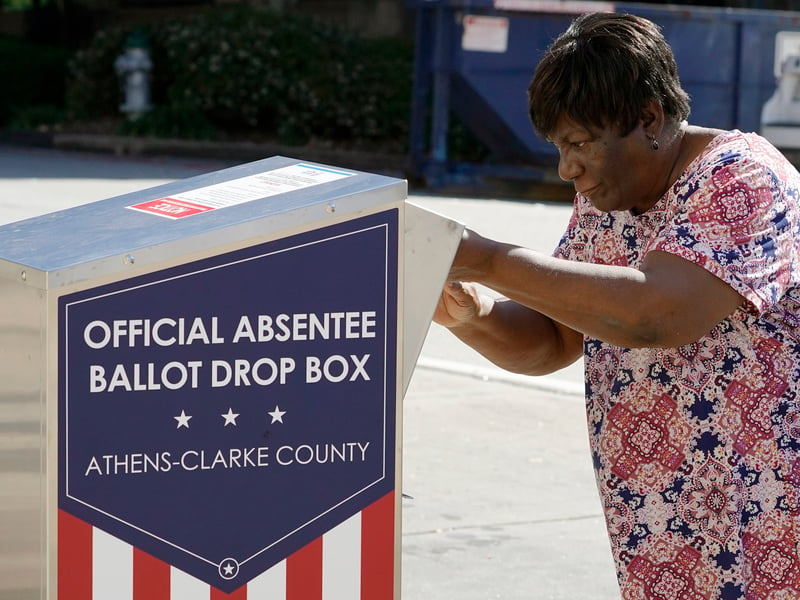
ATLANTA (CN) — A panel of 11th Circuit judges on Wednesday appeared poised to toss out a voting rights group’s request for an order ending the practice of requiring Georgia voters to pay for their own postage to submit absentee ballots and ballot applications.
A federal judge denied the bid for free postage last year, rejecting a class action brought by the nonprofit Black Voters Matter and two Georgia voters against Republican Secretary of State Brad Raffensperger and DeKalb County election officials.
An attorney for the plaintiffs told a three-judge panel of the Atlanta-based appeals court Wednesday that requiring voters to pay for postage to vote by mail is the equivalent of a poll tax outlawed by the 24th Amendment.
Sean Young, legal director for the ACLU of Georgia, argued that the state has unfairly abridged the right to vote by mail by conditioning it on voters’ ability to pay for postage.
“Similarly situated voters, all of whom are ready to deposit their ballots into their mailboxes… are treated categorically differently for one reason and one reason only: their failure to pay those postal fees,” Young said.
Young asked the panel to refer back to the court’s 2020 decision in Jones v. Governor of Florida , which he said established the definition of a tax as “any government monetary extraction that is not a penalty.” He told the panel that the definition of a tax is broad under the law.
Senior U.S. Circuit Judge Ed Carnes, a George H.W. Bush appointee, balked at Young’s argument, calling the plaintiffs’ position “absurd."
Black Voters Matter has requested that courts require election officials to provide voters with prepaid, returnable envelopes for mail-in ballots and applications.
The U.S. Postal Service has a policy of delivering absentee ballots even if they do not have sufficient postage. Ballots can be mailed using a 55-cent first-class stamp.
Young argued that even if stamps were one cent, “it would still be one cent too many under the strict standards of the 24th Amendment clause.”
But Carnes said the postage requirement is not a hurdle designed to deny anyone the right to vote.
“As I understand it, you’re saying not paying postage on an absentee envelope after furnishing the form in the addressed envelope – that’s a sophisticated way of denying people their right to vote? You really think Georgia thought, gosh, let’s be sure not to put a stamp on there and that way we can deny people their right to vote?” Carnes asked.
Young responded that the state’s intent was “irrelevant."
“I don’t know a judge in the United States of America that would accept that argument,” Carnes said.
An attorney for Raffensperger told the panel that asking voters to buy a stamp is absolutely not equivocal to a tax.
“Secretary Raffensperger imposes nothing, he levies nothing, and certainly postage rates are not returned to the state of Georgia,” said attorney Josh Belinfante of Atlanta firm Robbins Ross. “It’s simply not a tax under any definition.”
Belinfante insisted that it is the U.S. Postal Service, not the state’s election officials, that charges voters to mail in their ballots.
“If the complaint is about the fact that election mail requires a stamp, the proper party is the United States Postal Service, not the secretary,” he said. “The injury of imposing the stamp requirement is not traceable to the secretary.”
Belinfante urged the panel to uphold the lower court’s order dismissing the case.
“There is no court in the country that has said if a state allows absentee ballots if they don’t subsidize the stamp it’s a poll tax, and for good reason,” Belinfante said.
Carnes was joined on the panel by U.S. Circuit Judges Britt Grant and Elizabeth Branch, both Trump appointees.
Follow Kayla Goggin on Twitter
 Follow @KaylaGoggin_CNS
Subscribe to our free newsletters
Our weekly newsletter Closing Arguments offers the latest about ongoing trials, major litigation and rulings in courthouses around the U.S. and the world, while the monthly Under the Lights dishes the legal dirt from Hollywood, sports, Big Tech and the arts.