Search Articles


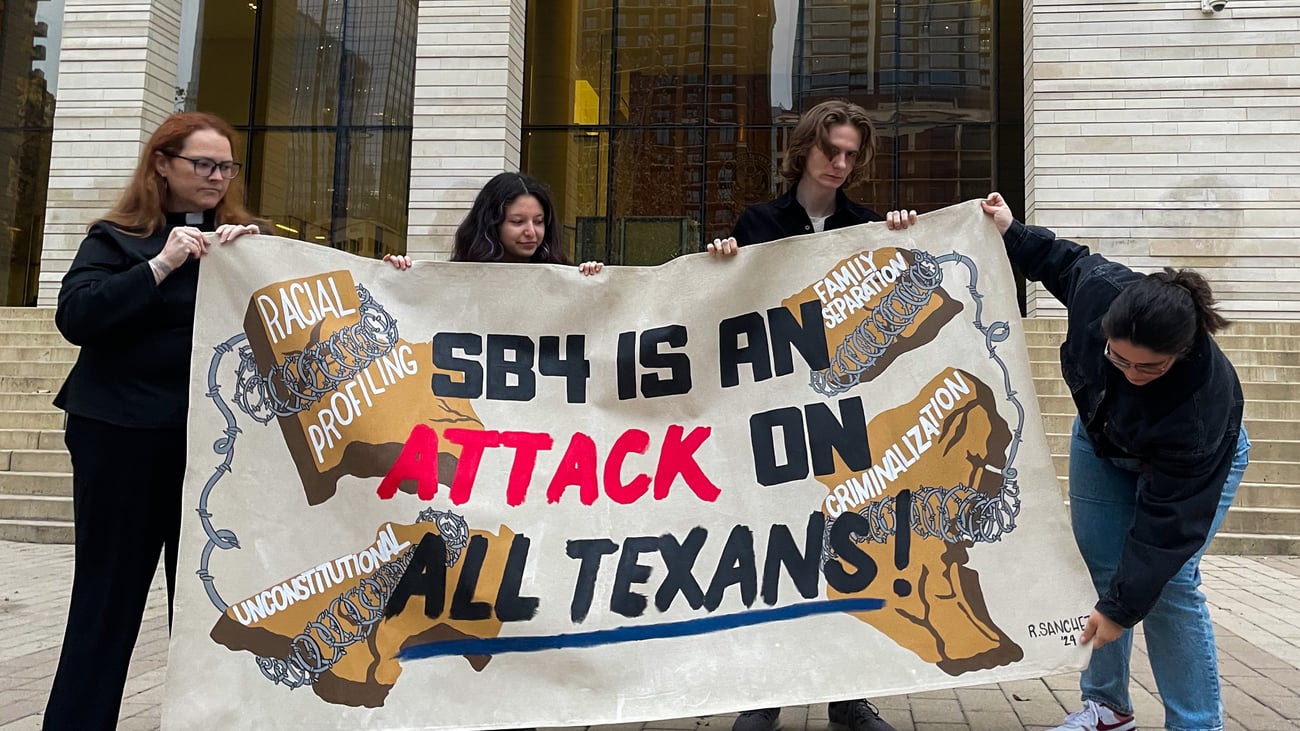
(CN) — A divided Fifth Circuit ruled 10-7 Friday to reverse an injunction blocking a Texas law allowing for state immigration enforcement, finding the legal groups and Texas county challenging the law lacked standing.
Passed in 2023, Senate Bill 4 allows state and local law enforcement to arrest people for immigration violations and permits state judges to issue deportation orders. The Justice Department sued before the law took effect.
The case was consolidated with a challenge by Las Americas Immigrant Advocacy Center, American Gateways and El Paso County. A federal judge in Texas issued a preliminary injunction blocking SB 4, finding it likely infringed on federal authority over immigration. The law has remained blocked as the case moved through the courts.
The federal government dropped its challenge in March 2025 after Donald Trump took office. In a ruling Friday, the U.S. Court of Appeals for the Fifth Circuit held the remaining plaintiffs lack standing to challenge the law.
“This case concerns whether the State of Texas, exercising its historic, sovereign police powers, can legislatively protect its citizens from a surge of illegal aliens in response to an unprecedented border crisis and a declared invasion,” U.S. Circuit Judge Jerry Smith, a Ronald Reagan appointee, wrote in the majority opinion. “Because the plaintiffs that are challenging the new statute lack standing, we vacate the preliminary injunction without addressing the merits of the preemption claim.”
Las Americas and American Gateways argued they have standing because SB 4 would force them to spend more resources defending clients facing deportation under the new state system. Smith rejected this argument, citing the Supreme Court’s 2024 ruling in FDA v. Alliance for Hippocratic Medicine.
In that case, the court held an anti-abortion group lacked standing to challenge the FDA’s approval of mifepristone, rejecting its argument that it was harmed by having to devote resources to opposing the agency’s actions. The court said “an organization that has not suffered a concrete injury caused by a defendant’s action cannot spend its way into standing simply by expending money to gather information and advocate against the defendant’s action.”
“If [the] nonprofit plaintiffs were to have standing,” Smith wrote in the Fifth Circuit’s ruling, “any enterprising legal-advocacy organization could repackage a generalized grievance as an ‘injury’ to its ‘core business activities’ and manufacture Article III standing every time a new law or regulation goes into effect.”
The majority also found El Paso County lacks standing. Smith wrote the county’s claim that SB 4 would harm “the trust the El Paso community has in its local government” is not actionable, and its concerns about increased law enforcement costs are “premature,” as “any assumption about how the law will be enforced is highly speculative.”
In dissent, U.S. Circuit Judge Priscilla Richman, a George W. Bush appointee, wrote that at least one plaintiff — Las Americas — has standing because “it has shown that state immigration laws ‘directly affect[] and interfere[] with [Las Americas]’s core business activities.’”
Richman pointed to how the Supreme Court differentiated its Alliance ruling from a 1982 case in which the civil rights organization Housing Opportunities Made Equal was found to have standing to sue an apartment complex owner who falsely told a Black “tester” employed by the organization that no apartments were available.
U.S. Supreme Court Justice Brett Kavanaugh, a Donald Trump appointee, wrote in the Alliance ruling that since “HOME not only was an issue-advocacy organization, but also operated a housing counseling service,” it had standing to sue because the apartment complex owner’s misrepresentation “directly affected and interfered with HOME’s core business activities.”
“The case before us is analogous,” Richman wrote in her dissent. “Las Americas is not only an issue-advocacy organization—it operates to provide legal services and legal counseling to low-income immigrants.”
Richman argued that since Las Americas has standing, the preliminary injunction should remain in place, as SB 4 is likely preempted by federal law.
“We do not write on a clean slate. There is Supreme Court precedent spanning nearly 150 years suggesting that the power to control the entry and removal of aliens is ‘vested solely in the federal government, rather than the states,’” Richman wrote. “In light of this caselaw, Texas cannot step into the shoes of the national sovereign under our Constitution and federal laws.”
Texas Attorney General Ken Paxton celebrated the Fifth Circuit’s ruling in a statement, calling it “a major victory for public safety and law and order.”
Meanwhile, the American Civil Liberties Union, which represents the plaintiffs in the case, said in a statement that “any enforcement of S.B. 4 will cause immediate and serious harm: racial profiling of Black and Brown Texans, family separation, and the criminalization of people who have lived and worked in Texas for years. Texas judges would be required to order deportations regardless of whether a person is eligible to seek asylum or other humanitarian protections under federal law.”
“This ruling is a procedural decision, not a ruling on the merits,” said Cody Wofsy, deputy director of the ACLU’s Immigrants’ Rights Project. “It does not change what every court to examine similar laws has found: S.B.4 is unconstitutional. This fight is far from over.”
Subscribe to our free newsletters
Our weekly newsletter Closing Arguments offers the latest about ongoing trials, major litigation and rulings in courthouses around the U.S. and the world, while the monthly Under the Lights dishes the legal dirt from Hollywood, sports, Big Tech and the arts.
Additional Reads
 Feds yet to return vehicle Renee Good was shot and killed in April 24, 2026
 California voter ID measure heads to November election April 24, 2026