
 Search Articles


(CN) — In a highly anticipated hearing Thursday, the Fifth Circuit heard arguments on whether President Donald Trump can use a centuries-old statute to remove Venezuelan nationals his administration determines to be gang members.
The Alien Enemies Act is an 18th-century law allowing the president to detain or deport noncitizens from enemy nations “whenever there is a declared war between the United States and any foreign nation or government, or any invasion or predatory incursion is perpetrated, attempted or threatened against the territory of the United States by any foreign nation or government.” The act has been invoked only a handful of times in U.S. history.
In March last year, Trump issued a proclamation declaring that Venezuelan citizens in the U.S. whom the government determines to be members of the gang Tren de Aragua, or TdA, are subject to removal under the act. In the proclamation, the president asserted that the gang has close ties with then-Venezuelan President Nicolás Maduro, operating as a “hybrid criminal state.”
“Evidence irrefutably demonstrates that TdA has invaded the United States and continues to invade, attempt to invade and threaten to invade the country; perpetrated irregular warfare within the country; and used drug trafficking as a weapon against our citizens,” Trump wrote.
In one of numerous cases challenging the proclamation, a three-judge Fifth Circuit panel ruled in September last year that Trump had unlawfully invoked the Alien Enemies Act, with the majority finding that the president’s claims about TdA’s activities are not enough to establish an “invasion” or “predatory incursion.”
Before the full Fifth Circuit Thursday, American Civil Liberties Union attorney Lee Gelernt, representing a putative class of Venezuelans held in northern Texas, argued that normal immigration law is the solution for removing TdA members from the country — not the Alien Enemies Act.
“The issue is not whether TdA is dangerous or whether they’re going to be allowed to stay in the country if they’re in fact TdA and committing crimes,” Gelernt said. “The question is whether the extraordinary power of the Alien Enemies Act dating back to 1798 is the right fit here. It is not.”
Much of the hearing focused on whether courts even have the power to review the president’s invocation of the act, an issue some of the judges appeared divided on.
U.S. Circuit Judge James Ho, a Donald Trump appointee, said that just as courts can’t second-guess Congress’ decision to declare war, they must defer to the president’s determination that an invasion or incursion has taken place.
Chief U.S. Circuit Judge Jennifer Walker Elrod asked what should happen if the president were to issue an Alien Enemies Act proclamation that was “fanciful on its face.”
“What if the proclamation said we’re having a British invasion — they’re sending all these musicians over to corrupt young minds, and the prime minister is in on it, and they’re coming over here and they’re taking over all kinds of establishments?” Elrod, a George W. Bush appointee, asked. “Would you be able to look at it on its face and say it doesn’t matter what these facts are and what they say, at some point it’s not credible? Or is there not a line like that?”
Ho pushed back, arguing that if the president were to abuse his power under the Alien Enemies Act, there would be solutions outside the judiciary, such as the 25th Amendment.
“Judiciary is not the only solution to the woes of America,” he said.
The capture of Maduro, who is currently being held in New York while awaiting trial on federal drug trafficking charges after being taken from Venezuela by U.S. forces earlier this month, was not brought up at the hearing. The Trump administration asserted in a Jan. 5 letter to the court that Maduro’s indictment bolsters its case that Trump’s use of the Alien Enemies Act is lawful.
“These new developments underscore the Maduro regime’s control over TdA and TdA’s violent invasion or predatory incursion on American soil,” Justice Department attorneys wrote. “As a result, it is even clearer that the president’s invocation of the Alien Enemies Act was part of a high-level national security mission that exists outside the realm of judicial interference.”
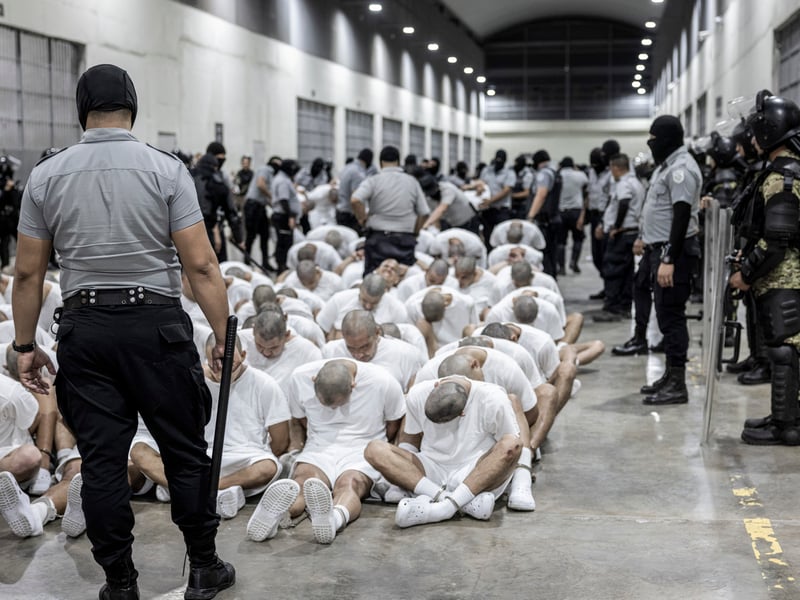
Shortly after Trump issued the Alien Enemies Act proclamation last year, his administration used it to send at least 137 Venezuelans to El Salvador, along with others who were deported under normal immigration law. They were held for months in the Central American nation’s brutal mega-prison known as CECOT before being released to Venezuela as part of a prisoner exchange. The move has been widely condemned by human rights groups, with serious doubts raised about the validity of the evidence used to establish TdA membership.
In interviews with the media, former CECOT detainees have detailed abuses they say they experienced in the prison, including beatings and sexual assaults.
Subscribe to our free newsletters
Our weekly newsletter Closing Arguments offers the latest about ongoing trials, major litigation and rulings in courthouses around the U.S. and the world, while the monthly Under the Lights dishes the legal dirt from Hollywood, sports, Big Tech and the arts.