
 Search Articles


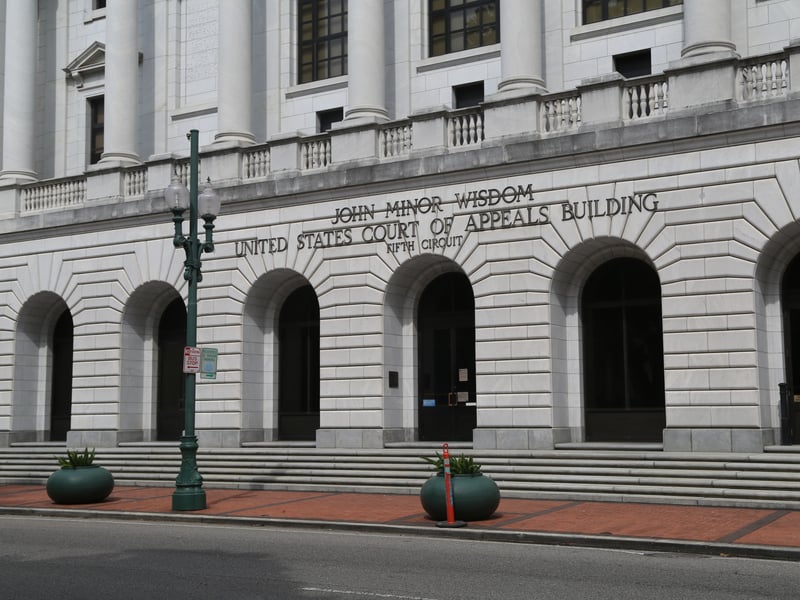
NEW ORLEANS (CN) — A Fifth Circuit panel appeared likely Monday to side with a campaign finance advocacy group in a dispute over a small piece of Texas election law.
The Institute for Free Speech, a nonprofit focusing on First Amendment and campaign finance litigation, appealed to the three-judge panel that the Texas Election Commission’s 2022 advisory opinion on providing free legal services to political candidates unfairly restricted their First Amendment rights.
The institute wanted to represent a City Council candidate in a small town south of Dallas, Texas, who himself wanted to challenge a separate piece of the election code related to a warning printed on political signs. When they asked the commission if that conduct would violate campaign contribution laws, the commission voted 5-3 to find it would be a form of “in kind” contribution.
Months later, the institute sued the five commissioners who voted in its favor. The group argued the advisory opinion unconstitutionally prohibited them from exercising their First Amendment rights to provide legal services to candidates in Texas. And though a federal judge dismissed the institute’s claims a year later for lack of standing, the three-judge panel of the Fifth Circuit seemed open to reviving the case.
Chief U.S. Circuit Judge Jennifer Walker Elrod, a George W. Bush appointee, led the panel’s questioning of both lawyers but pressed especially hard at Cory Liu, the attorney for the five commissioners.
In her discussion with Endel “Del” Kolde, the lawyer for the Institute for Free Speech, Elrod seemed to agree with Kolde’s position that the case still had room for dispute.
“There are cases where the government says, ‘We won’t pursue this,’ and have refused to give such an assurance in this case,” Elrod noted toward the end of her questions for Kolde. She repeatedly brought up this point in questioning both attorneys and did not seem satisfied with Liu’s answers.
When Elrod pressed him for an answer on whether Texas would pursue a case against the institute if they contracted with a candidate today, Liu said it depends.
“The advisory opinion says it is only an in-kind contribution if it is directly related to the campaign,” Liu told the panel. “If there was a real case here, the candidate would have filed it themselves.”
Liu then contrasted this case with other similar cases, stating, “Here, we have a decades-old law with no history of enforcement. An advisory opinion alone, without evidence of enforcement, is not sufficient for standing.”
But when Liu again argued the institute had filed its case prematurely, Elrod had a simple but clear response for him regarding the commission’s opinion.
“It chills speech,” she told Liu. “It chills legal representation. What is the compelling interest?”
Elrod’s retort landed on two key tenets of First Amendment case law.
The chilling effect, as derived from a 1952 Supreme Court concurrence, describes when a law discourages people from exercising their broader rights because they do not know whether that law will harm them. And in many civil rights cases, the government must present a compelling interest or a specific reason why a given right must be limited.
“We thought the argument went well for us and that the panel asked the right questions," Kolde said after the hearing. “The questions reflected an understanding that we face a threat of enforcement if we did what we propose to do, that is, represent a Texas candidate or political committee in pro bono litigation. We also don’t believe that the TEC was able to articulate a compelling state interest for applying its corporate contribution ban to our activities. We look forward to reading the panel’s opinion.”
When asked for a comment, Liu gave a much shorter response: “We’ll just wait for the judges to do their job.”
Donald Trump appointees U.S. Circuit Judge Kurt Engelhardt and U.S. District Judge Greg Guidry, sitting by designation from the Eastern District of Louisiana, joined Elrod on the panel.
Subscribe to our free newsletters
Our weekly newsletter Closing Arguments offers the latest about ongoing trials, major litigation and rulings in courthouses around the U.S. and the world, while the monthly Under the Lights dishes the legal dirt from Hollywood, sports, Big Tech and the arts.