
 Search Articles


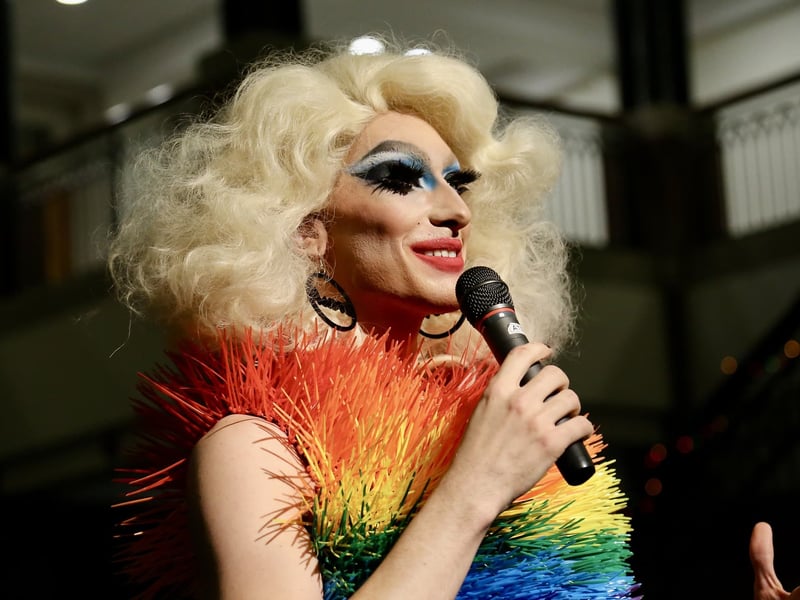
NEW ORLEANS (CN) — The Fifth Circuit Court of Appeals issued a ruling Monday allowing an LGBTQ+ student group to continue its lawsuit against the president and vice president of West Texas A&M University, two years after they barred the organization from hosting a charity drag show on campus.
U.S. Circuit Judge Leslie Southwick, a George W. Bush appointee, found in his majority opinion Monday that the university president’s ban on the student drag show violated the student group’s First Amendment right to expressive conduct and right to access a public forum.
Drag shows have been the repeated target of ire from conservatives in Texas and other states in recent years. Texas passed its own drag ban two years ago, which a federal judge ultimately struck down as unconstitutional under the First Amendment.
Back in March 2023, the president of West Texas A&M University issued a controversial decision to block an LGBTQ+ student group from hosting a charity drag show on campus. Leaders of the student group, Spectrum WT, had worked with university staff without issue for months while they prepared the show.
But the school’s Christian president, Walter Wendler, abruptly blocked them from hosting it just days before the event, claiming the show would discriminate against women. The group ultimately held the show at a venue off campus, but Spectrum WT and its leaders sued the university in federal court the day after Wendler’s decision.
Six months later, U.S. District Judge Matthew Kacsmaryk blocked the student group’s request for a preliminary injunction against the university. Both the Fifth Circuit and the Supreme Court upheld the Donald Trump appointee’s decision in the student group’s emergency appeal, with the high court giving no reasoning or noted dissents.
Now a three-judge panel of the Fifth Circuit has reversed Kacsmaryk’s decision by a 2-1 vote, sending the case back down for him to sign an injunction. Southwick and Bill Clinton-appointed U.S. Circuit Judge James Dennis voted to reverse, while U.S. Circuit Judge James Ho dissented.
Southwick rejected the lower court’s arguments on the two key First Amendment points: whether the student group hosting a drag show is expressive conduct, and whether the hall on campus they chose to host it is a broad or limited public forum.
On the first point, Southwick examined a long list of past cases for whether a performance of some kind is expressive conduct, summarizing that “the conduct must convey one or more messages to make the First Amendment relevant.” He rejected the lower court’s finding that the drag show did not convey a specific message, finding that the group’s drag show clearly intended to show support for LGBTQ+ people and their rights.
And on the second point, Southwick rejected Wendler’s argument that the hall on campus was not a “designated public forum” because the university has a long record of hosting public and student-only events at the hall that Spectrum WT wanted to host their drag show in.
“On the record, President Wendler’s objections were not to the message but to the way it was delivered," Southwick wrote. “Instead of the significant interference with the right of expressive association that the Supreme Court permitted there, the university here was interfering with the expressive activity itself, the speech.”
Ho, appointed during Donald Trump’s first term and considered a candidate for the Supreme Court in his second term, defended university officials in his dissent. He agreed with Wendler that the drag show discriminated against women, echoing the university president’s comparison to blackface performances.
“Spectrum WT claims that it has a First Amendment right to put on a drag show in a public facility at West Texas A&M University,” Ho wrote. “But university officials have determined that drag shows are sexist, for the same reason that blackface performances are racist. And Supreme Court precedent demands that we respect university officials when it comes to regulating student activities to ensure an inclusive educational environment for all.”
Ho cited some of the talking points conservatives have used in recent years to push back against public acceptance of transgender people. He pointed to the congressional testimony of Riley Gaines, a female swimmer who became a frequent conservative speaker after she tied for fifth place with a trans woman in a collegiate event, as well as the decision by the U.S. Olympic team to block trans women from competing on the U.S. team in women’s events.
Earlier this year, a federal judge in Houston granted a similar injunction requested by a different student group at the main Texas A&M campus, after the university administration blocked a similar charity drag show performance.
U.S. District Judge Lee Rosenthal, a George W. Bush appointee, expressed a simple response to university officials or members of the public who disapprove of a drag show’s message: “Anyone who finds the performance or performers offensive has a simple remedy: don’t go.”
In a press release Monday, the nonprofit representing the West Texas student group, the Foundation for Individual Rights and Expression, celebrated the Fifth Circuit’s decision.
“FIRE is pleased that the Fifth Circuit has halted President Wendler’s unconstitutional censorship and restored the First Amendment at West Texas A&M,” FIRE supervising senior attorney JT Morris said in the press release. “This is a victory not just for Spectrum WT, but for any public university students at risk of being silenced by campus censors.”
Courthouse News has requested comments from FIRE and the Texas Attorney General’s Office, which represents Wendler and West Texas A&M.
Subscribe to our free newsletters
Our weekly newsletter Closing Arguments offers the latest about ongoing trials, major litigation and rulings in courthouses around the U.S. and the world, while the monthly Under the Lights dishes the legal dirt from Hollywood, sports, Big Tech and the arts.