
 Search Articles


(CN) — A Fifth Circuit panel on Monday wrestled with the issue of who pays when police damage property while pursuing a suspect.
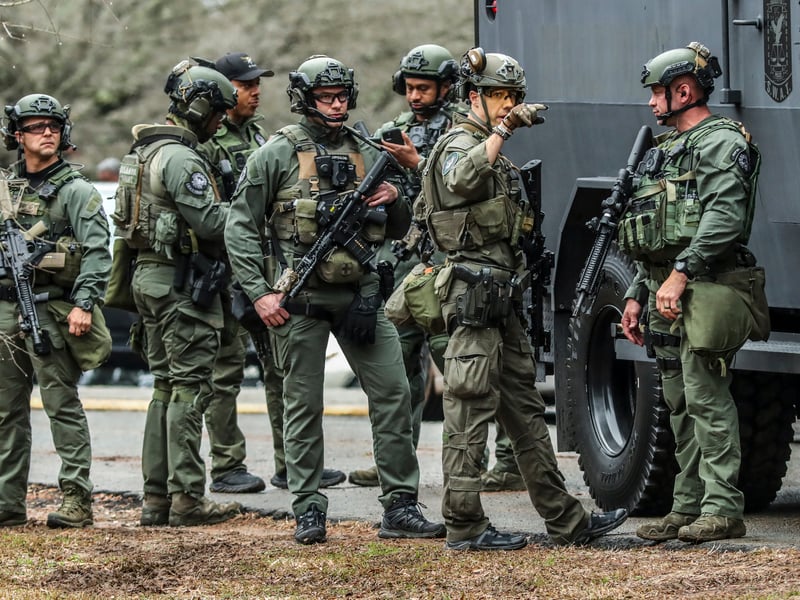
The city of McKinney, Texas, is asking the panel to overturn a nearly $60,000 judgment for a homeowner whose house was badly damaged during a 2020 police standoff with an armed fugitive who had taken shelter in the home. Another panel previously overturned a prior judgment in favor of the homeowner, Vicki Baker, under the Fifth Amendment’s takings clause.
That panel expressed “sympathy for Ms. Baker, on whom misfortune fell at no fault of her own,” but it found that “as a matter of history and precedent, the takings clause does not require compensation for damaged or destroyed property when it was objectively necessary for officers to damage or destroy that property in an active emergency to prevent imminent harm to persons.”
Chief U.S. District Judge Amos Mazzant, a Barack Obama appointee in the Eastern District of Texas, then issued judgment for Baker under the Texas Constitution’s takings clause.
The city’s attorney, Ed Voss, told the panel Monday Mazzant should have declined to exercise supplemental jurisdiction over Baker’s state constitution claim once her federal claims were dismissed. Texas takings jurisprudence is similar to federal takings jurisprudence, he argued, and therefore it should be up to Texas courts to decide whether the exception identified by the previous panel for federal takings claims also applies to state takings claims.
But Suranjan Sen, an attorney representing Baker, argued the Texas Supreme Court already decided the issue in its 1980 ruling in Steele v. City of Houston, where the court held that a couple whose home was destroyed by Houston police officers seeking to recapture a group of escaped convicts could sue the city under the Texas takings clause.
“The city argues that the destruction of the property as a means to apprehend escapees is a classic instance of police power exercised for the safety of the public,” the Texas Supreme Court wrote in the Steele decision. “We do not hold that the police officers wrongfully ordered the destruction of the dwelling; we hold that the innocent third parties are entitled by the constitution to compensation for their property.”
U.S. Circuit Judge James Ho, a Donald Trump appointee, seemed to agree with this argument, telling Voss that Steele is “pretty devastating for your position.”
U.S. Circuit Judge Stephen Higginson, who authored the previous panel’s decision, asked what the “limiting principle” is in this sort of case.
“If you’re in a car accident and you can’t get out and the police use jaws of life to tear the car up to save your life, they, in turn, in Texas, have to pay to repair the car?” the fellow Obama appointee asked.
But U.S. Circuit Judge Catharina Haynes, a George W. Bush appointee, pushed back, suggesting a case where police action was necessary to save a human life would be “a different arena than what we have here.” Sen agreed, noting that, although the fugitive had initially had a 15-year-old hostage in the house with him, she had already been released by the time the police began their assault on the home.
“That’s why Steele is on all fours here,” he said.
Subscribe to our free newsletters
Our weekly newsletter Closing Arguments offers the latest about ongoing trials, major litigation and rulings in courthouses around the U.S. and the world, while the monthly Under the Lights dishes the legal dirt from Hollywood, sports, Big Tech and the arts.