
 Search Articles


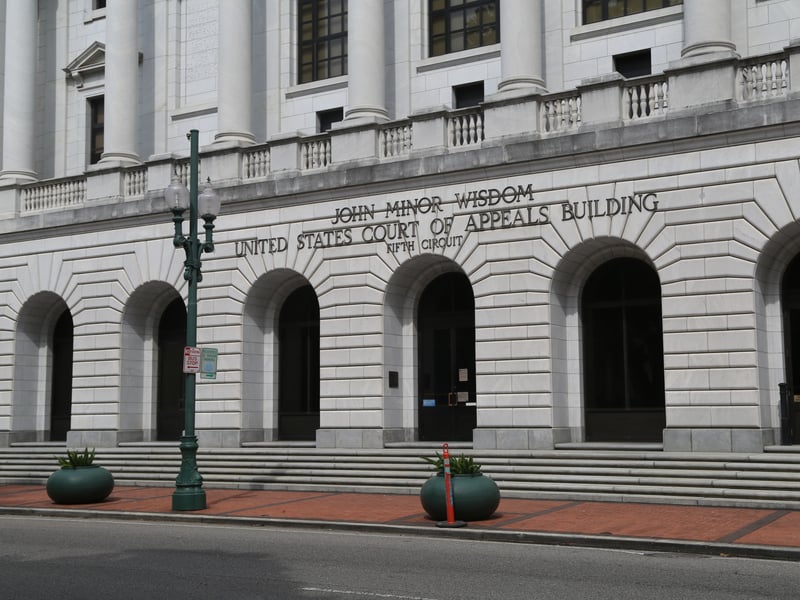
(CN) — A Fifth Circuit panel grappled Tuesday with a question of first impression in a $145 million health care fraud appeal: Is the federal workers’ compensation program for government employees a “health care benefit program” under the statute that criminalizes defrauding such programs?
The question was raised in the appeal of former Texas pharmacy managers Dehshid “David” Nourian and Christopher Rydberg, convicted after a lengthy trial of running a kickback scheme that funneled unnecessary compounded-drug prescriptions to TRICARE, the Federal Employees’ Compensation Act and Blue Cross Blue Shield. Defense lawyers urged the court to rule that FECA, which pays medical benefits to injured federal workers, falls outside the fraud statute’s reach — a holding that would gut the FECA-related counts against both men.
In their opening briefs, Nourian’s attorneys raised six issues, including insufficient evidence, prosecutorial misconduct, sentencing errors, perceived lack of remorse and forfeiture of a brokerage account, but Tuesday’s argument focused heavily on Rydberg’s statutory argument.
Attorney Brent E. Newton, representing Rydberg, opened by urging the court to apply the plain-meaning rule in the specific context of the health care fraud statute.
“In deciding whether the meaning of the undefined word is plain,” Newton said, “this court also must consider the overall statutory scheme, including any other related statutes which use the same or similar terms.” He argued that Congress enacted the anti-kickback statute’s broader definition, yet deliberately omitted “or otherwise” from the health care fraud definition.
“FECA is unquestionably workers’ comp,” Newton emphasized. “It is not health insurance. It’s not a contract.”
U.S. Circuit Judge Stephen Higginson, a Barack Obama appointee, pressed Newton on prior Fifth Circuit precedent, noting the court had described FECA alongside TRICARE as part of a “health care fraud program” in Shaw v. United States. Newton countered that Shaw addressed only the anti-kickback statute. U.S. Circuit Judge James Ho, a Donald Trump appointee, questioned whether the lack of prior decisions created ambiguity.
“How is that? No one’s interpreted it?” Ho asked. “That just makes it an issue of first impression. It doesn’t make it ambiguous.”
Newton replied that the ordinary meaning of “health care plan” in everyday usage refers to insurance cards, not workers’ compensation.
Government attorney Javier Alberto Sinha defended the statute’s breadth.
“Section 24(b) says ‘plan’ and includes no limitation on what kinds of plans,” he argued. “Congress could not have written more broadly by saying ‘any plan’ here.”
Sinha noted that no court has ever rejected FECA as a qualifying program under the statute, and he suggested any variance in the indictment would be nonfatal. The panel also probed the defendants’ claim that the government’s rebuttal closing argument deprived them of a fair trial.
Attorney Ashley Louise Kaper, arguing for defendant Nourian, described the government’s use of a “three monkeys” slide — “see no evil, hear no evil, speak no evil” — as directly contradicting the District Court’s refusal to give a deliberate ignorance instruction and suggested the District Court’s curative instruction was insufficient because it did not fully address the accompanying argument.
Sinha responded that the slide was aimed at rebutting the defense’s “no knowledge” closing argument, not at inviting a deliberate ignorance theory.
“The slide wasn’t saying the jury should believe what the slide shows,” he said. “What the slide shows can’t be believed. The evidence is so clear. They had knowledge.”
Kaper also pressed Nourian’s sentencing claim, arguing the District Court improperly relied on his perceived lack of remorse. She quoted the sentencing transcript: The judge stated Nourian “did not say he was sorry. He did not say that he had learned his lesson.”
Kaper linked the comment to Fifth Amendment concerns under Mitchell v. United States, arguing it penalized Nourian’s allocution. Sinha countered that Nourian had waived any Fifth Amendment protection by submitting a letter and allocuting and that the court’s brief reference did not affect the sentence.
Both defense attorneys briefly touched on the sufficiency of the evidence tying their clients to knowledge of medically unnecessary prescriptions. Newton distinguished kickback evidence from proof of fraud, while Kaper noted that cooperator testimony incriminating Nourian on prescription pads also contained exculpatory details.
The panel asked no questions on the two-level victims enhancement or forfeiture issues. After roughly 35 minutes of argument, U.S. Circuit Judge Catharina Haynes, a George W. Bush appointee, thanked counsel and said the court would decide the case. No ruling timeline was announced.
 Follow @gabetynes
Subscribe to our free newsletters
Our weekly newsletter Closing Arguments offers the latest about ongoing trials, major litigation and rulings in courthouses around the U.S. and the world, while the monthly Under the Lights dishes the legal dirt from Hollywood, sports, Big Tech and the arts.