Search Articles


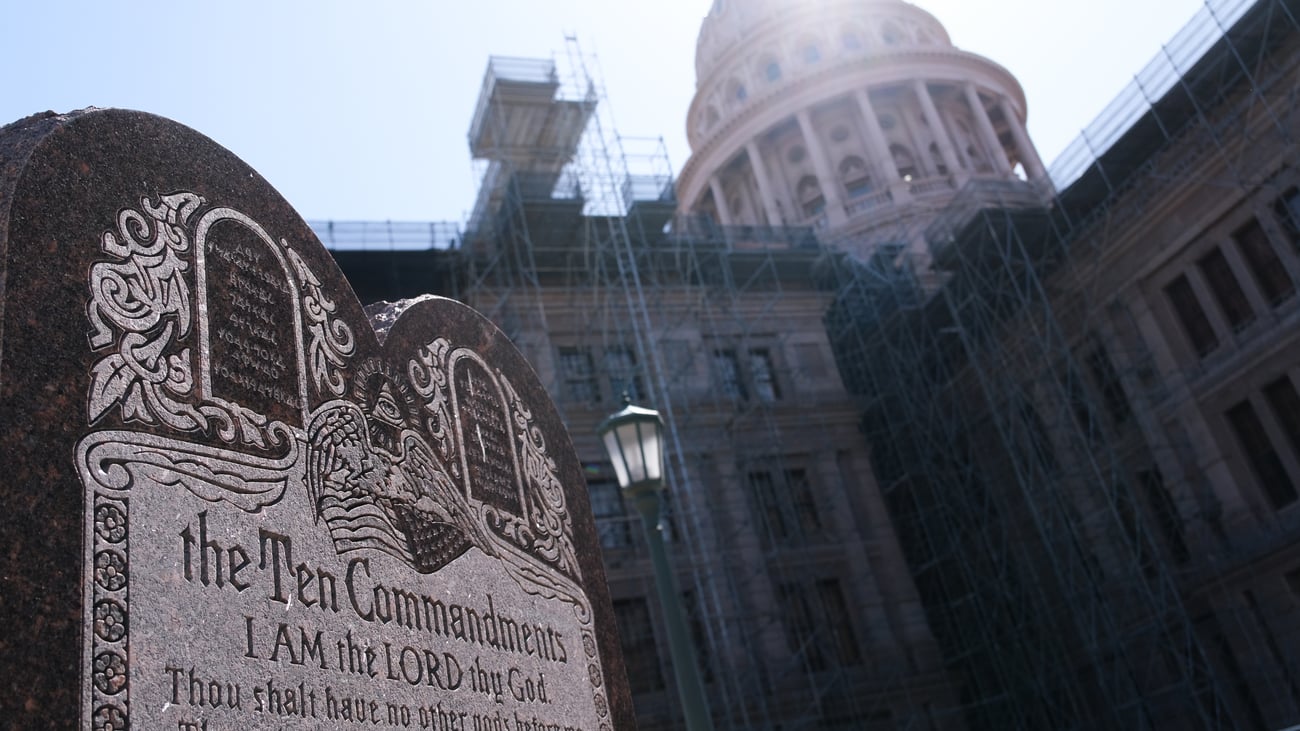
(CN) — A panel of the New Orleans-based Fifth Circuit handed down a win for conservative Christian lawmakers in Texas Tuesday, dismissing a coalition of multi-faith families’ challenge to a law requiring the Ten Commandments be displayed in every public school classroom.
Applauding the court’s decision, Texas Attorney General Ken Paxton called the ruling a major victory for the state and its moral values.
“My office was proud to defend SB 10 and successfully ensure that the Ten Commandments will be displayed in classrooms across Texas,” Paxton said. “The Ten Commandments have had a profound impact on our nation, and it’s important that students learn from them every single day.”
The law, Senate Bill 10, was enacted by the Legislature and signed into law by Texas Governor Greg Abbott last year, then swiftly challenged by the parents and their minor school-age children. The families are represented by the American Civil Liberties Union, ACLU of Texas, Americans United for Separation of Church and State, the Freedom From Religion Foundation and Simpson Thacher & Bartlett. They claimed the law violated their First Amendment rights by the state establishing a religion and coercing the children into recognizing the biblical document.
A federal judge was convinced by the plaintiffs’ arguments, finding the law likely violated the First Amendment, and issued an injunction blocking the families’ school districts from enforcing SB10.
However, in a 9-to-8 ruling, the conservative wing of the federal appeals court found SB10 passes constitutional muster. In his 53-page majority opinion, U.S. Circuit Judge Stuart Kyle Duncan, a Donald Trump appointee, wrote the law violates neither the establishment clause nor the free exercise clause of the U.S. Constitution.
“To plaintiffs, merely exposing children to religious language is enough to make the displays engines of coercive indoctrination,” Duncan wrote. “We disagree.”
Duncan reaches this opinion by citing recent rulings by the U.S. Supreme Court, which upended how laws relating to religious practices should be vetted. In his opinion, he gives thanks to the high court for ending the Lemontest, a method for determining whether a law violated the establishment clause. With the test being rendered void with the Supreme Court’s 2022 ruling in Kennedy v. Bremerton School District, Duncan reasoned that previous Supreme Court rulings, such as Stone v. Graham in 1980, which held a law similar to SB10 unconstitutional, were no longer relevant.
Under these new standards, Duncan wrote SB 10 must be examined under the question of whether the law at issue resembles what the founding fathers considered the establishment of religion when drafting the Constitution.
“S.B. 10 looks nothing like historical religious establishment,” Duncan wrote. “It does not tell churches ot synagogues or mosques what to believe or how to worship or who to employ as priests, rabbis, or imams. It punishes no one who rejects the Ten Commandments, no matter the reason. It levies no taxes to support clergy. It does not co-opt churches to perform civic functions. These are the kinds of things ‘establishment of religion’ did at the founding. SB10 does none of them.”
Next, Duncan picked apart the family’s claim that requiring the Ten Commandments in classrooms violates the parents’ right to direct their children’s religious upbringing. The plaintiffs point to a Supreme Court decision from last year, Mahmoud v. Taylor, which gave religious parents the ability to opt their children out of being exposed to LGBTQ-inclusive storybooks.
While the parents who sued to block SB10 point to Mahmoudas a precedent that supports their argument, Duncan found the ruling did the opposite. Because the law does not require the Ten Commandments to be used by teachers in lessons or have children recite them, it cannot be considered coercive. Furthermore, Duncan wrote that the plaintiffs failed to show the law would substantially burden the children being exposed to it.
In her 26-page dissent, U.S. Circuit Judge Irma Carrillo Ramirez, a Joe Biden appointee, accused the majority of failing to abide by the precedent set in *Stone v. Graham,*which she argues is still binding, despite the death of the Lemontest.
“Without any case demonstrating that the Supreme Court has exercised its lone ‘perogative’ to overturn Stone … this court continues to be bound by that case even if it ‘is in tension with some other line of decisions’ … and even if, as defendants argue, ‘more recent cases’ may appear to ‘overrule’ Stone‘by implication,’” Ramirez wrote.
Ramirez and her fellow dissenting judges would have upheld the lower court’s preliminary injunction at this stage.
Tuesday’s decision primes this debate to soon be rested in the hands of the U.S. Supreme Court as the plaintiffs prepare an appeal.
In a joint statement, the organizations representing the multi-faith families, including the American Civil Liberties Union, ACLU of Texas, Americans United for Separation of Church and State, the Freedom From Religion Foundation and Simpson Thacher & Bartlett, said the court’s decision goes against the First Amendment.
“The First Amendment safeguards the separation of church and state, and the freedom of families to choose how, when and if to provide their children with religious instruction,” the organizations wrote. “This decision tramples those rights. We anticipate asking the Supreme Court to reverse this decision and uphold the religious-freedom rights of children and parents.”
 Follow @KirkMcDanie1
Subscribe to our free newsletters
Our weekly newsletter Closing Arguments offers the latest about ongoing trials, major litigation and rulings in courthouses around the U.S. and the world, while the monthly Under the Lights dishes the legal dirt from Hollywood, sports, Big Tech and the arts.
Additional Reads
 Virginia voters approve Democrats' redistricting effort April 21, 2026
 11th Circuit shoots down challenge to machine gun ban April 21, 2026